UK and Netherlands Partner on £2.4 Billion Amphibious Fleet with Drone Operations at Its Core
The UK and Netherlands have announced a joint programme to build eight Landing Platform Dock (LPD) vessels worth £2.4 billion (approx. USD 3.2 billion), with four ships for each navy. Expected to enter service in the early 2030s, the new vessels will feature flight decks designed to operate long-range drones and autonomous systems, aligning with the Royal Navy's 'Hybrid Navy' transformation strategy and reinforcing NATO's northern flank.
Highlights
- The UK and Netherlands have signed a £2.4 billion (USD 3.2 billion) deal to jointly build eight new LPD amphibious assault ships, four per navy, targeting early-2030s service entry.
- Flight decks on the new vessels are specifically designed to operate long-range drones and autonomous systems, making UAV capability a core design requirement rather than an afterthought.
- The UK's Defence Investment Plan has allocated over £5 billion over four years exclusively for drone and autonomous system capabilities, with further UK-Netherlands UAV collaboration confirmed.
- The programme replaces the cancelled Multi-Role Support Ship (MRSS) initiative and addresses the Royal Navy's amphibious capability gap following the retirement of HMS Albion and HMS Bulwark.
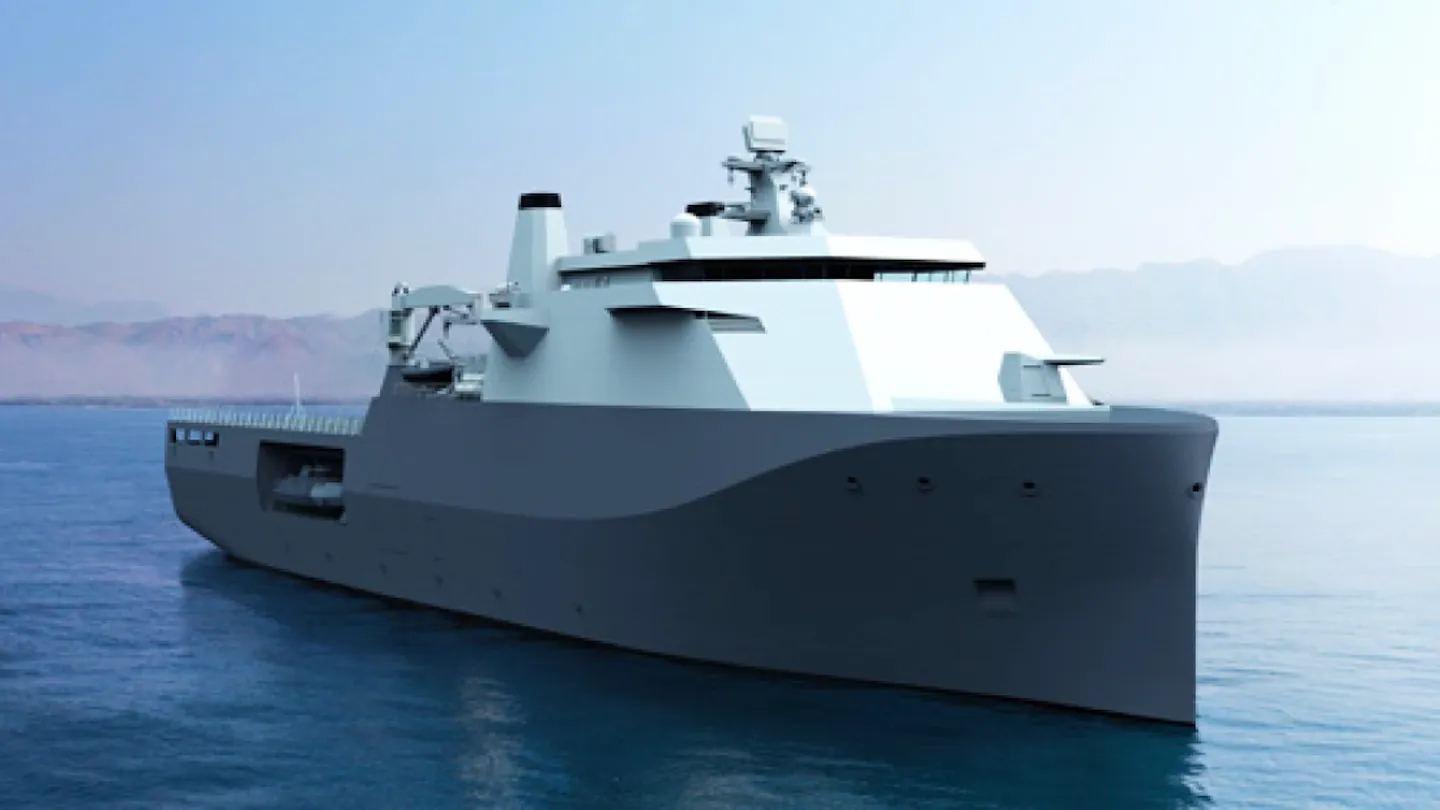
- Harland & Wolff in Belfast is expected to be the primary UK construction site, with the design likely based on Damen's Enforcer amphibious ship series at 15,000 tonnes displacement and approximately 160 metres in length.
The governments of the United Kingdom and the Netherlands have announced a joint programme to develop a new class of amphibious transport vessels under a bilateral maritime partnership. Each nation will operate four ships, with the aim of strengthening NATO's amphibious warfare capability and enhancing the alliance's rapid response to crises.
Summit Announcement and High-Level Commitments
UK Prime Minister Keir Starmer made the announcement on the sidelines of the NATO summit in Turkey: "Combining British industrial expertise with Dutch design and maritime experience to provide a world-class platform for our elite amphibious forces, this partnership will strengthen NATO."
Programme Scope and Budget
The new Landing Platform Dock (LPD) vessels will be based on a Dutch design and built at UK shipyards "in cooperation with Dutch industry." The total contract value stands at £2.4 billion (approximately USD 3.2 billion), covering four ships for the Royal Navy and four for the Royal Netherlands Navy, with entry into service planned for the early 2030s.
In the UK, the programme is officially designated the Amphibious Transport Ship Programme, replacing the previous Multi-Role Support Ship (MRSS) initiative, which was abandoned after being assessed as overly complex and misaligned with the future requirements of the UK Commando Force.
Hull Design: The Damen Enforcer Family
Although the final design has yet to be confirmed, it is widely anticipated that Dutch shipbuilder Damen will provide the design baseline, likely drawing from its Enforcer amphibious ship series. Damen currently offers seven Enforcer variants, ranging from 9,000 to 17,000 tonnes displacement.
The UK government has stated the new vessels will be approximately 525 feet (160 metres) in length and displace 15,000 tonnes. It has not yet been confirmed whether the design will follow a conventional LPD configuration or feature a full through-deck flight deck, the latter offering extended deck space for helicopter and drone operations.
For construction, the programme is expected to rely heavily on Harland & Wolff shipyard in Belfast, Northern Ireland. Navantia UK, Harland & Wolff's parent company, stated: "The Amphibious Transport Ship will be a vital part of the UK's future sovereign naval defence capability, enabling force projection globally and representing a necessary replacement for the Albion-class assault ships."
Filling the Royal Navy's Amphibious Capability Gap
The Royal Navy's amphibious capability has been progressively reduced in recent years. In 2018, HMS Ocean was decommissioned and sold to Brazil, leaving the Royal Marines reliant on two Albion-class LPDs. In 2024, the Ministry of Defence announced that HMS Albion and HMS Bulwark would both be retired the following year.
Since then, the Royal Marines have been supported by three Bay-class landing ship dock (auxiliary) vessels operated by the Royal Fleet Auxiliary (RFA) — broadly analogous to the US Military Sealift Command — though these ships offer considerably less capability than a dedicated LPD.
The UK had originally planned to procure up to six Multi-Role Support Ships to replace the two Albion-class vessels, three Bay-class ships, and the single RFA Argus, but budget pressures forced a scaling back of ambitions. The Royal Navy will now receive four new amphibious assault ships, forming a combined amphibious force alongside an equal number of Dutch vessels.
The Royal Netherlands Navy currently operates two Rotterdam-class LPDs and one Karel Doorman-class joint support ship; the new LPDs are expected to replace the Rotterdam class.
Drones and Autonomous Systems: Central to Future Operations
A defining feature of the new LPDs is a flight deck designed from the outset to operate both current and future long-range unmanned aerial vehicles (UAVs) and autonomous systems, consistent with the Royal Navy's strategic shift toward a Hybrid Navy model.
The UK's latest Defence Investment Plan has allocated more than £5 billion (approximately USD 6.6 billion) over four years specifically for drone and related capabilities. Both governments have also confirmed that further collaborative development in drone and autonomous technology will follow.
Strengthening North Atlantic and High-North Security
The partnership carries significant implications for security in the North Atlantic and High North — regions of growing strategic importance as NATO reinforces its northern flank in response to Russian threats.
The two navies have maintained close ties since the Cold War through the UK-Netherlands Amphibious Force, and the commonality of the new LPD class is expected to further facilitate joint training, deployment, and combined operations.
UK Minister for Defence Procurement Dan Jarvis said: "We are building a stronger amphibious force alongside the Netherlands, as NATO allies and Joint Expeditionary Force partners, to enhance defence and deterrence together."
Conclusion
The eight new amphibious transport ships represent a significant reconstitution of UK amphibious capability following years of uncertainty and force reductions. Combining Dutch design heritage, autonomous systems integration, and NATO ally collaboration, the new vessels are expected to become a cornerstone of the Royal Navy's future expeditionary and hybrid warfare posture.
原文來源: 查看原文
FAQ
Reviewed and published by the LAETimes editorial desk ·