China Conducts First 'Law Enforcement Patrol' in Waters East of Taiwan, Raising Blockade Fears
China's Coast Guard has conducted its first declared 'law enforcement patrol' in the Pacific Ocean east of Taiwan, operating 80–140 miles off Taiwan's eastern coast. Analysts warn the move signals Beijing's intent to establish a permanent maritime presence in the area and is rehearsing mechanisms for a future blockade or quarantine, prompting sharp concern from Taipei and several Western governments.
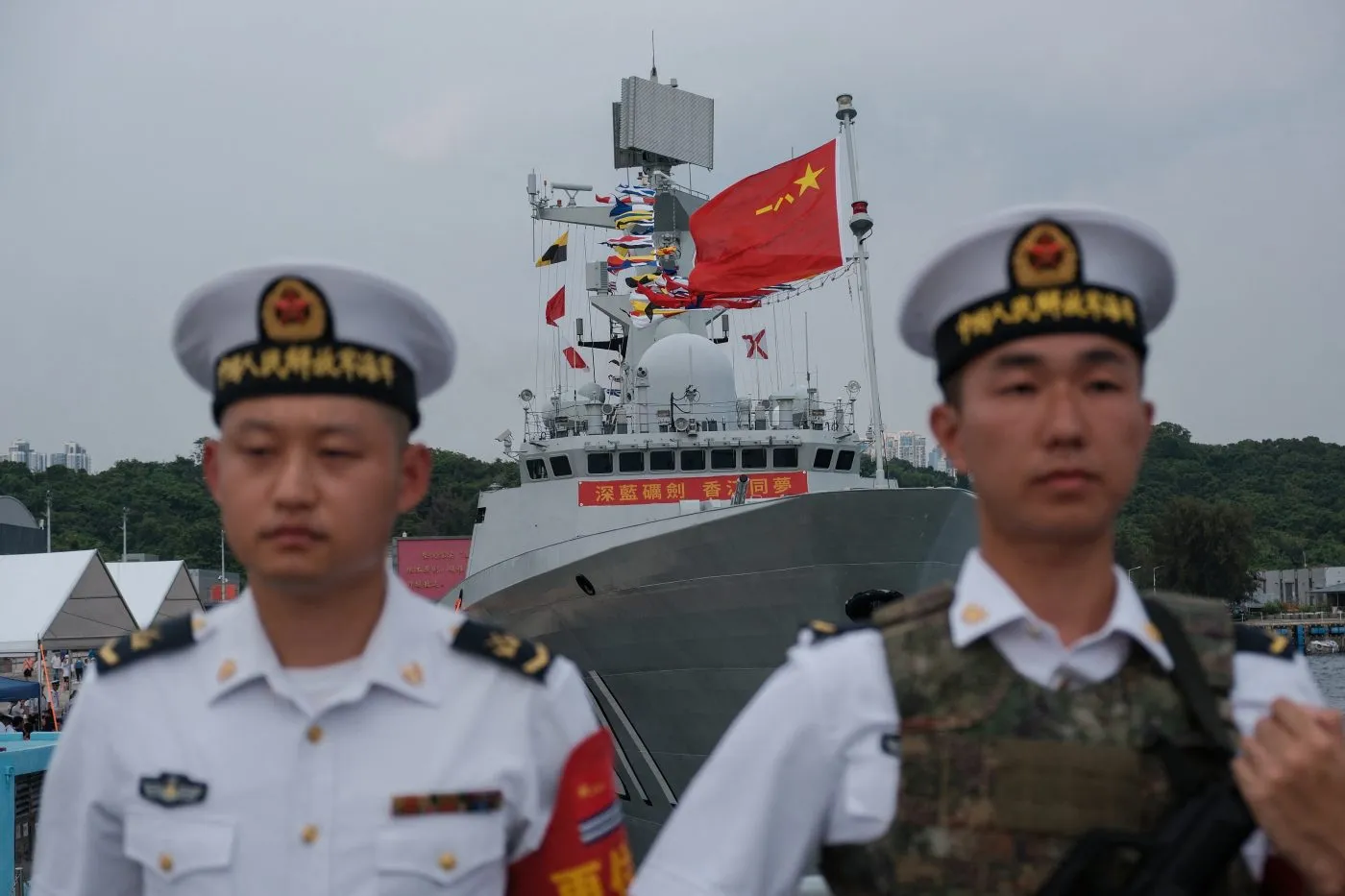
Highlights
- China's Coast Guard conducted its first declared 'law enforcement patrol' in the western Pacific, 80–140 miles east of Taiwan, with a second rotation of vessels already deployed to sustain the presence.
- CCG vessels made radio contact with passing cargo ships for the first time, requesting crew numbers and destination ports; one Singapore-flagged container ship complied.
- Taiwan's National Security Council Secretary-General Joseph Wu reported tracking a record of more than 110 PLAN and CCG vessels operating along the First Island Chain.
- CSIS analyst Gregory Poling warned Beijing is asserting enforcement authority 'far beyond what international law permits' within its claimed exclusive economic zone east of Taiwan.
- Taiwan's INDSR analyst Su Tzu-yun described the operations as China's 'sashimi strategy' — incremental, near-imperceptible moves that cumulatively shift the strategic status quo toward a potential blockade capability.
China Conducts First 'Law Enforcement Patrol' in Waters East of Taiwan, Raising Blockade Fears
Analysts say China has signaled a clear intent to establish a permanent China Coast Guard (CCG) patrol presence in waters east of Taiwan, framing the operations as 'law enforcement patrols.' The move is widely viewed as a carefully calibrated escalation in Beijing's long-standing claim of sovereignty over the self-governing island of 23 million people.
CCG Deploys to Western Pacific for First Time
The operation, announced by the China Coast Guard, involved at least two vessels conducting patrols in the western Pacific Ocean, approximately 80 to 140 miles (137–230 km) from Taiwan's eastern coastline. The deployment mirrors a similar exercise the previous month and is broadly seen as part of China's effort to normalize its maritime presence in the region.
Experts characterize the patrols as an extension of Beijing's 'grey zone' strategy — deliberately employing coast guard and civilian maritime assets rather than warships to challenge Taipei's control over strategic sea lanes while avoiding outright military confrontation.
In a notable first, Chinese coast guard vessels made radio contact with cargo ships transiting waters near Taiwan, requesting information on crew members and destinations.
Reactions from All Sides
Chinese state media claimed the operation was a response to discussions between Japan and the Philippines over delimiting boundaries in the area. Taipei, however, characterized the move as 'expansionism in a new bottle,' and several Western governments expressed concern over what they described as an 'unprecedented' action.
CCG spokesperson Jiang Lue said on Saturday that the vessels currently on patrol had been relieved by a second group of ships, which would 'continue law enforcement patrol missions.'
Ray Powell, director of SeaLight, an organization that monitors Chinese maritime activities, told AFP: 'China is essentially declaring a new normal.'
Significant Strategic Implications
Gregory Poling, director of the Asia Maritime Transparency Initiative at the Washington-based Center for Strategic and International Studies (CSIS), said the patrols were 'more than political signaling.'
'Beijing appears to be asserting broad enforcement authority within what it claims as its exclusive economic zone — far beyond what international law permits,' Poling told AFP.
Su Tzu-yun, a military analyst at Taiwan's Institute for National Defense and Security Research (INDSR), noted that China's patrol operations are establishing 'new operational norms.'
'By conducting radio-check procedures on passing merchant vessels, China is effectively rehearsing the mechanisms it would need for a future blockade or quarantine,' he said.
Taiwan Responds Actively
Taiwan's National Security Bureau Director Tsai Ming-yen said on Monday that four Chinese formations — including naval vessels — are currently operating in the western Pacific, noting an 'upward trend' in military mobilization during China's peak maritime exercise season.
Taiwan's National Security Council Secretary-General Joseph Wu wrote on X on Saturday: 'We are tracking a record of more than 110 PLAN and CCG vessels' operating along the First Island Chain.
Taiwan has responded to China's new coast guard patrols by deploying two of its own coast guard vessels to shadow the two Chinese ships.
Sung Chung-en, deputy minister of Taiwan's Ocean Affairs Council, said on Wednesday that China was attempting to 'establish a pattern that makes the shipping industry feel compelled to report to them,' but had so far failed to do so. He stressed the importance of stopping China 'at the initial stage' to ensure it 'never succeeds.'
'We will ensure these patrols do not become the norm, because they should not be there in the first place,' Sung told AFP.
The 'Sashimi Strategy': Slicing Away at the Status Quo
During last month's operation, Taiwan heard for the first time Chinese coast guard vessels contacting three passing cargo ships to request crew numbers and destination ports. One Singapore-flagged container ship complied with the request, a senior CCG official told AFP.
Powell described the patrols east of Taiwan as 'a step up on the escalation ladder toward a blockade,' adding: 'It is a very clear signal that they intend to be there for the long term.'
Su characterized the activity as consistent with China's so-called 'sashimi strategy' of methodically expanding regional patrols.
'China is making extremely thin, almost imperceptible cuts — each slice appearing insignificant on its own, but cumulatively producing a major change to the strategic status quo,' he said.
Reported by Agence France-Presse (AFP); originally published in The Eurasian Times.
原文來源: 查看原文
FAQ
Reviewed and published by the LAETimes editorial desk ·