Drone Airlifts Flood Survivor to Safety — But the Operation Would Be Illegal in Most Countries
On July 6, 2025, a heavy-lift cargo drone rescued a truck driver stranded atop a tanker during Typhoon Maysak flooding in Guangxi, China, by carrying him suspended in a harness over raging floodwaters. The operation — while successful — would be illegal in almost every jurisdiction worldwide, reigniting debate over emergency exceptions for drone regulations.
Highlights
- On July 6, 2025, a heavy-lift drone with a ~220 lb payload capacity airlifted a truck driver stranded atop a tanker in flood-hit Yunbiao Town, Guangxi, China, during Typhoon Maysak.
- Typhoon Maysak flooding trapped more than 15,000 residents in Yunbiao Town, making boat access to the stranded driver impossible due to swift currents.
- Carrying a human being by drone is explicitly prohibited under the FAA's Part 107 in the United States and under EASA regulations in Europe, with no current emergency exemption covering personnel airlifts.
- Two heavy-lift drones with wingspans over 10 feet and three reconnaissance drones were deployed in the rescue operation; other teams used drones to string guide lines toward inflatable rescue boats.
- Industry observers are calling on regulators to establish formal emergency pathways for certified operators to conduct human airlifts when no other rescue option exists.
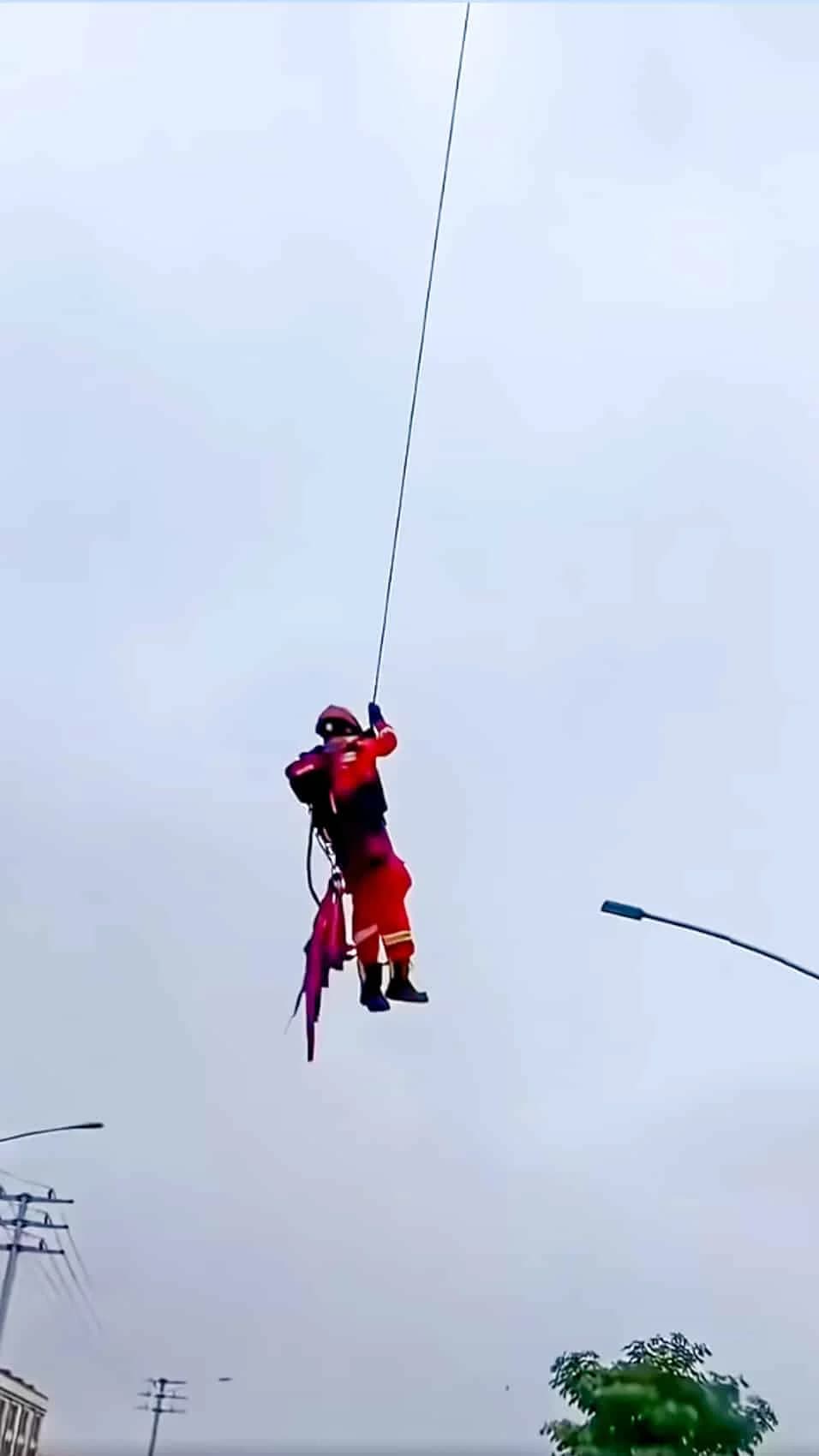
A heavy-lift cargo drone in southern China lifted a stranded truck driver from the roof of a tanker truck and carried him suspended over raging floodwaters to dry ground.
Image credit: Global Times
The rescue took place on July 6 in Yunbiao Town, Guangxi — a community submerged by Typhoon Maysak. Rescuers secured the man in a harness, and a heavy-lift drone hoisted him into the air as he gripped the suspension line and was transported to safety. Footage released by the Hengzhou Integrated Media Center and redistributed by state media outlet Xinhua went viral almost immediately — and posed a sobering question to the drone industry.
Heavy-Lift Drone Extracts Stranded Man from Tanker Roof
The situation on the ground was as dramatic as it sounds. Heavy rainfall from Typhoon Maysak inundated Yunbiao Town on July 6, trapping more than 15,000 residents. One truck driver, caught by rising water levels, found himself stranded on top of the tanker he had been driving.
The swift current made it impossible for any boat to approach. Rescuers deployed a heavy-lift drone — the type normally used for agricultural spraying and industrial cargo transport. Operators secured the man in a harness, the drone bore his full weight, and he was carried across the water while gripping a support line.
Two heavy-lift drones were deployed that day, each with a wingspan of more than 10 feet (3 meters) and a maximum payload capacity of nearly 220 lbs (100 kg). Three smaller reconnaissance drones assisted by surveying the disaster area. Separate rescue teams used drones to string lines that guided residents toward inflatable rescue boats.
Carrying People by Drone Is Prohibited in Almost Every Jurisdiction
This is where the story becomes more than a feel-good rescue video. In the vast majority of countries, using a drone to transport a human being is explicitly illegal — and has been since modern drone regulations were first established.
In the United States, Part 107, which governs commercial drone operations, prohibits carrying human beings. The entire regulatory framework was built for cargo transport and aerial imaging, not passenger carriage. The FAA's 2021 rules allowing drones to fly over people under certain conditions are an entirely different matter from attaching a person to an airframe.
Image credit: Global Times
The European Union Aviation Safety Agency (EASA) draws the same line. Heavy-lift drones in Europe are approved to carry equipment and medical supplies — not people. The reasoning is blunt: cargo drones are not certified as crewed aircraft. A motor failure or signal loss while a person is suspended beneath one is not a minor incident. It is a fatality.
Disasters Do Not Wait for Regulations to Catch Up
Those regulations exist for sound reasons. None of those reasons would have helped a man about to drown. That is the dilemma this footage drops in the lap of the drone world: the safest available method of reaching him — possibly the only method — happened to be the one the rulebook explicitly forbids.
Regulatory bodies do maintain narrow emergency exemptions for drones. The FAA permits first responders to apply for tactical waivers to conduct beyond visual line of sight (BVLOS) operations in "extreme emergencies involving the protection of life." Those waivers cover getting to a scene, however — not airlifting a person away from one.
China regulates its own airspace under its own framework, and someone at that flooded riverbank made a real-time judgment call. On the roof of that tanker, the gap between breaking a rule and saving a life had narrowed to almost nothing.
But the man was drowning. Picture yourself standing there with the controller in your hands.
Would you genuinely call the FAA or EASA and wait for authorization? When lives are on the line, some processes have to give way.
Heavy-Lift Drones Will Force the Issue
This will not be the last time a rescue team faces this choice. As heavy-lift drones become more capable and less expensive, more emergency response teams will find themselves looking at a person who could be extracted by drone while the regulatory manual says no.
Image credit: Global Times
The technology is already there. These are the same platforms now widely used for pesticide application and construction material transport. A 220-lb payload is well within their operating envelope. Drone involvement in disaster response dates back at least to 2013, when Texas A&M University deployed UAVs to document the Moore tornado — but at that point the role was strictly reconnaissance and supply delivery, never personnel transport.
Pretending this incident did not happen helps no one. The productive path forward is deciding what a legal version of this operation should look like: certified airframes, genuine redundancy systems, trained operators — so that the next rescue team does not have to choose between the law and a human life.
DroneXL Analysis
To be direct: this footage will inevitably be cited by two completely different camps. One will call it definitive proof that heavy-lift drones should be integrated into every flood and wildfire response plan. The other will frame it as a reckless stunt that happened to work. Both have a point.
The rescue succeeded. A person is alive because someone disregarded the operating manual. That deserves to be stated plainly — without turning it into a template that everyone should replicate tomorrow.
What comes next? Heavy-lift drones will only grow more capable of carrying people. Regulators should establish a formal emergency pathway — one that allows trained operators to make a life-or-death call when there is no other option. To any firefighter or pilot who may one day face a thirty-second decision window: the answer is straightforward. Do it.
What China demonstrated is that the capability exists and the need exists. Regulators can engage with that reality head-on, or continue to pretend such situations will not arise again.
But the floodwaters will keep rising.
Image credit: Global Times
原文來源: 查看原文
FAQ
Newsletter
Subscribe to our Low-Altitude Industry Newsletter
Daily curated news on low-altitude economy and drone industry, delivered to your inbox.
Reviewed and published by the LAETimes editorial desk ·