Flapping-Wing Robot Mimics Diving Birds to Achieve Both Swimming and Flight
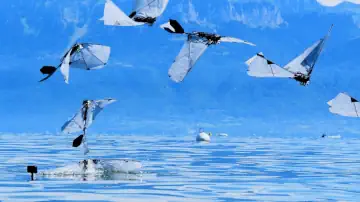
Researchers have developed a bio-inspired flapping-wing robot that replicates the cross-medium locomotion of more than 100 diving bird species — including loons, gulls, puffins, and petrels — enabling it to both swim underwater and fly through the air. The breakthrough represents a significant advance in cross-medium unmanned vehicle technology.
Highlights
- Researchers developed a bio-inspired flapping-wing robot capable of both aerial flight and underwater swimming, modeled on more than 100 diving bird species including loons, puffins, and petrels.
- The robot overcomes an 800-fold density difference between air and water by mechanically replicating avian flapping-wing motion within a single unified structure.
- The cross-medium vehicle (CMV) can transition seamlessly at the air-water interface, achieving agility comparable to natural diving birds.
- Practical applications include marine environmental monitoring, search and rescue, infrastructure inspection of water-adjacent structures, and scientific wildlife tracking.
- The research establishes a key technical foundation for next-generation intelligent robots designed to move freely between aerial and aquatic environments.
Loons, gulls, puffins, and petrels are among roughly 100 bird species that can dive beneath the water's surface and take to the air with equal ease. The cross-medium locomotion these animals evolved over millions of years has long captivated engineers and biomechanics researchers alike.
Now, taking direct inspiration from these diving birds, scientists have successfully developed a bio-inspired flapping-wing robot capable of replicating avian swimming and flight movements within a single mechanical platform — marking a significant breakthrough in the field of cross-medium unmanned vehicles (CMVs).
The Core Engineering Challenge
Designing a single mechanical structure that performs effectively in both air and water is an extraordinarily difficult engineering problem. The density difference between the two media exceeds 800-fold, and conventional aircraft or underwater vehicles are typically optimized for just one environment, making dual-medium performance extremely difficult to achieve.
This bio-inspired robot overcomes that challenge by mechanically replicating the flapping-wing motion of diving birds, enabling it to transition seamlessly at the air-water interface and demonstrate agility comparable to its natural counterparts.
Application Potential for Cross-Medium Robotics
Cross-medium robots of this kind hold significant promise across a wide range of real-world applications, including:
- Marine environmental monitoring: Flying to a target area before diving to collect subsurface data
- Search and rescue operations: Conducting missions in complex environments where land, air, and water intersect
- Infrastructure inspection: Performing comprehensive surveys of bridges, dams, and other structures that span both water and land
- Scientific research: Tracking aquatic wildlife or monitoring marine ecosystems
This research demonstrates the enormous potential of biomimetics in next-generation unmanned vehicle design, laying an important technical foundation for future intelligent robots capable of moving freely between air and water.
原文來源: 查看原文
FAQ
Reviewed and published by the LAETimes editorial desk ·