Maritime Counter-Drone Warfare: How Sensors and Effectors Match the Threat
Retired Turkish Rear Admiral Hasan Özyurt, now Naval Systems Coordinator at ULAQ Global, examines the complete maritime counter-drone kill chain—detection, identification, tracking, and hard-kill engagement. The analysis concludes that compact AESA radars, multispectral electro-optical systems, and a combined SAL/IR/IIR precision-guided lightweight missile pairing on a shared launcher represent the most operationally mature and economically viable solution against Tier 2 one-way attack drone threats.
Highlights
- Tier 2 OWA 無人機 RCS 低至 0.1 m²,只有專為反無人機設計的緊湊型 AESA 雷達能在 USV SWaP 限制內完成偵測與追蹤任務。
- 海上反無人機電光系統(EOS)必須在 5–10 公里距離內對 2.5–3.5 公尺長目標完成正向識別,並需整合日光、MWIR 熱像與 SWIR 三通道。
- 各效應器類別每次交戰成本差距超過八個數量級,從電子戰的約 0.01 美元到先進飛彈的 475 萬美元,Tier 3 地對空飛彈對無人機攻勢的成本交換比超過 100:1 對攻擊方有利。
- 攔截無人機因螺旋槳驅動限速低於 300 km/h,無法攔截速度達 500–650 km/h 的噴射動力 OWA 變體,且依賴操作員導引無法自主在目標間交接。
- SAL 與 IR/IIR 精確導引輕型飛彈裝於共用發射架,是目前唯一同時具備經濟可持續性、作戰成熟度與 USV 驗證紀錄的海上 Tier 2 硬殺傷效應器組合。
Maritime Counter-Drone Warfare: How Sensors and Effectors Match the Threat
Effective anti-drone warfare (ADW) requires a complete kill chain—detect, identify, track, and hard-kill engage—with every link matched to the physical characteristics and economic realities of Tier 2 one-way attack (OWA) drone threats. Written by retired Rear Admiral Hasan Özyurt, currently serving as Naval Systems Coordinator at ULAQ Global, this article examines the technology choices at each stage: why only AESA radar meets detection requirements, what performance an electro-optical system must achieve, and how the main effector categories compare.
A previous article in this series established that counter-drone warfare is a distinct operational domain with its own threat physics, engagement economics, and platform requirements. The following analysis rests on two principles: forward deployment is essential—when threats approach from the sea, defence cannot begin at the coastline, and effective maritime ADW requires intercept forward along the threat axis; layered overlap provides depth—a three-tier framework (Tier 1 counter-UAS, Tier 2 ADW, Tier 3 air-defence operations) reflects the reality that no single system covers the full threat spectrum, so a system optimised for Tier 2 that extends into Tier 1 and the low end of Tier 3 provides defence in depth.
The Kill Chain Problem
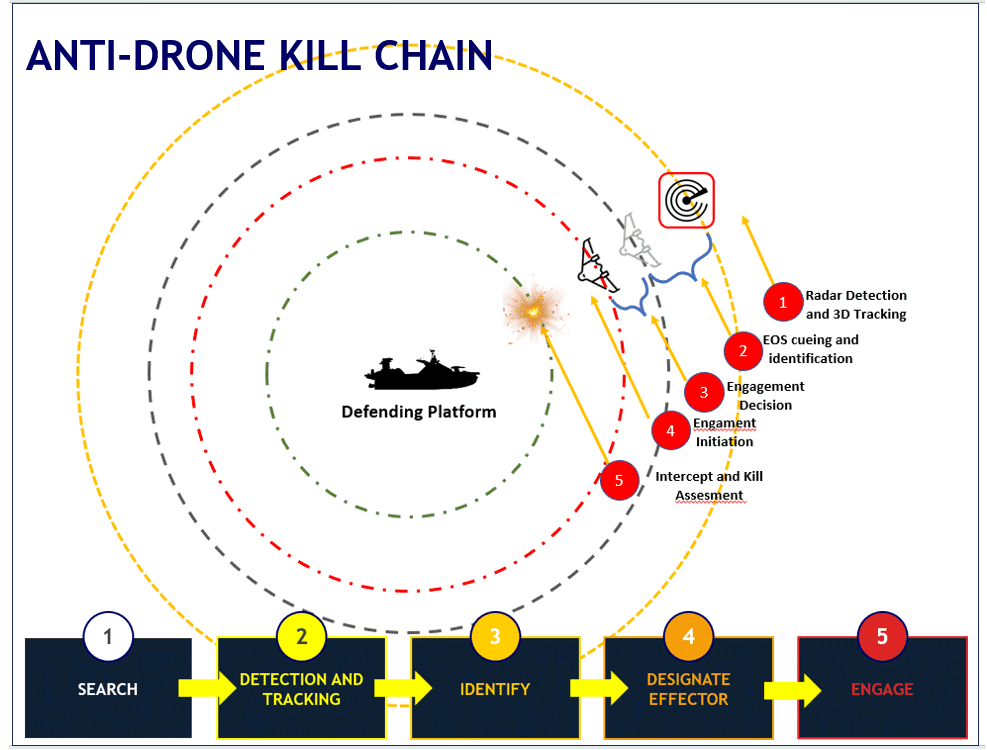
Defending against U.S. DoD Group 3 / NATO Class II OWA drones requires closing a complete kill chain within a severely compressed time window. Detection must occur at sufficient range to allow reaction time; identification must confirm hostile intent; tracking must maintain fire-control-quality data; and hard-kill engagement must destroy the drone before it reaches its target.
Failure at any single link breaks the entire chain. A sensor that detects but cannot track, an electro-optical system that identifies but cannot designate, or an effector with insufficient kill probability or slow response time all produce the same outcome: a leaker. For a port, energy facility, or vessel at anchor, a single leaker can be catastrophic. The technology selection challenge is therefore not finding the best individual component, but assembling an integrated chain matched to platform constraints, cost boundaries, and engagement timelines.
Detection and Tracking: The First and Hardest Problem
The detection challenge is defined by two compounding parameters: radar cross-section (RCS) and platform constraints. Tier 2 OWA drones present RCS values as low as 0.1 m², rendering them nearly invisible to conventional air-search radars. Large naval AESA systems can detect targets down to 0.01 m², but they are designed for major surface combatants—their weight, power consumption, and cost are prohibitive for scalable forward-deployed screening. Establishing a detection barrier along the maritime threat axis requires sensors that can be deployed in quantity on small unmanned platforms within strict size, weight, and power (SWaP) constraints.
Passive systems—radio-frequency direction-finding and acoustic sensors—face a fundamental limitation: they generally cannot provide the three-dimensional data required for engagement-quality tracking, and as autonomous OWA variants increasingly emit no signal in the terminal phase, there is simply nothing to detect. Passive detection is accordingly relegated to Tier 1 counter-UAS or cueing roles.
Compact active electronically scanned array (AESA) radars designed specifically for the counter-drone mission resolve these constraints. Modern compact AESA designs can detect and track targets with RCS as low as 0.01 m² within the SWaP envelope of small-to-medium unmanned surface vehicles (USVs). They provide 360° coverage with simultaneous multi-target tracking and scanning, maintain performance in adverse weather, and cover the full speed envelope from slow piston-engine types to jet-powered variants. Compact AESA radar is the foundation of Tier 2 ADW detection.
Detection range figures are operationally representative data against a 0.1 m² RCS target under maritime conditions.
Identification and Fire Control: The Electro-Optical System
While the AESA radar handles search and tracking, the electro-optical system (EOS) performs identification and fire control upon receiving the radar cue. It executes three sequential functions: automatic slewing to visually acquire the target, providing high-resolution data to confirm hostile intent, and delivering continuous fire control—coded laser designation or seeker handoff—followed by post-strike damage assessment.
Under maritime conditions, positive identification of a target 2.5 to 3.5 metres in length must be achievable at 5 to 10 kilometres. This requires a stabilised gimbal capable of sub-pixel tracking precision under sea-state-induced motion, together with automatic radar-to-EOS handoff to match compressed engagement timelines. Reliable performance across the full envelope depends on multispectral capability: a daylight camera (highest resolution under favourable conditions), a thermal MWIR channel (penetrating darkness, haze, and smoke), and a SWIR channel (penetrating maritime aerosols and humidity).
The choice between a high-end integrated suite and a mid-tier compact director depends on the effector carried. Platforms employing semi-active laser (SAL)-guided missiles require a coded laser designator and precision stability to maintain illumination throughout missile flight; IR/IIR fire-and-forget effectors can operate with a mid-tier EOS focused primarily on cueing and lock-on confirmation.
Effector Survey
Selecting an effector means balancing kill probability against the cost-exchange ratio needed to absorb a large-scale drone offensive. Per-engagement costs across system categories span more than eight orders of magnitude—from approximately $0.01 for electronic warfare to $4.75 million for advanced missile interceptors. This spread represents entirely different economic regimes, and each effector category must be judged against the economic regime in which Tier 2 missions actually operate.
Advanced surface-to-air missiles—Patriot PAC-3, NASAMS, IRIS-T SLM—deliver outstanding kill probability, but against drones costing $20,000 to $50,000, the cost-exchange ratio exceeds 100:1 in the attacker's favour, and their weight and power requirements make them unsuitable for small unmanned platforms. These belong to Tier 3, not Tier 2.
Gun systems with programmable air-burst ammunition offer cost-effective per-engagement economics, but small-calibre guns have limited range, while large-calibre rapid-fire systems are too heavy and power-hungry for USVs. An effective envelope of 3 to 5 kilometres leaves little margin for re-engagement; suitable for surface combatants and fixed shore installations, but incompatible with a forward-deployed USV screen.
Electronic warfare is highly effective against Tier 1 drones that rely on operator links and GNSS, but offers limited effect against autonomous Tier 2 OWA drones using pre-programmed inertial navigation (INS), hardened GNSS, terrain-matching, or AI-based visual navigation. The trend toward terminal autonomy makes EW unreliable as a primary Tier 2 tool.
Directed energy weapons (DEW) offer near-zero per-engagement cost and virtually unlimited magazine depth, but sustained engagement requires hundreds of kilowatts—currently incompatible with small-to-medium USVs—and maritime atmospheric effects attenuate and diffract beam effectiveness. DEW remains a compelling long-term solution but is still an emerging capability.
Interceptor drones offer an attractive per-engagement cost, but propeller-driven variants are aerodynamically limited to below 300 km/h, making intercept geometry against jet-powered OWA variants (500–650 km/h) geometrically impossible. The evolution of interceptor drones toward rocket propulsion and higher closing speeds confirms the problem rather than solving it: when an interceptor drone achieves sufficient speed, it converges on the precision-guided missile it was meant to replace. At sea, the problem is compounded further—there is no terrain to anchor a continuous intercept line, and FPV-guided interceptors depend on operators and cannot autonomously hand off between targets, imposing a hard ceiling on engagement rate against saturation salvos.
Optimal Effector Selection: Precision-Guided Lightweight Missiles
Analysing the options reveals a clear pattern: Tier 3 SAMs are economically unsustainable against mass attacks; guns and DEW face physical or maturity constraints on small unmanned vessels; interceptor drones and EW are defeated by the basic physics of OWA speed and terminal autonomy. Precision-guided lightweight missiles in the SAL and IR/IIR categories consistently score highest—high kill probability, rapid response, sustainable cost-exchange ratios, and proven USV compatibility.
The two roles are complementary: SAL missiles deliver precision lethal engagements out to 5 kilometres, working sequentially through multiple targets per patrol; IR/IIR missiles provide genuine fire-and-forget autonomy out to 8 kilometres, freeing the EOS immediately after launch to support near-continuous engagement cycles against saturation salvos. Combined on a shared launcher, this pairing closes the tactical gap that either system leaves when employed alone.
Conclusion
The kill chain analysis points to three unambiguous conclusions:
- Detection requires a compact AESA radar—conventional mechanically scanned systems cannot match the low-RCS tracking and multi-target capability required for modern ADW within the SWaP envelope of a USV.
- Identification and fire control require a multispectral EOS architecture incorporating daylight, thermal, and SWIR channels; single-channel systems will fail operationally in shifting sea conditions, darkness, and maritime humidity.
- The current answer for hard kill is a SAL and IR/IIR lightweight missile combination on a shared launcher—the only effector pairing that is simultaneously economically sustainable, operationally mature, and validated on unmanned hulls.
Against the threats that exist today, the conclusion is unambiguous: matching sensors and effectors to the physical and economic realities of the Tier 2 OWA drone threat determines whether the maritime ADW kill chain truly closes—or produces leakers.
Originally published in Naval News. The author, Hasan Özyurt, is a retired Turkish Navy Rear Admiral and currently serves as Naval Systems Coordinator at ULAQ Global.
原文來源: 查看原文
FAQ
Reviewed and published by the LAETimes editorial desk ·