Trump Claims Iran Fired Over 100 Missiles at USS Abraham Lincoln in One Hour as US-Iran Tensions Escalate
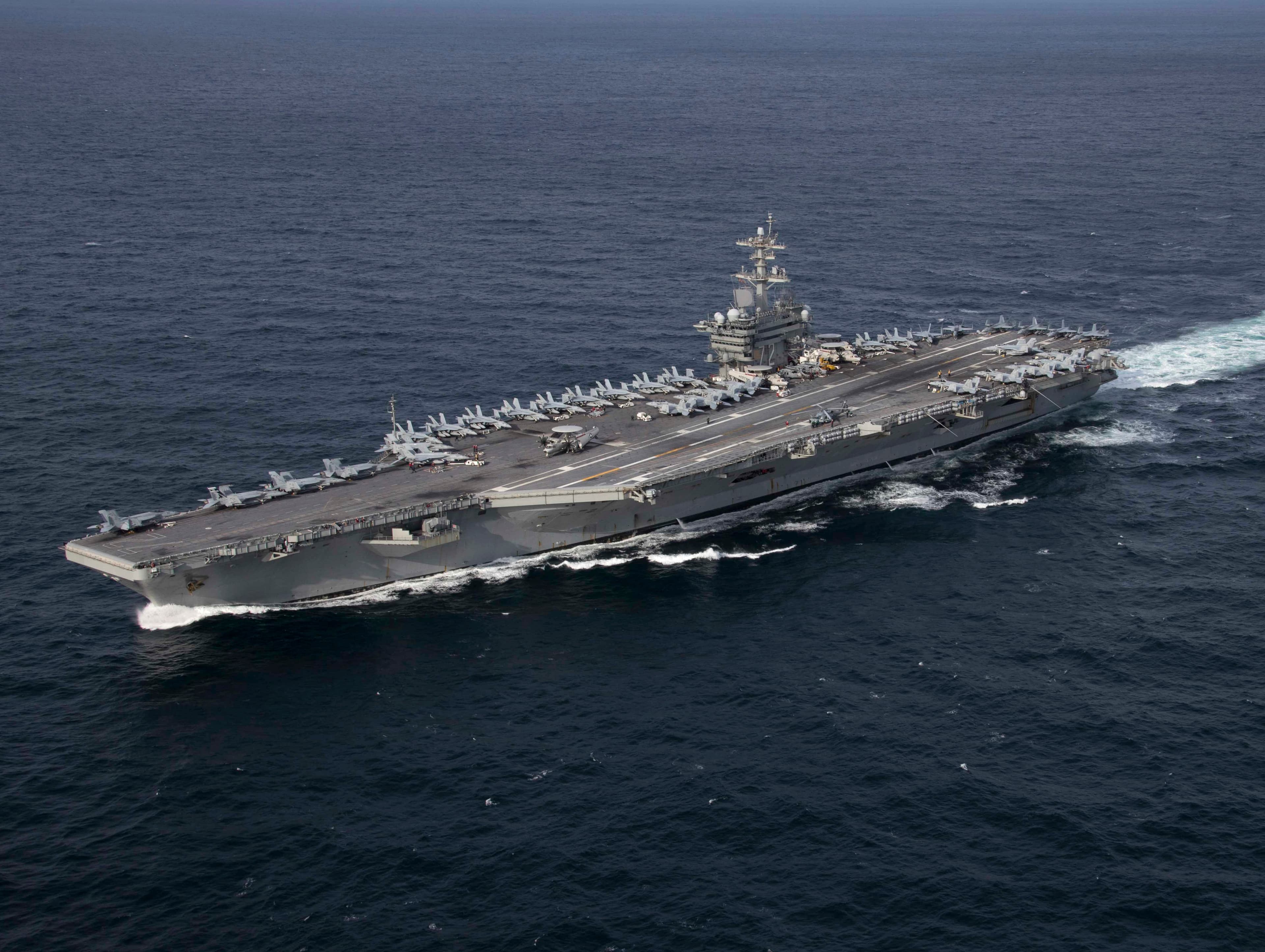
President Donald Trump stated on July 8, 2026, at the NATO summit in Ankara, Turkey, that Iran launched 111 missiles at the USS Abraham Lincoln (CVN-72) within a single hour, all of which were intercepted. The claim has not been confirmed by the Pentagon. Trump also declared the ceasefire agreement has collapsed, with U.S. forces launching fresh strikes on Iranian targets as the conflict intensifies.
Highlights
- President Trump claimed on July 8, 2026, that Iran fired 111 missiles at USS Abraham Lincoln (CVN-72) within one hour, all of which were intercepted — a claim not confirmed by the Pentagon.
- Trump misspoke and referred to Iran as 'Japan' during remarks at the NATO summit in Ankara, Turkey.
- Iran's IRGC previously claimed to have struck the Lincoln with four ballistic missiles on March 1, but CENTCOM denied any missiles came close to hitting the carrier.
- USS Gerald R. Ford, the other U.S. carrier in the region, was forced to withdraw to Greece on March 12, 2026, following a major onboard fire.
- Trump declared the U.S.-Iran ceasefire agreement over and said U.S. forces struck Iranian targets overnight on July 8, with further strikes described as possible that same evening.
Trump Reveals: Iran Fired 111 Missiles at USS Abraham Lincoln in One Hour
When the Pentagon redeployed the USS Abraham Lincoln Carrier Strike Group (CSG) from the Indo-Pacific to the Middle East in January 2026, few could have anticipated that the flagship symbol of American naval power would face intense attack during Operation Epic Fury.
President Donald Trump disclosed that Iranian forces launched a large-scale attack against the Lincoln during the 40-day U.S.-Iran conflict. Trump made the remarks on July 8, 2026, on the sidelines of the NATO summit in Ankara, Turkey, during a meeting with Ukrainian President Volodymyr Zelensky.
"The Islamic Republic… Japan fired 111 missiles at us," Trump said — misstating "Iran" as "Japan" in an embarrassing slip, given that Japan is one of America's closest allies and key partners in the Indo-Pacific.
Trump claimed Iran launched 111 missiles at the Lincoln within a single hour, all of which were intercepted. "They didn't hit the carrier — you know what would have happened if they had," he emphasized.
This may represent the first public U.S. acknowledgment of the scale of the missile attack on the carrier, though the claim has not been formally confirmed by the Pentagon.
Discrepancy Between Iranian Claims and U.S. Account
Prior to Trump's remarks, Iran's Islamic Revolutionary Guard Corps (IRGC) claimed on March 1 that the Lincoln had been struck by four ballistic missiles. U.S. Central Command (CENTCOM) quickly refuted the claim, stating: "The Lincoln was not hit — the missiles fired didn't even come close."
Deployment and Defensive Capabilities of the Lincoln Strike Group
The Abraham Lincoln CSG deployed to the CENTCOM area of responsibility in January 2026 as part of a major military buildup ahead of Operation Epic Fury in February 2026.
The strike group is equipped with guided-missile destroyers and cruisers armed with Tomahawk cruise missiles, as well as Carrier Air Wing 9 (CVW-9), which operates F-35C stealth fighters, F/A-18 Super Hornets, electronic warfare aircraft, and helicopters. Escort vessels include the Arleigh Burke-class destroyers USS Frank E. Petersen Jr., USS Michael Murphy, and USS Spruance.
Notably, Iran's military strategy emphasizes Anti-Access/Area Denial (A2/AD). Tehran has amassed anti-ship missiles with ranges exceeding 1,000 kilometers and has adapted large ballistic missiles into anti-ship variants, posing a significant threat to U.S. naval assets.
Saturation Attack Tactics: Overwhelming Defenses with Volume
The attack pattern described by Trump — a massive volley of missiles fired within a very short window — suggests Tehran attempted a "saturation attack" aimed at sinking or severely disabling the carrier.
Iran has long planned to deploy coordinated waves of missiles and drones to overwhelm U.S. naval defenses — exhausting the limited interceptor magazines of escort vessels, overloading radar systems, and allowing some weapons to break through and strike high-value targets such as the Lincoln.
However, U.S. Navy carriers are not easy targets. The fleet is equipped with early-warning radars, and E-2D Hawkeye airborne early warning aircraft provide extended detection ranges. The Lincoln strike group's Aegis destroyers carry SPY radar capable of tracking over 100 targets simultaneously, along with SM-3 and SM-6 interceptor missiles. The carrier itself is also equipped with Evolved Sea Sparrow Missiles (ESSM), Rolling Airframe Missiles (RAM), and the Phalanx Close-In Weapon System (CIWS).
Importantly, a carrier is not a stationary target — the Lincoln's top speed of 35 knots means it can shift position by several nautical miles during a ballistic missile's flight time, forcing attackers to continuously update targeting data.
Second Carrier Has Already Left the Theater
The USS Gerald R. Ford, the other carrier deployed to the region, was forced to sail to Greece on March 12, 2026, following a major onboard fire. Had the Lincoln been seriously damaged, it would have represented a significant blow to U.S. naval capabilities in the region.
However, multiple analysts speaking to EurAsian Times noted that Trump's penchant for exaggeration means his account should not be taken at face value.
Retired Commodore Anil Jai Singh said: "Despite what President Trump claims, I am not sure this is true. The Lincoln did come under attack from four ballistic missiles early in the war, but I don't believe any further missile attacks have occurred since then. In fact, the carrier is currently deployed in the Arabian Sea, remaining on standby in case the ceasefire breaks down and hostilities resume."
U.S.-Iran Tensions Escalate Sharply
On the sidelines of the NATO summit, Trump launched a fierce verbal assault on the Iranian regime, declaring the ceasefire agreement dead. The trigger was an Iranian attack on a tanker transiting the Strait of Hormuz off the coast of Oman, prompting mutual retaliatory actions.
Trump accused Iran of "lying" and "cheating," alleging Tehran had violated the interim agreement requiring both sides to halt hostilities. "I think it's all over — I don't want to deal with them anymore. They are scum… they are led by sick people, they are brutal, violent people," he said angrily.
Trump then told reporters that U.S. forces "hit them very hard last night" and suggested they "may hit them again tonight."
In response, Iranian Foreign Minister Abbas Araghchi posted on X: "We do not respond to vulgarity with vulgarity — we respond with actions, fearlessly and with great courage."
The situation remains highly volatile. According to the latest reports, U.S. forces launched a second round of overnight strikes against Iranian targets on July 8, while Tehran retaliated with attacks on U.S. bases in Bahrain, Kuwait, and Qatar. The United States is reportedly preparing for a conflict with Iran that could last days or even weeks, with the scale and intensity of further operations depending on Iran's next moves.
原文來源: 查看原文
FAQ
Newsletter
Subscribe to our Low-Altitude Industry Newsletter
Daily curated news on low-altitude economy and drone industry, delivered to your inbox.
Reviewed and published by the LAETimes editorial desk ·