U.S. Army Publishes Vulnerability Assessment of China's ZTZ-100 Tank — Then Proceeds to Build Nearly the Same Thing
The U.S. Army's threat analysis unit has released a formal assessment of China's new ZTZ-100 (Type 99) hybrid-electric tank, acknowledging its strengths — including a silent-running mode, AR crew helmets, and networked command capability — while cataloguing exploitable weaknesses such as limited battery range and fragile high-voltage wiring. The irony: the U.S. Army's own next-generation M1E3 Abrams program shares virtually the same design architecture.
Highlights
- The U.S. Army's Operational Environment assessment office formally evaluated China's ZTZ-100 hybrid-electric tank in spring 2025, less than ten months after its public debut at Beijing's Victory Day parade.
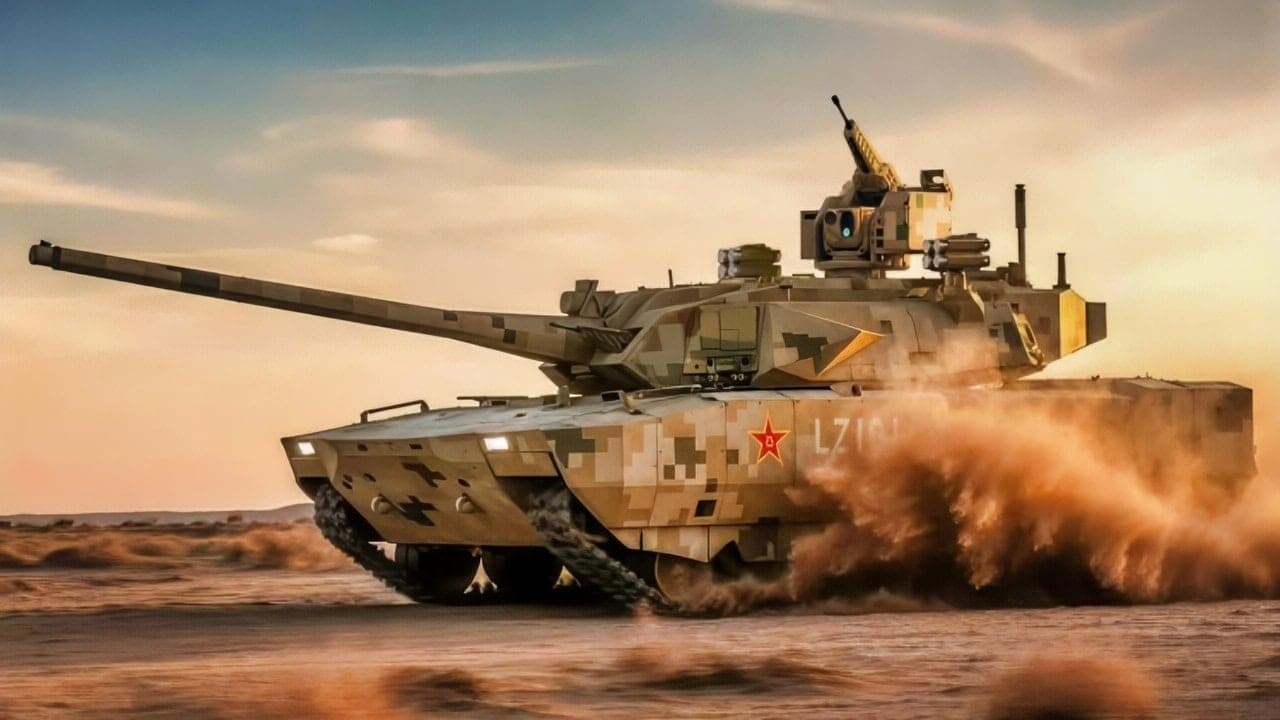
- The ZTZ-100 features a ~1,500 hp hybrid diesel-electric drivetrain enabling silent running, an unmanned turret with a 105 mm autoloading gun, and AR helmets integrating drone feeds — transforming it into a networked command node.
- The U.S. Army identified three primary exploitable vulnerabilities: limited battery endurance creating detectable recharging windows, fragile high-voltage wiring harnesses, and heavy battery packs that constrain mobility and payload.
- The ZTZ-100 is estimated to cost approximately $7.5 million USD per unit at current production rates, with the target dropping to ~$6 million at full-rate production, and was developed and fielded in roughly four years.
- The U.S. Army's M1E3 Abrams next-generation tank — backed by $723.5 million and scheduled for soldier testing in 2026 — shares nearly identical design architecture with the ZTZ-100, making the Chinese tank's identified weaknesses directly applicable to the American program.
When China's ZTZ-100 (Type 99) tank made its debut at Beijing's Victory Day parade last September, it caught analysts off guard. The unmanned-turret, hybrid-electric platform was widely regarded as a next-generation armored weapon purpose-built for the drone age. Less than ten months later, the tank has entered active service — and the U.S. Army's threat analysis community has published a formal assessment in response. The report cuts both ways: it acknowledges the ZTZ-100's genuine strengths while detailing how U.S. forces might exploit its weaknesses, from battery endurance constraints to vulnerable high-voltage wiring harnesses. The deeper irony, however, is that the U.S. Army is itself fast-tracking a next-generation tank built on nearly identical design principles — making the ZTZ-100 vulnerability list read, in effect, as a self-warning.
Is the ZTZ-100 a Flawed Design?
When the ZTZ-100 first appeared at Tiananmen Square, conventional wisdom held that it would take years to confirm its real-world performance. The speed with which it transitioned from parade display to operational service proved otherwise, and the Pentagon responded with analysis rather than speculation. The U.S. Army's "Operational Environment" assessment office — the agency responsible for characterizing threats facing American soldiers — published its evaluation of China's new hybrid-electric armor this spring. It rewards reading on two levels: what it concedes, and what it targets.
Capabilities the U.S. Army Acknowledges
The assessment is not dismissive. It notes that the ZTZ-100, fielded alongside a hybrid-upgraded variant of the older Type 99A, represents a People's Liberation Army armored force with superior survivability, lethality, and combat power relative to most adversaries.
The tank's hybrid diesel-electric drivetrain, rated at approximately 1,500 horsepower, enables silent running in pure-electric mode — dramatically reducing acoustic and thermal signatures, the two vulnerabilities that proved fatal to armored vehicles on the Ukrainian battlefield. The system also generates surplus electrical power to feed active protection radars, electronic warfare systems, and an array of sensors. Crew members are equipped with augmented reality (AR) helmets integrated with feeds from unmanned reconnaissance drones, transforming the tank, in U.S. assessment terms, from a standalone gun platform into a networked command node capable of over-the-horizon operations.
On the hardware side, the ZTZ-100 — developed by the 201st Research Institute and manufactured at a plant in Baotou — mounts an autoloading 105 mm main gun in its unmanned turret, with a claimed muzzle velocity of 1,706 meters per second. China asserts this is comparable to larger 120 mm and 125 mm guns, a claim worth treating with skepticism. The crew (typically reported as three personnel) is housed in a protected compartment within the hull, isolated from the ammunition store, with intercept systems directed by four radar panels and a laser-blinding suite. The vehicle weighs approximately 35–45 tonnes depending on the source estimate, placing it firmly in the medium-tank category — a deliberate departure from the heavy-armor arms race. China designates it a fourth-generation tank, though that label carries no internationally agreed definition.
Vulnerabilities the U.S. Army Has Identified
The assessment then pivots to what amounts to a targeting memo. The same report concludes that hybrid-electric tanks, while gaining new advantages, introduce technical, logistical, and doctrinal vulnerabilities that U.S. forces can exploit.
Limited battery endurance: The silent pure-electric mode has a strictly constrained operating window, creating predictable recharging intervals — periods during which the tank must run its diesel engine or expose its position to recharge, transforming a previously silent target into a noisy, thermally conspicuous one.
Battery packs and power electronics add weight and volume, constraining strategic mobility and reducing available payload.
Complex high-voltage wiring harnesses and cooling systems are susceptible to combat damage and difficult to repair rapidly in the field — a serious liability for a vehicle designed to operate far from logistics bases.
Independent analysts are blunter still. Ukrainian military outlet Militarnyi, in an otherwise broadly positive technical review, warned that the design's complexity, combined with uncertainties about Chinese manufacturing quality, could trigger cascading equipment failures — and that the PLA may be more reliant on mass production and rapid replacement than on field repair capability. In short, the ZTZ-100's technical sophistication is simultaneously its exposure.
Fielded, In Production, and Relatively Affordable
None of that makes the ZTZ-100 a paper tiger. Training footage released in early May implicitly confirmed operational service entry; the tank is currently in low-rate initial production, with per-unit cost estimates of approximately $7.5 million USD — projected to fall to roughly $6 million USD at full-rate production. These figures are analyst estimates derived from subsystem comparisons, not official Chinese data. Development running from approximately 2016–2022 and deployment within roughly four years thereafter represents a striking industrial tempo — comparable to the pace at which South Korea's K2 tank reshaped the global armor market.
One well-regarded expert analysis holds that China has evolved from viewing the tank as a standalone combat unit to treating it as one node within a broader operational system — a 35–40-tonne machine capable of withdrawing under electric power even if its diesel system is destroyed. Speed, cost, and doctrine combined are the real story: China conceived a new class of tank and fielded it while Western programs were still debating generational rankings for the previous one.
The Mirror Image: The U.S. Army Is Building the Same Tank
This is where the U.S. Army assessment becomes most consequential. The M1 Abrams has dominated armored warfare debates for four decades; its successor breaks sharply from virtually every key characteristic.
The M1E3 Abrams will feature a hybrid diesel-electric drivetrain, an unmanned turret with an autoloader, and a three-person crew relocated to a protected hull compartment, with a target weight of approximately 60 tonnes — lighter, quieter, easier to deploy, with protection integrated into the design rather than bolted on as appliqué armor.
The program has been accelerated by roughly five years. The first early prototype has been built; testing is scheduled to begin in 2026, backed by a $723.5 million budget, with prototype vehicles soon to be handed over to soldiers for field evaluation. 19FortyFive reporter Harry Kazianis examined the M1E3 up close at the Detroit Auto Show in January of this year, and the silent hybrid drivetrain was the defining feature of the day.
This means that every vulnerability the U.S. Army catalogued in its ZTZ-100 assessment — battery endurance windows, power electronics fragility, forward maintenance burden — now applies with equal force to the U.S. Army's own design.
Task & Purpose summarized the philosophical risk of the entire approach as: "a 60-tonne target built for the last war."
The design convergence is not coincidental. Washington and Beijing examined the same drone-saturated battlefield and reached the same engineering conclusions. The next great tank-on-tank engagement will be fought between two machines that are, in engineering terms, cousins.
The U.S. Army's ZTZ-100 assessment is the most candid document yet to emerge from this competition — simultaneously a threat intelligence report on an adversary and, whether or not its authors intended it as such, a checklist of problems the U.S. Army's next-generation tank will urgently need to solve.
Author: Harry J. Kazianis, former Senior Director of National Security Affairs at the Center for the National Interest (CFTNI), holds a Master's degree in International Affairs from Harvard University, and has served as Executive Editor of The National Interest and The Diplomat.
原文來源: 查看原文
FAQ
Newsletter
Subscribe to our Low-Altitude Industry Newsletter
Daily curated news on low-altitude economy and drone industry, delivered to your inbox.
Reviewed and published by the LAETimes editorial desk ·