Ukraine Has No Navy — Yet It's Forced Russia to Hide Its Fleet and Cage Its Submarines. Every Navy in the World Is Taking Notes.
Satellite imagery confirms Russia is welding anti-drone cages onto Kilo-class submarine conning towers in Novorossiysk. Ukraine, which scuttled its only frigate at the war's outset, has since destroyed roughly one-third of Russia's Black Sea Fleet using maritime drones costing a few hundred thousand dollars each — less than the price of a single torpedo. The campaign is forcing a global rethink of large-platform naval strategy.
Highlights
- The UK Ministry of Defence confirmed on July 3 that Russia has fitted anti-drone steel mesh cages onto three of four Kilo-class submarines at Novorossiysk to protect against Ukrainian drone strikes.
- Ukraine, which scuttled its only frigate at the war's outset, has destroyed or seriously damaged roughly one-third of Russia's Black Sea Fleet using Magura maritime drones costing a few hundred thousand dollars each.
- In October 2023, Russia was forced to abandon its historic base at Sevastopol and retreat over 200 miles east to Novorossiysk after sustained Ukrainian USV attacks rendered the port untenable.
- Ukraine's Magura drone achieved the first recorded surface-launched missile kill of fixed-wing aircraft (two Su-30 fighters) and the first confirmed in-port submarine kill by an unmanned underwater vehicle.
- The U.S. Pentagon plans to deploy thousands of small unmanned surface vessels in the Indo-Pacific by the end of the decade, and U.S. special operations forces have already conducted live-fire exercises with Ukrainian-built Magura drones near the Philippines.
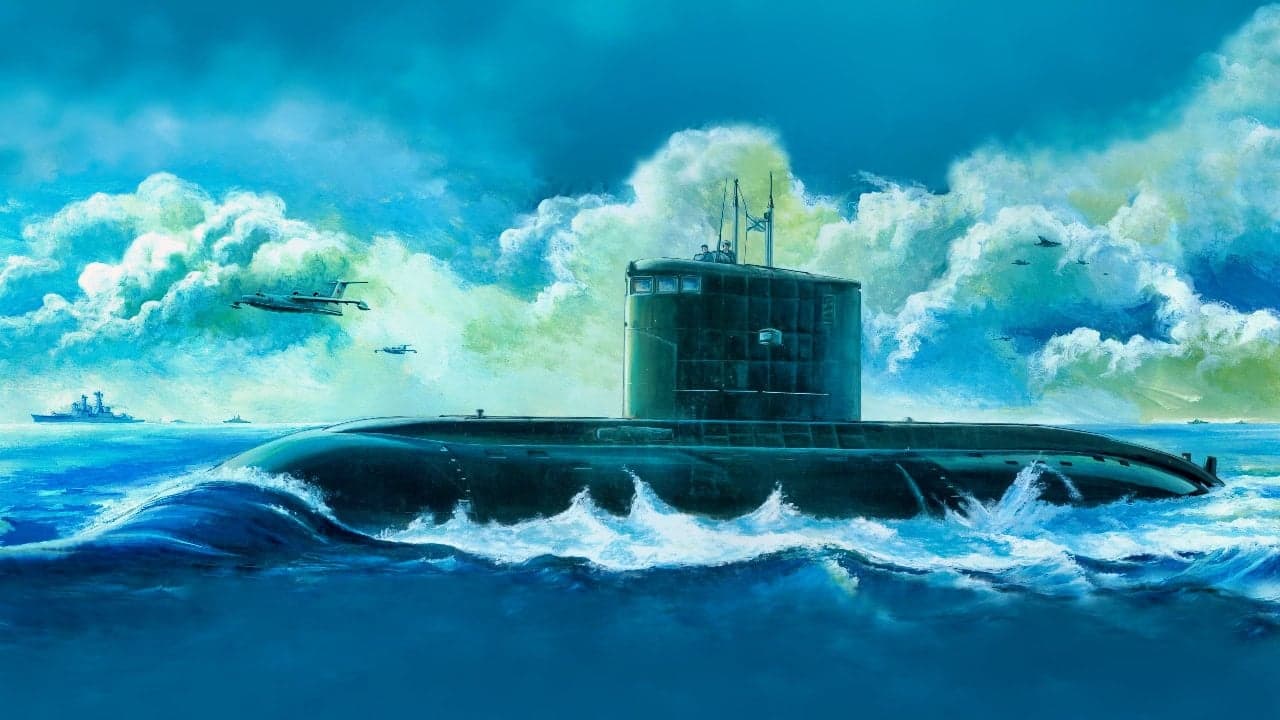
This past summer, satellite imagery revealed a scene that stunned the global naval community: inside the port of Novorossiysk, Russia was welding steel mesh cages onto the conning towers of its Black Sea Fleet's Kilo-class submarines, attempting to shield periscopes, communication masts, and hatches from Ukrainian drone attacks.
At the outset of the war, Ukraine's entire naval inventory amounted to a single frigate — one it scuttled itself to prevent capture. Yet since then, this nominally navy-less country has sunk or seriously damaged roughly one-third of Russia's Black Sea Fleet, driven the surviving vessels out of Crimea, and fundamentally rewritten the definition of modern sea power — using tools that cost less than a single torpedo the enemy once fired at it.
UK MoD Confirms: Russian Submarines Now Fitted with Anti-Drone Cages
On July 3, the UK Ministry of Defence officially confirmed intelligence first revealed by satellite imagery in early June: Russia's Black Sea Fleet has begun installing anti-drone mesh cages on Kilo-class submarines berthed at Novorossiysk, with three of the four active submarines already fitted. The cages are designed to protect periscopes, communication masts, and hatches while minimizing any impact on the submarines' underwater stealth capability.
It is a small, improvised, yet profoundly significant measure: one of the world's most historically storied navies now has to weld iron cages around its submarines in its own home port just to keep them safe at the pier. This is not merely one fleet's predicament — it is a symptom of a far deeper transformation.
An Unprecedented Combat Record
Ukraine's maritime achievements have virtually no parallel in modern military history. According to Ukraine's Ministry of Defence, roughly one-third of Russia's Black Sea Fleet has been destroyed or severely damaged. As early as March 2024, the UK MoD assessed the fleet to be "not operationally effective."
In October 2023, Russian forces were compelled to abandon their historic home port of Sevastopol and retreat more than 200 miles east to Novorossiysk. Yet even that proved no safe haven:
- March: A strike involving more than 200 drones reportedly sank a minesweeper and damaged two anti-submarine vessels.
- April: Ukrainian forces attacked the frigates Admiral Alexander Alexandrovich Otzen and Admiral Makarov — the two largest surface combatants Russia had left in the Black Sea following the sinking of the cruiser Moskva in 2022.
- December: A Ukrainian uncrewed underwater vehicle struck a submarine inside port — assessed as the first recorded instance of an unmanned underwater vehicle killing a submarine in harbor.
Perhaps most remarkably, Ukraine's Magura maritime drone downed a Russian helicopter and subsequently two Su-30 fighter jets — the first confirmed instances in naval history of fixed-wing aircraft being shot down by surface-launched missiles fired from an unmanned surface vessel.
The Arithmetic That Upends 400 Years of Naval Logic
What makes this campaign a "revolution" rather than a streak of Russian misfortune is a brutal equation.
A Ukrainian maritime drone costs a few hundred thousand dollars — less than a single modern torpedo — yet these drones have sunk warships worth tens of millions and driven a fleet built across generations into hiding. For four centuries, sea power has meant expensive, large vessels and hundreds of sailors; the entire investment logic rested on the assumption that cheap weapons could not threaten a fleet at scale. Ukraine has shattered that assumption in plain sight.
It has achieved sea denial — making a body of water too dangerous for an adversary's fleet to use — without a fleet of its own, relying instead on disposable unmanned machines that can be manufactured in clandestine workshops faster than the enemy can sink them.
A Wake-Up Call for Navies Worldwide
This is precisely why navies around the world are studying the Black Sea campaign with unprecedented intensity. The Pentagon, focused on a potential conflict with China, plans to deploy thousands of small unmanned surface vessels in the Indo-Pacific by the end of the decade. In June, U.S. special operations forces exercising near the Philippines used Ukrainian-built Magura drones to sink a target vessel — the first operational use of this technology in the Pacific theater.
The lesson strikes at the most expensive naval assets: if a drone worth a few hundred thousand dollars can threaten a frigate, the same logic imperils a $10 billion aircraft carrier. This reinforces every warning about insufficient U.S. shipbuilding capacity, the vulnerability of fixed bases, and the fragility of large platforms in the Pacific — anxieties that recur in virtually every war-game scenario involving the Taiwan Strait.
NATO has already begun exercising Ukrainian tactics, and Ukrainian unmanned surface vessel operators outperformed Alliance counterparts across multiple scenarios during a naval exercise in Portugal last year. The country without a navy has become the world's foremost naval instructor.
The Revolution Is Not Over: Russia Adapts
Yet this story is not finished, nor is it as one-sided as a highlights reel suggests. Russia is adapting seriously. The UK MoD assesses that the Russian Navy is simultaneously developing its own offensive drone capabilities and counter-drone defenses; Russian forces have hardened port defenses and begun deploying helicopter-borne FPV drones to hunt Ukrainian maritime drones. The submarine cages are simply the most visible element of a broader defensive effort.
The pace of this contest is unforgiving. Analysts describe innovation cycles measured in months: a weapon that dominates today may be countered within a quarter. Ukraine's advantage is a lead that must be actively defended, not a permanent winning formula.
The drones themselves carry real limitations: they are susceptible to electronic jamming, they perform poorly in rough weather, and many are shot down before reaching their targets. A fleet that remains at high alert, dispersed, and well-defended is far harder to strike than the unwary, harbor-anchored force Ukraine caught off guard in 2023.
Furthermore, Ukraine's overall achievement rests heavily on Western technical support. When Russia reportedly attempted to build its own maritime drone offensive, it was set back after SpaceX revoked its Starlink access — a reminder of just how much this revolution depends on a satellite network controlled by a single private company.
The Direction Is Unmistakable
Adaptation is not escape, and the direction of travel is beyond dispute. Every Russian countermeasure — the eastward retreat, the hardened ports, the helicopter patrols, the submarine cages — is an acknowledgment that cheap machines have changed the rules, forcing a major naval power to spend time and money defending against vessels that cost a fraction of its own warships.
That is the image worth remembering: not merely Ukraine's victories, but a Russian admiral in Novorossiysk deliberating over which submarine gets its cage first. Every navy that still measures power in large, expensive hulls is quietly doing the same arithmetic right now — and hoping the answer works out differently for them than it has for Russia.
Harry J. Kazianis (@Grecianformula) is the former Senior Director of National Security Affairs at the Center for the National Interest (CFTNI), the Washington foreign-policy think tank founded by President Richard Nixon. He has over a decade of experience in think-tank and national-security publishing, with work appearing in The New York Times, The Washington Post, The Wall Street Journal, CNN, and other major global outlets. He has held positions at CSIS, The Heritage Foundation, and the University of Nottingham, and has served as Executive Editor of both The National Interest and The Diplomat. He holds a Master's degree in International Affairs from Harvard University.
原文來源: 查看原文
FAQ
Reviewed and published by the LAETimes editorial desk ·