Inspired by Tinker Bell and Mew, a Floating Robot Redefines Home Companionship
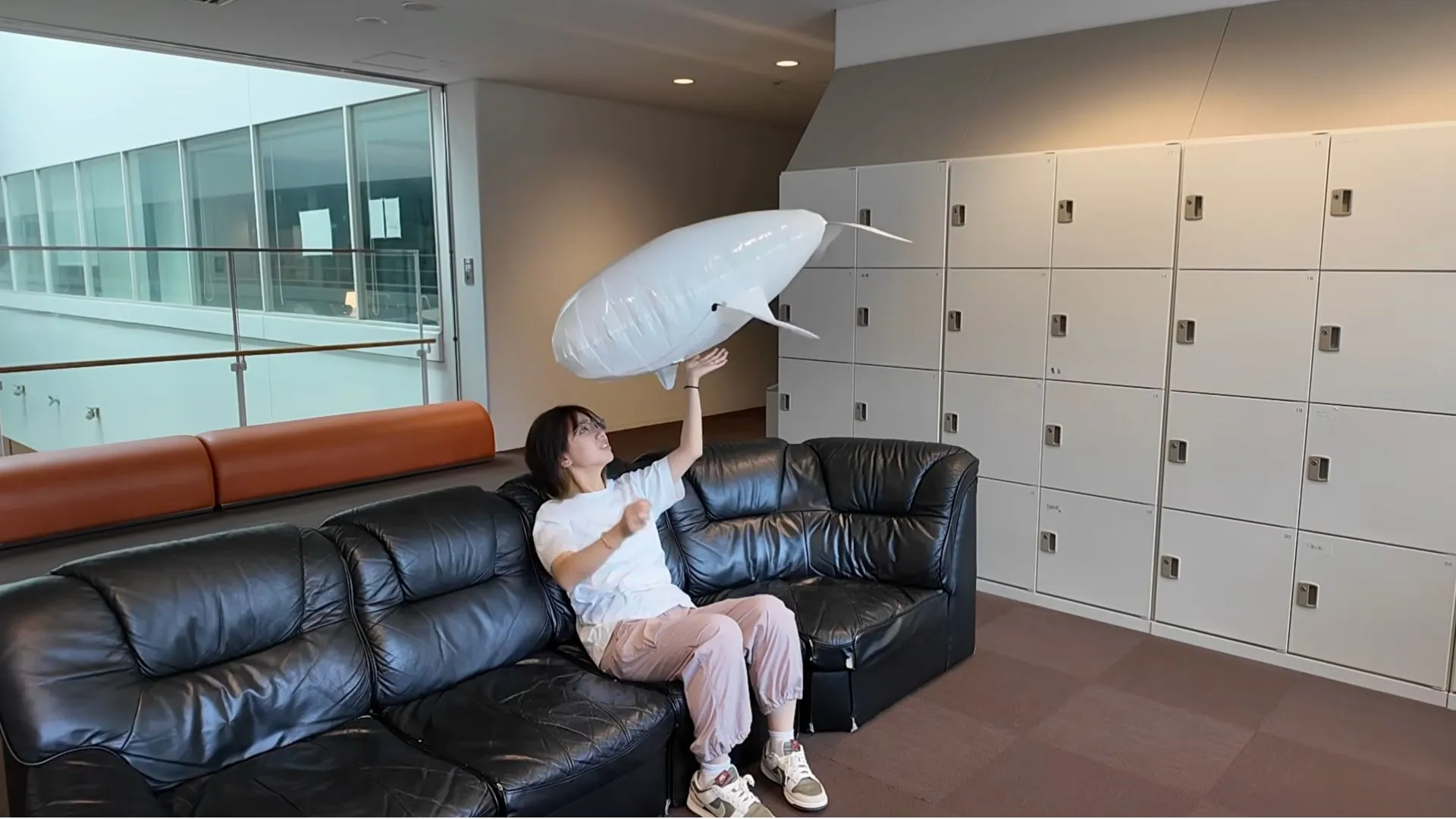
Researchers from Keio University and MIT Media Lab have developed a soft floating robot (SFR) shaped like a miniature beluga whale, inspired by Tinker Bell, Pokémon's Mew, and Studio Ghibli's Soot Sprites. Powered by helium buoyancy and propelled by flapping fins, the near-silent companion robot can perform daily tasks such as wake-up reminders and study companionship. The team also established what they call the first systematic interaction design framework for soft floating robots.
Highlights
- Keio University and MIT Media Lab jointly developed a Soft Floating Robot (SFR) shaped like a miniature beluga whale, inspired by Tinker Bell, Pokémon's Mew, and Studio Ghibli's Soot Sprites.
- The SFR uses a helium envelope for buoyancy and soft flapping fins for propulsion, enabling near-silent operation and eliminating the rotor noise and downwash of conventional drones.
- The robot can perform daily home tasks including wake-up alerts, study companionship, and playful interaction, and is designed to integrate naturally into indoor spaces.
- The research team established what they describe as the first systematic interaction design framework for SFRs, defining 10 key design dimensions based on input from 12 experts.
- Helium provides approximately 1 gram of lift per liter, making payload capacity a critical engineering constraint that the team addresses through ultra-lightweight components and offloaded computation.
Japanese researchers have developed a near-silent floating companion robot that glides gracefully through the air like an animated creature — rather than rolling across the floor or buzzing like a drone.
The project was led by a team at Keio University in Tokyo, in collaboration with MIT Media Lab and other institutions. The researchers designed the lighter-than-air prototype with the goal of making it feel approachable, safe, and comfortable in human environments.
The soft robot's design draws inspiration from Tinker Bell, Pokémon's Mew, and the Soot Sprites from Studio Ghibli's My Neighbor Totoro — taking the physical form of a miniature beluga whale drifting gently through indoor spaces.
The researchers believe the design could open a new frontier for more natural, emotionally resonant human-robot interaction in everyday home life.
A Near-Silent Floating Robot
The research team introduced a comprehensive design framework for a new class of Soft Floating Robots (SFRs), combining helium buoyancy, soft inflatable bodies, and biomimetic motion to create quieter, safer, and more natural indoor companion robots.
Unlike conventional drones that rely on spinning rotors for lift, the SFR uses a helium-filled envelope to stay airborne — with buoyancy carrying the vast majority of its weight and the propulsion system responsible only for movement and steering. This approach yields lower energy consumption, extended hover times, and near-silent operation, entirely eliminating the disruptive rotor noise and strong downwash associated with multirotor drones.
The team's prototype resembles a small floating beluga whale, gliding through the air using soft flapping fins rather than exposed propellers. Its smooth, rhythmic motion makes it appear more like a living creature than a machine. In demonstration footage, the floating companion performs a range of everyday tasks, including waking users up, sending reminders, accompanying them during study sessions, moving in response to music, and providing playful interactions. Rather than replacing a smartphone or smart speaker, it is designed to be a friendly physical presence that integrates naturally into the home environment.
Beyond building a single prototype, the researchers developed what they describe as the "first systematic interaction design framework for soft floating robots." The framework was built on input from 12 experts across robotics, human-computer interaction, and design, and defines ten key dimensions covering mobility, communication, appearance, motion, human-robot interaction, relational role, and degree of autonomy.
A Floating Aerial Companion
One of the robot's key advantages is its soft, helium-filled body. The lightweight, compliant structure makes accidental contact with people, pets, and furniture far safer than with a conventional drone. Rather than relying solely on collision avoidance, the researchers embrace what they call "safety through compliance" — enabling gentle interaction modes such as soft nudges, haptic reminders, and even hugs.
The buoyancy-based design also allows the robot to make full use of the underutilized three-dimensional space inside a home. It can float above furniture, navigate stairwells, and position itself at eye level, overhead, or near the floor — reaching areas inaccessible to wheeled robots while remaining far less intrusive than a traditional drone.
The prototype integrates a helium envelope, carbon-fiber-reinforced flapping fins, lightweight micro servo motors, a microcontroller, and a small lithium battery. Symmetric flapping generates forward thrust, while differential fin motion provides steering control, enabling smooth and quiet indoor flight.
Because helium provides only approximately 1 gram of lift per liter, payload capacity remains a key engineering challenge. To maximize performance, the researchers recommend using ultra-lightweight drone-grade electronics, offloading computationally intensive tasks to external systems, and minimizing onboard processing requirements.
The framework also accommodates multiple propulsion approaches, including flapping fins, fish-tail oscillation, jellyfish-inspired actuators, vectored thrust, and propeller-free ultrasonic micro-blowers. The researchers envision these floating robots taking on roles as emotional companions, ambient assistants, and household helpers — ushering in a new everyday frontier for human-robot interaction.
原文來源: 查看原文
FAQ
Newsletter
Subscribe to our Low-Altitude Industry Newsletter
Daily curated news on low-altitude economy and drone industry, delivered to your inbox.
Reviewed and published by the LAETimes editorial desk ·