France Integrates Low-Cost Laser-Guided Rockets on Rafale Fighter to Counter Drone Threats
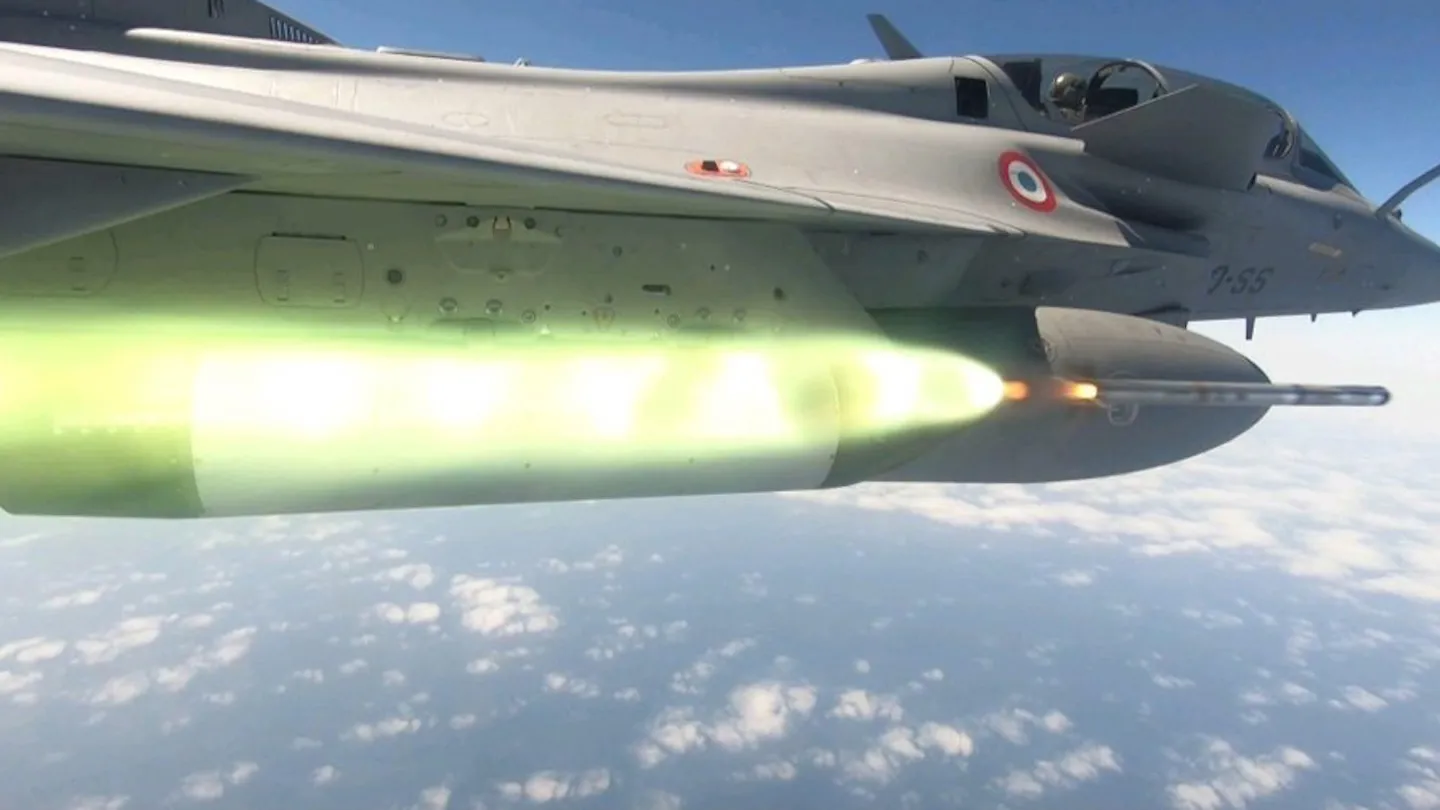
France's DGA has successfully integrated 68mm laser-guided rockets onto the Rafale fighter jet under the LADAC program, using Thales Telson JF12 pods carrying 12 rockets each. The system pairs with the Rafale's existing RBE2 radar and Talios targeting pod. Aimed at cost-effectively intercepting one-way attack drones such as Iran's Shahed series, the rockets cost tens of thousands of dollars compared to the roughly $2 million per-shot MICA missile, and full deployment to France's Rafale fleet is expected by end of this month.
Highlights
- France's DGA declared the LADAC program a success, completing live-fire integration of 68mm laser-guided rockets on the Rafale fighter jet, with full fleet deployment expected before the end of this month.
- The system uses Thales Telson JF12 pods (12 rockets each), paired with the Rafale's RBE2 radar and Talios targeting pod; the rocket is the Aculeus-LG with a stated range of 3.7 miles (6 km).
- A single French MICA missile costs approximately $2 million versus a Shahed drone's roughly $50,000 price tag, making laser-guided rockets — costing only tens of thousands of dollars — a far more cost-effective intercept option.
- LADAC was launched as an urgent requirement on 31 December, prompted by French Rafales expending dozens of MICA missiles defending UAE airspace during Operation Epic Fury in February.
- The UK Royal Air Force announced APKWS integration on its Typhoon fighters in May 2025, while US F-16s first used APKWS in combat against Houthi drones in 2024, reflecting a broader NATO trend toward low-cost counter-drone rockets on fighter aircraft.
France has completed live-fire testing of laser-guided rockets launched from the Rafale fighter jet, adding a low-cost counter-drone capability to its premier combat aircraft. Following the United States and United Kingdom, France's move reflects a defining trend in modern air warfare: air forces increasingly recognize the need for multi-layered, cost-effective intercept options rather than relying solely on expensive air-to-air missiles.
LADAC Program Declared a Success
France's Defence Procurement and Technology Agency (DGA) announced today the successful integration of 68mm laser-guided rockets onto the Rafale, with testing having begun in February of this year. The DGA stated that the integration effort was led by the French Air and Space Force's Military Aviation Proficiency Centre (CEAM), with technical support from Dassault Aviation and Thales. The program's official designation is Lutte anti-drone sur avion de combat (LADAC — Combat Aircraft Counter-Drone Capability).
LADAC initially targets France's Air Force and Navy Rafale fleets, but may eventually be offered to export customers of the Rafale and potentially extended to other aircraft types.
Using Million-Dollar Missiles Against Cheap Drones Is Unsustainable
In a parliamentary hearing last October, General Jérôme Bellanger, Chief of Staff of the French Air and Space Force, stated that it was essential to equip the Rafale and/or Mirage 2000D RMV with laser-guided rockets to counter long-range one-way attack drones such as Iran's Shahed-136 and Russia's Geran series.
"In airborne counter-drone operations, using a MICA air-to-air missile costing over one million euros to shoot down a drone worth a few thousand dollars is simply not sustainable," Bellanger said. "We must develop our own low-cost firing capability or improve the existing gun fire-control system."
The Chief of Staff hinted at the time that an off-the-shelf solution might be adopted, but France ultimately chose an approach based predominantly on domestic technology.
Technical Details: Rocket Pods Paired with Rafale's Existing Sensors
The system uses 68mm laser-guided rockets loaded into Thales Telson JF12 rocket pods, each holding 12 rounds. Once fired, the rockets work in conjunction with the Rafale's existing RBE2 radar (modified for this mission) and the Talios targeting pod (responsible for target tracking and laser designation).
The rocket itself is reported to be the Aculeus-LG, with an officially stated range of 3.7 miles (approximately 6 km).
The LADAC program was launched on 31 December last year as an urgent requirement. In late February, French Rafales were engaged in protecting UAE airspace from Iranian drone incursions during Operation Epic Fury, firing dozens of MICA IR/EM missiles within a matter of weeks. In April, the French parliament was informed that fitting Rafales with rocket pods was under study; that same month, unofficial imagery emerged showing a test Rafale departing Istres-Le Tubé Air Base (DGA's primary test facility) with a pair of JF12 pods under its wings.
According to the original schedule, LADAC capability was to be deployed by this summer — a target that is on track to be met, with full fielding across the French Air and Space Force Rafale fleet expected before the end of this month.
Gun-Based Counter-Drone Option Still Unconfirmed
It remains unclear whether the Rafale will also receive specific modifications to its onboard 30mm cannon for counter-drone missions, as Bellanger previously suggested. Such modifications would involve adjusting the gun's fire-control system to reduce the hazard posed by debris from destroyed drones. Using a cannon against small, slow, low-altitude targets carries significant risks for a high-performance fighter, including speed and engagement dynamics, collision risk, fragmentation and debris, and the potential for collateral damage on the ground.
US and UK Led the Way
The United States has been at the forefront of integrating laser-guided rockets on fighter aircraft for counter-drone missions. The air-to-air variant of the 70mm laser-guided APKWS (Advanced Precision Kill Weapon System) has been certified for use on the US Air Force's F-15E Strike Eagle, F-16C, and A-10, with the US Navy's F/A-18E/F Super Hornet also slated to follow.
In 2019, The War Zone (TWZ) first reported on the US Air Force's exploration of APKWS for air-to-air counter-drone use; in 2024, US F-16s used rockets to shoot down Houthi-launched drones in combat for the first time, again broken by TWZ. Subsequently, F-15Es and F-16s have used rockets on multiple occasions against Iranian drone and missile threats, playing a key role in defending Israel — including instances where missile stocks ran dry, underscoring the necessity of laser-guided rockets.
The UK Royal Air Force announced in May of this year that its Typhoon fighters had been equipped with APKWS, "significantly enhancing capability against emerging threats in Middle East operations."
Cost-Effectiveness: Low-Cost Answers to High-Volume Threats
Laser-guided rockets offer several advantages over conventional air-to-air missiles for counter-drone missions. Their flight performance is particularly well-suited to intercepting steady, low-performance targets — including drones and subsonic cruise missiles. Each pod can carry multiple rockets, dramatically improving magazine depth compared to a conventional missile, where the same hardpoint typically carries only a single round.
Most critically, the cost differential is stark: France's MICA missile costs approximately $2 million per shot, well above the roughly $1 million per-round price of the latest AIM-120 AMRAAM, while a single Shahed drone costs around $50,000. The cost of the Aculeus-LG rocket has not been officially disclosed, but is expected to be comparable to the APKWS — whose laser guidance kit runs approximately $15,000–$20,000, with rocket motor and warhead bringing the total to just tens of thousands of dollars per round.
Export Potential and Possible Ukrainian Application
France's Rafale fleet will almost certainly not be the only one to receive this weapon. The Middle East already hosts a large number of Rafale operators — Qatar has already fielded the type, and the UAE is set to take delivery shortly. Moreover, since these rockets were previously considered for the Mirage 2000, Ukraine's Mirage fleet could also become an integration candidate; Ukraine's Air Force already operates APKWS on its F-16s.
As saturation attacks by one-way drones and cruise missiles become a norm in future conflicts, low-cost laser-guided rockets are set to become standard equipment on modern combat aircraft.
原文來源: 查看原文
FAQ
Reviewed and published by the LAETimes editorial desk ·