Historic First: Ukraine Conducts World's First Fully Autonomous Amphibious Assault at Kinburn Spit
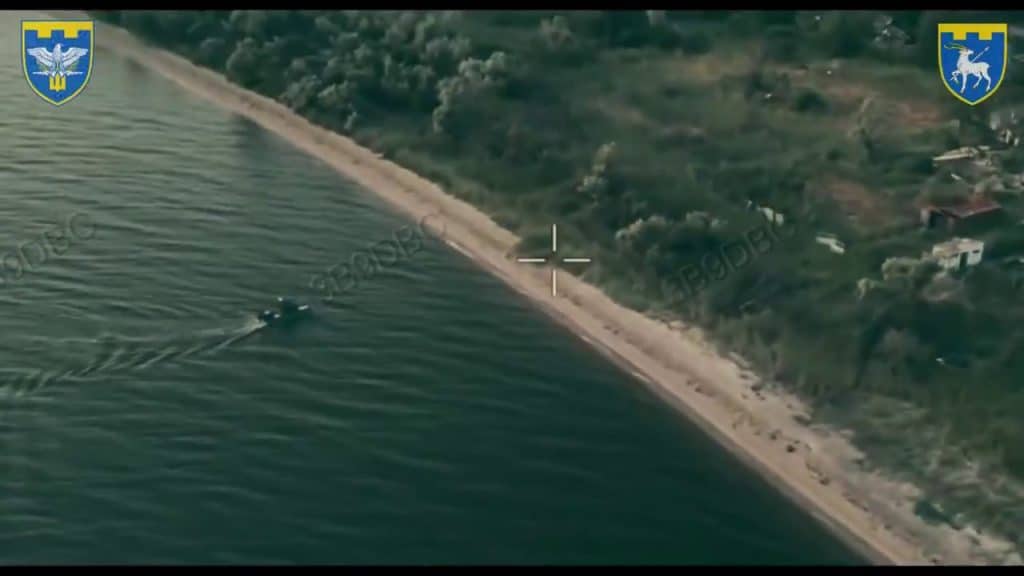
Ukrainian forces from the 123rd Territorial Defense Brigade reportedly executed the world's first fully unmanned amphibious assault on Russian positions at Kinburn Spit, coordinating unmanned surface vehicles (USVs), unmanned ground vehicles (UGVs), and UAVs across sea, land, and air domains. The operation featured a Rys UGV — developed by Ukrainian firm Roboneers and armed with a 7.62mm PKT machine gun — delivered ashore by USV while UAVs provided aerial observation throughout.
Highlights
- Ukraine's 123rd Territorial Defense Brigade conducted what is believed to be the world's first fully autonomous amphibious assault at Kinburn Spit, integrating USV, UGV, and UAV systems across sea, land, and air.
- A Rys UGV developed by Ukrainian firm Roboneers and armed with a 7.62mm PKT machine gun was delivered ashore by USV and engaged Russian positions before the USV withdrew.
- Ukrainian guerrilla network ATESH reported that Russia's 337th Regiment has retreated from the northern and western portions of Kinburn Spit due to a complete breakdown in food, ammunition, and fuel supply.
- Ukrainian forces planted a flag on Kinburn Spit on June 25, and sustained drone strike campaigns have been targeting Russian logistics routes between Mariupol and Crimea.
- Analysts note this operation may signal a new doctrine in which unmanned systems conduct reconnaissance and assault phases to prepare the way for conventional amphibious follow-on forces.
Ukraine Conducts World's First Fully Autonomous Amphibious Assault at Kinburn Spit
Ukrainian armed forces have reportedly launched a landmark amphibious assault against Russian-held positions on the Kinburn Spit, executed entirely by unmanned systems operating across sea, land, and air domains. The operation is believed to mark the first fully autonomous amphibious assault carried out under real combat conditions in military history.
Operational Details
The mission was reportedly conducted by Ukraine's 123rd Territorial Defense Brigade. An unmanned surface vessel (USV) transported an unmanned ground vehicle (UGV) to the beaches of Kinburn Spit, where the UGV disembarked and reportedly engaged enemy positions further along the coastline. The operational results of the assault have not been officially disclosed.
The entire operation was recorded by a UAV flying overhead. Footage shows the USV delivering a UGV — very likely the Rys UGV developed by Ukrainian company Roboneers, armed with a 7.62mm PKT machine gun. Once the USV's ramp dropped, the UGV rolled ashore and quickly moved into nearby vegetation for cover while the USV withdrew.
Subsequent footage shows the UGV deployed at the water's edge, firing on distant targets. At least three shots were fired: two landed in the sand short of the target, and the final round — apparently a tracer — followed a curved trajectory, suggesting the UGV was engaging at or near its maximum effective range, which may account for the limited accuracy observed.
No footage has emerged showing the UGV being recovered by the USV, though the absence of such imagery does not confirm it was abandoned. It also remains unclear whether Russian troops were present at the targeted positions at the time, or whether the assault was primarily a proof-of-concept demonstration intended to pave the way for future operations.
Background: Escalating Tensions at Kinburn Spit
This operation appears to represent the first instance in military history of unmanned systems conducting a fully integrated amphibious assault across all three domains under wartime conditions — sea for transport, land for assault, and air for observation and surveillance.
Tensions around Kinburn Spit, located in southern Ukraine, have been escalating in recent weeks. Russian military bloggers have predicted that Ukrainian amphibious operations are imminent, citing deteriorating Russian logistics in the area. Ukrainian forces had previously planted a Ukrainian flag on Kinburn Spit on June 25, likely using drones. Footage has also documented airstrikes on Kinburn Spit, indicating sustained Ukrainian pressure on Russian positions.
Russian Logistics Collapse
Ukraine's medium-range drone strike campaign in recent weeks has systematically targeted Russian supply lines across southern Ukraine and Crimea, focusing on trucks traveling between Mariupol and Crimea and severely degrading fuel and ammunition resupply capabilities.
Ukrainian guerrilla network ATESH recently reported that Russian troops garrisoning Kinburn Spit have been withdrawing due to a complete breakdown in supply lines. According to ATESH, Russia's 337th Regiment has retreated from the northern and western portions of Kinburn Spit after running out of food, ammunition, and fuel. If accurate, this would leave Kinburn Spit highly vulnerable to a Ukrainian amphibious incursion.
Footage shows the Rys UGV deployed near a village. While no precise geolocation has been provided, the terrain visible in the footage is consistent with the area west of Pokrovske, with the UGV's targets apparently located in the vicinity of "Pokrovsʹki Khutory."
Strategic Significance: A First Step Toward Retaking Kinburn Spit
The 123rd Territorial Defense Brigade's assault may be interpreted as a preliminary probe to assess the feasibility of recapturing Kinburn Spit. By deploying a UGV, Ukrainian forces were able to test Russian defensive strength while simultaneously applying pressure and attempting to suppress enemy positions. Seizing Kinburn Spit would carry significant strategic value for Ukraine — it would be a critical first step toward reopening the Dnipro River waterway and restoring sea access to the port of Mykolaiv.
Analysis: Implications for the Future of Amphibious Warfare
Ukraine's amphibious deployment of the Rys UGV may well signal the beginning of a new chapter in amphibious warfare doctrine. The emergence of unmanned combat systems — particularly the widespread use of USVs and FPV drones — has dramatically raised the risk calculus for conventional amphibious operations. Unmanned systems now allow defending forces to monitor and strike vast coastal areas without committing large numbers of troops.
USVs and FPV drones can intercept slow-moving amphibious landing craft both en route to designated landing zones and while staging offshore in support of the actual assault. Even if marines successfully establish a beachhead, they face relentless FPV drone attacks that steadily accumulate casualties and equipment losses.
Yet Ukraine appears to be demonstrating that unmanned combat systems can breathe new life into amphibious warfare — using these platforms to conduct reconnaissance, deliver assault fires, suppress known enemy positions, and establish an initial assault force that prepares the way for follow-on conventional amphibious landings.
This concept remains in active development. Whether it can be scaled up in future operations with larger numbers of simultaneously deployed UGVs remains to be seen. Given the strategic importance of Kinburn Spit and the reportedly weakened state of Russian forces in the area, the probability of continued amphibious operations at this location remains considerable.
Source: Naval News
原文來源: 查看原文
FAQ
Reviewed and published by the LAETimes editorial desk ·


