Russia's Iskander-M Missile Is Rewriting the Rules of Air-Defense Combat
Russia's Iskander-M short-range ballistic missile continues to penetrate advanced Western air-defense systems such as the Patriot through high-speed maneuvering, decoys, electronic jamming, and coordinated drone-swarm tactics. The Ukraine war has served as a live proving ground, accelerating software and guidance upgrades while forcing NATO to reassess its European missile-defense strategy.
Highlights
- Russia's Iskander-M SRBM, fielded since 2006, has a range of up to 500 km and can carry a 480–700 kg warhead, including nuclear options.
- The missile defeats advanced air-defense systems such as the Patriot and THAAD through terminal maneuvering, decoy dispensers, and onboard electronic countermeasures.
- Combat experience in Ukraine has driven continuous software and guidance upgrades to the Iskander-M, according to RUSI analysts.
- Coordinated drone-swarm tactics are used to exhaust defender interceptor stocks before Iskander-M strikes, compounding the challenge for NATO-supplied air-defense units.
- NATO Secretary General Mark Rutte stated that NATO's entire annual defense-industrial output equals only three months of Russian production, highlighting a critical replenishment gap.
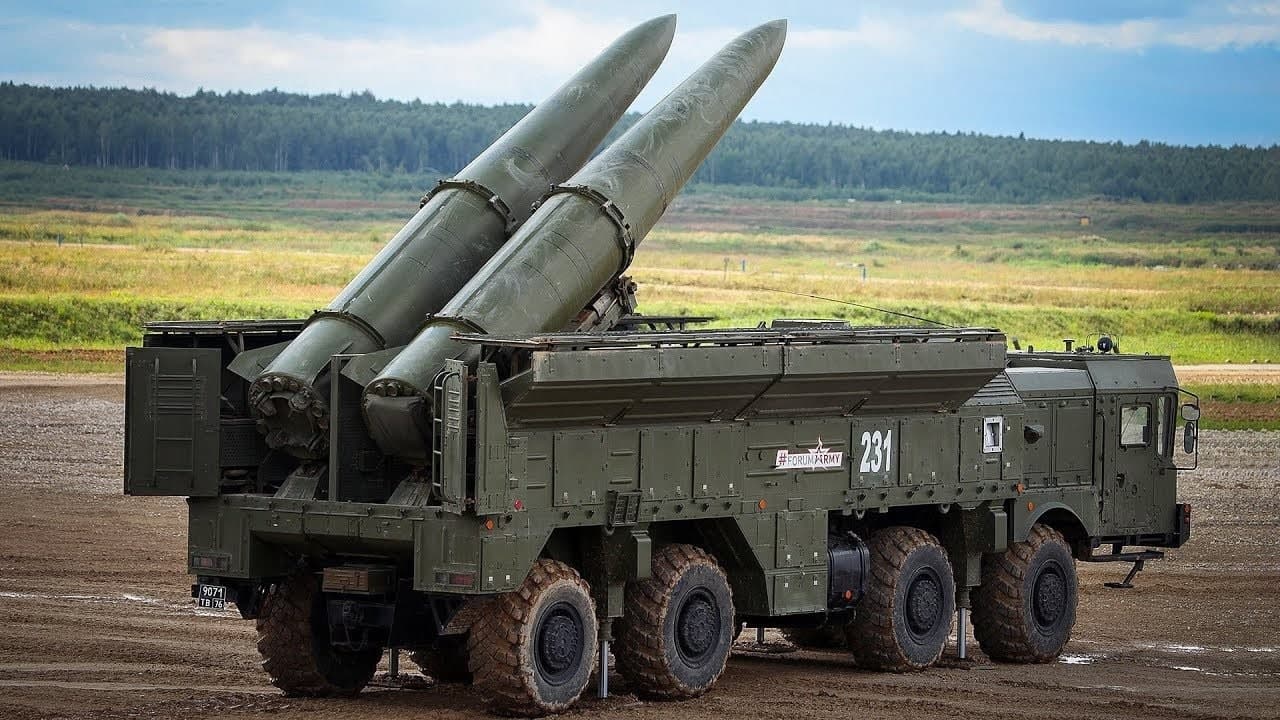
Russia's Iskander-M is a road-mobile short-range ballistic missile (SRBM) that entered service with the Russian military in 2006, replacing the Cold War-era OTR-23 Oka system.
The missile represents one of the flagship achievements of Russia's military modernization drive under President Vladimir Putin. It is mounted on a highly mobile transporter-erector-launcher (TEL) that typically carries two ready-to-fire rounds. Notably, the system is also capable of delivering nuclear warheads.
According to data from the Center for Strategic and International Studies (CSIS), the Iskander-M's key performance parameters are as follows:
- Range: Up to 500 km
- Warhead weight: 480–700 kg
- Propulsion: Solid-fuel rocket motor
- Launch preparation time: Only a few minutes
The system also employs a "shoot and scoot" tactic to evade enemy counter-battery fire.
How the Iskander-M Defeats Multiple Missile-Defense Systems
Unlike legacy Soviet systems, the Iskander-M's sophisticated design reflects the results of Putin's modernization agenda and underscores its strategic role in Russia's military posture.
The Iskander-M was engineered from the outset to penetrate NATO and Ukrainian defensive systems. After launch, the missile approaches its target on a depressed trajectory while executing violent mid-course maneuvers that radically alter its flight path to evade intercepts. It also dispenses decoys to complicate interception further.
On top of this, the missile carries advanced electronic countermeasures capable of jamming the guidance systems of interceptor missiles. Its extremely low radar cross-section means air-defense operators may miss the target entirely on radar or misidentify it as a non-threatening object.
Russian designers specifically incorporated penetration aids into the Iskander-M to defeat NATO's advanced defense architectures, including the Patriot, Terminal High Altitude Area Defense (THAAD), and the Aegis system.
Ukraine as a Live Proving Ground for the Iskander-M
Whatever one's assessment of Russia's overall battlefield performance in Ukraine, the protracted conflict has allowed Russian forces to refine systems such as the Iskander-M at a pace impossible to replicate in peacetime. Analysts at the Royal United Services Institute (RUSI) have noted that the extended war has produced not a single revolutionary upgrade but a continuous stream of software and guidance improvements driven by real-world combat data.
Perhaps most alarmingly, the Iskander-M has now demonstrably been integrated into coordinated drone-swarm operations. A tactic widely adopted by both sides is to dispatch large numbers of cheap drones to exhaust the enemy's finite air-defense resources, allowing higher-cost, higher-lethality missiles such as the Iskander-M to slip through the resulting gaps.
This is the iterative development process of warfare as the ultimate driver of weapons-system innovation.
Suppressing Enemy Air Defenses
Russia has assembled a comprehensive arsenal specifically designed to attrit Ukrainian air-defense assets. Through its alliance with Iran, Russia maintains a large and growing inventory of Shahed-derivative low-cost drones, while factories in Russia's Far East churn out cruise missiles at scale.
NATO Secretary General Mark Rutte stated publicly last year that the entire NATO defense-industrial base produces in one year what Russia's defense industry produces in three months.
Kalibr, Kh-101, Kinzhal, and Iskander-M together form an integrated, networked offensive architecture aimed at paralyzing command-and-control nodes while forcing defenders into impossible triage decisions over scarce Patriot interceptors. Even where individual missiles are not technically outstanding, combined-arms salvos can overwhelm existing defenses — Russian intelligence assessments indicate that NATO defensive assets are being consumed faster than they can be replenished.
Why NATO Fears the Iskander-M
Beyond its conventional role, the Iskander-M can carry nuclear warheads, and its range means it can strike deep into NATO's European member states. Poland, Lithuania, Latvia, Estonia, and most of Finland are within reach, while the deployment of Iskander-M systems in Kaliningrad puts even Germany inside its engagement envelope.
Should Moscow decide to escalate the conflict beyond Ukraine's borders — a possibility that Russian officials have recently threatened — the Iskander-M would play a central role in any escalation scenario involving NATO.
Key Takeaways
At the end of the Cold War, Western planners believed that steadily improving missile-defense capabilities would gradually neutralize the threat posed by short-range ballistic missiles. The war in Ukraine has proven that assumption untenable.
Russia has rapidly eroded the defensive effectiveness of advanced systems such as the Patriot through continuous software updates, improved terminal maneuvering, decoy proliferation, and combined-strike tactics — while the defensive side's sensors and tactics have also adapted in response.
As RUSI has observed, this is a long-term iterative competition rather than a permanent advantage for either side. For now, however, the Iskander-M's performance suggests Russia is adapting faster than NATO.
Combining precision strike capability, high mobility, strong survivability, and dual-capable conventional and nuclear warheads, the Iskander-M has cemented its reputation as a potent and highly adaptable weapons system.
Author: Brandon J. Weichert, Senior National Security Editor at 19FortyFive, and author of four bestselling national security books including Winning Space: How America Remains a Superpower and Prophecy of War.
原文來源: 查看原文
FAQ
Reviewed and published by the LAETimes editorial desk ·