Ancient 'Little Red Dots' May Be the Source of Mysterious High-Energy Neutrinos
Astrophysicists have identified a potential source for the high-energy neutrinos that have puzzled scientists since 2013: ancient cosmic objects known as 'little red dots,' observed by the James Webb Space Telescope. These early-universe structures, linked to quasars and supermassive black holes, may explain the mysterious particles continuously detected by the IceCube Observatory buried deep in Antarctic ice.
Highlights
- The IceCube Observatory in Antarctica has been detecting unexplained high-energy cosmic neutrinos continuously since 2013.
- New research suggests 'little red dots' — ancient objects observed by JWST and linked to early-universe supermassive black holes — may be the neutrino source.
- IceCube is the world's largest neutrino detector, with optical sensors buried 1.5–2.5 km beneath the Antarctic ice sheet.
- Quasars driven by supermassive black holes can accelerate particles to near-light speeds, making them prime candidates for high-energy neutrino production.
- Astronomers plan to combine further JWST deep-space observations with long-term IceCube data to resolve this nearly decade-old cosmic mystery.
For nearly a decade, astrophysicists have been tracking a steady stream of high-energy neutrinos raining down on Earth. Since 2013, the IceCube Observatory — a massive neutrino detector buried deep beneath the Antarctic ice sheet — has been capturing these enigmatic particles arriving from the far reaches of the universe.
Yet where exactly these high-energy neutrinos originate has remained one of astronomy's most enduring mysteries. New research now suggests the answer may lie in a class of ancient cosmic structures formed in the very early universe — objects scientists have dubbed 'little red dots.'
What Are 'Little Red Dots'?
'Little red dots' are distant objects observed by the James Webb Space Telescope (JWST). Their characteristic red appearance results from extreme redshift values, indicating that these objects are extraordinarily far away and existed during the earliest epochs of the universe.
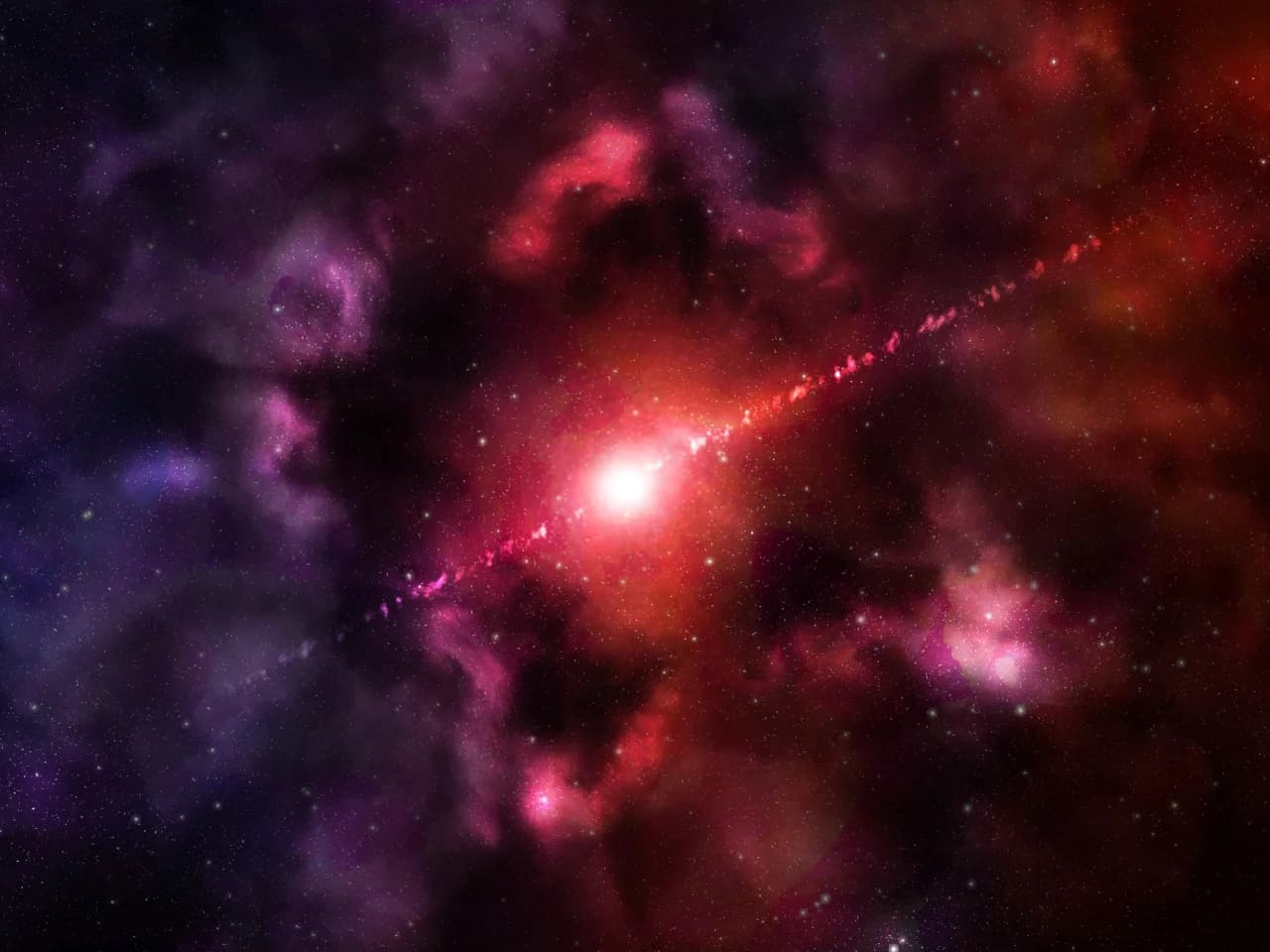
Scientists believe these objects may be closely associated with quasars and supermassive black holes — precisely the kind of extreme astrophysical environments capable of producing high-energy particles on a massive scale.
The Key Role of IceCube
The IceCube Observatory is currently the world's largest neutrino detector, comprising thousands of optical sensors embedded approximately 1.5 to 2.5 kilometres beneath the Antarctic ice. The detector works by capturing faint flashes of light produced when neutrinos occasionally interact with the surrounding ice as they pass through.
Since commencing full operations in 2013, IceCube has logged a substantial catalogue of high-energy cosmic neutrino events, providing scientists with invaluable observational data to help trace the cosmic origins of these particles.
How Black Holes and Quasars Accelerate Particles
Quasars are extraordinarily luminous galactic nuclei powered by supermassive black holes. Their immense gravitational fields and intense magnetic environments can accelerate particles to near-light speeds, launching them into space in powerful jets. In theory, such environments are prime candidates for generating high-energy neutrinos in large quantities.
If 'little red dots' are indeed connected to supermassive black hole activity in the early universe, there may be a direct causal link between these ancient structures and the mysterious neutrinos detected by IceCube.
Research is ongoing. Astronomers hope that continued deep-space observations with the James Webb Space Telescope, combined with the long-term accumulation of data from IceCube, will gradually unravel a cosmic puzzle that has challenged the scientific community for nearly ten years.
原文來源: 查看原文
FAQ
Reviewed and published by the LAETimes editorial desk ·


