Georgia Tech's 'Learn to Teach' Framework Enables Humanoid Robots to Navigate Sand, Gravel, and Slopes
Researchers at Georgia Tech have developed a machine learning framework called 'Learn to Teach' that allows humanoid robots to walk stably across complex terrains — including sand, gravel, wet grass, ramps, stairs, and slippery surfaces — while significantly reducing training time and computational costs. The findings were presented at the IEEE International Conference on Robotics and Automation (ICRA).
Highlights
- Georgia Tech's 'Learn to Teach' framework trains teacher and student AI models simultaneously, cutting humanoid robot controller training time and GPU costs compared to traditional sequential methods.
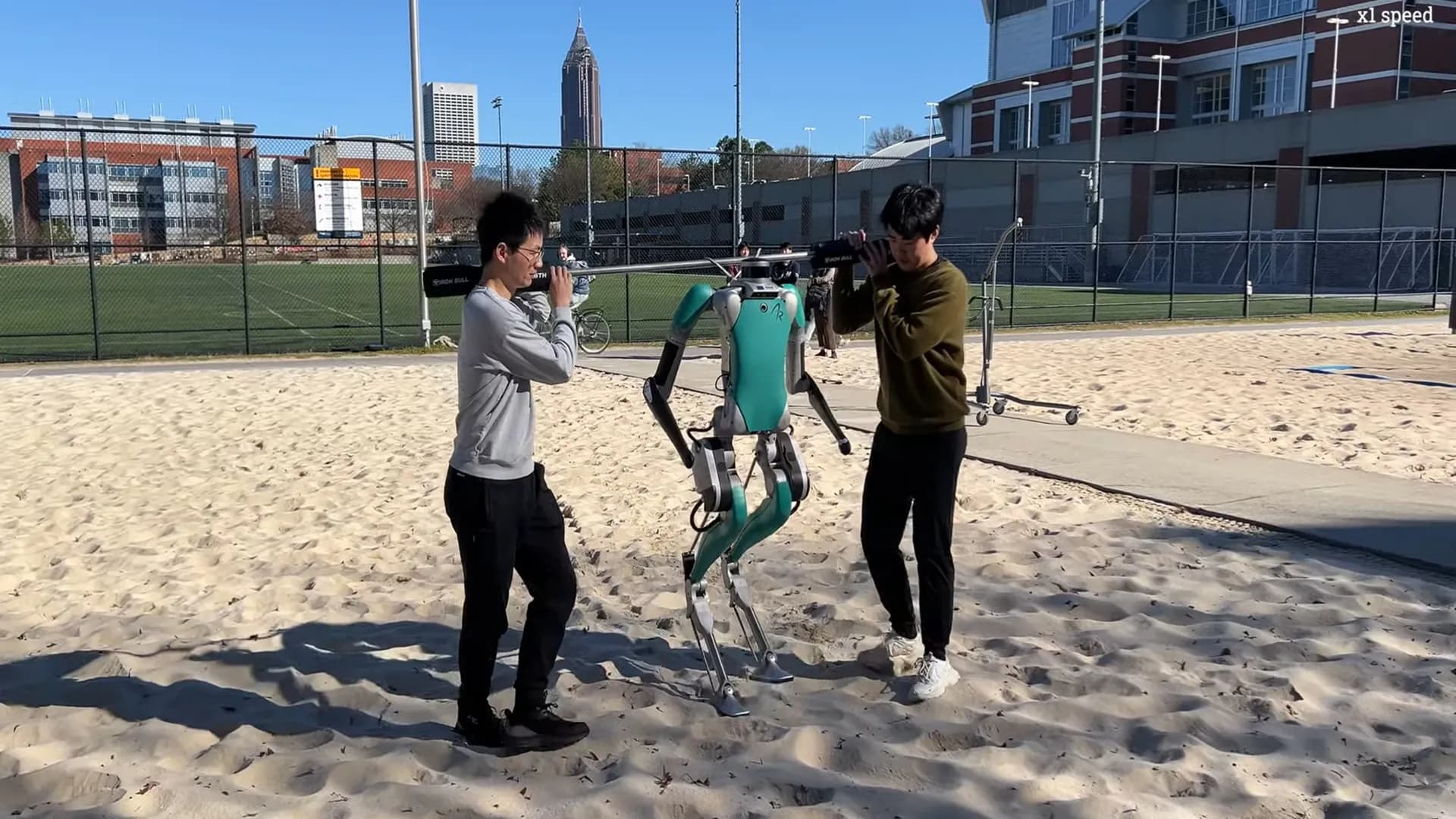
- The framework was tested on a full-size humanoid robot in Associate Professor Ye Zhao's lab, successfully navigating sand, gravel, wet grass, ramps, stairs, and slippery floors with a single controller.
- The new controller outperformed the humanoid robot manufacturer's original software in real-world terrain trials, according to Associate Professor Ye Zhao.
- The research addresses the teacher-student imitation gap by allowing the teacher model to learn from the student's real-world experiences, improving generalization to unseen environments.
- Findings were formally presented at the IEEE International Conference on Robotics and Automation (ICRA), with researchers noting the framework's potential for broader robotics applications beyond humanoid walking.
Georgia Tech Framework Helps Humanoid Robots Conquer Challenging Terrain
A research team at Georgia Institute of Technology has developed a new machine learning framework that enables humanoid robots to navigate a wide range of difficult terrains — including sand, gravel, wet grass, ramps, stairs, and smooth floors — while significantly cutting the time and computational resources required to train robot controllers.
The team named their approach 'Learn to Teach', an enhancement of the widely used teacher-student reinforcement learning model. By shifting from sequential to simultaneous teacher-student training, the framework produces controllers capable of handling previously unseen terrain with far fewer computing resources.
The Bottleneck of Traditional Teacher-Student Learning
Conventional teacher-student reinforcement learning requires building a 'teacher' model that fully learns from detailed simulation data before transferring that knowledge to a 'student' model controlling the physical robot. This sequential process has two key drawbacks.
Lead researcher Feiyang Wu explained: "There are two problems with this approach: sequential training takes a lot of time, and much of the information the teacher gathers during learning simply goes to waste." Training robot controllers through simulation can require hours of computation on expensive GPU hardware, making the process both time-consuming and costly.
Simultaneous Training: Learning and Teaching at the Same Time
The Georgia Tech team broke from convention by training the teacher and student models simultaneously. As the teacher gradually learns, it immediately passes that knowledge to the student, dramatically shortening the overall training timeline.
"You don't need to wait for the teacher to become an expert before it starts teaching the student," Wu said. "The teacher can pass along what it's learning in real time, step by step."
The team also enabled the teacher to learn in reverse from the student's real-world experiences, effectively narrowing what is known in robotics as the teacher-student imitation gap — the disparity between the situations a student encounters in real environments and the idealized simulations used to train the teacher.
Real-World Terrain Test Results
The new controller was deployed on a full-size humanoid robot in the lab of Associate Professor Ye Zhao, successfully traversing both rugged outdoor terrain and smooth indoor surfaces without requiring a controller swap between environments.
During testing, the team also applied external pushing and pulling forces to the robot, which adjusted its gait in real time to maintain stability. Wu admitted the results exceeded expectations: "For a large, tall humanoid robot, agile locomotion across such harsh terrain had never been demonstrated before. But our efficient training approach proved adaptable to a wide variety of terrains and environments."
Associate Professor Zhao added that the controller even outperformed the software provided by the robot's original manufacturer, underscoring the value of combining machine learning research with real-world robotics applications.
Looking Ahead
The research was officially presented at the IEEE International Conference on Robotics and Automation (ICRA). The researchers noted that the 'Learn to Teach' framework is not limited to humanoid walking — it has potential applications across other robot designs and any task requiring reliable movement in unpredictable environments, opening new possibilities for controller development across the broader robotics industry.
原文來源: 查看原文
FAQ
Newsletter
Subscribe to our Low-Altitude Industry Newsletter
Daily curated news on low-altitude economy and drone industry, delivered to your inbox.
Reviewed and published by the LAETimes editorial desk ·