'Phantom Twist': US Team Designs High-Speed Spinning, Near-Invisible Drone
Northwestern University has developed a low-visibility drone called 'Phantom Twist' that spins its entire airframe up to 25 times per second, creating a motion-blur effect that blends the craft into its surroundings. In tests, the design proved 10 times harder to spot visually than a conventional quadrotor. The research was presented at the Robotics: Science and Systems 2026 conference in Sydney, Australia.
Highlights
- Northwestern University's Phantom Twist drone spins its entire airframe at up to 25 revolutions per second, creating a motion-blur halo effect that makes it visually blend into its surroundings.
- In testing, Phantom Twist was 10 times harder to visually detect than a conventional quadrotor drone.
- An AI design pipeline evaluated 20,000 structural configurations across 100 simulated real-world backgrounds, using a human-vision-based scoring metric to minimize detectability.
- Target applications include wildlife ecological surveys and industrial infrastructure inspection, where drone disturbance to animals or personnel is a concern.
- The research was formally presented at the Robotics: Science and Systems (RSS) 2026 international conference in Sydney, Australia.
Northwestern University Develops 'Phantom Twist' Low-Visibility Drone
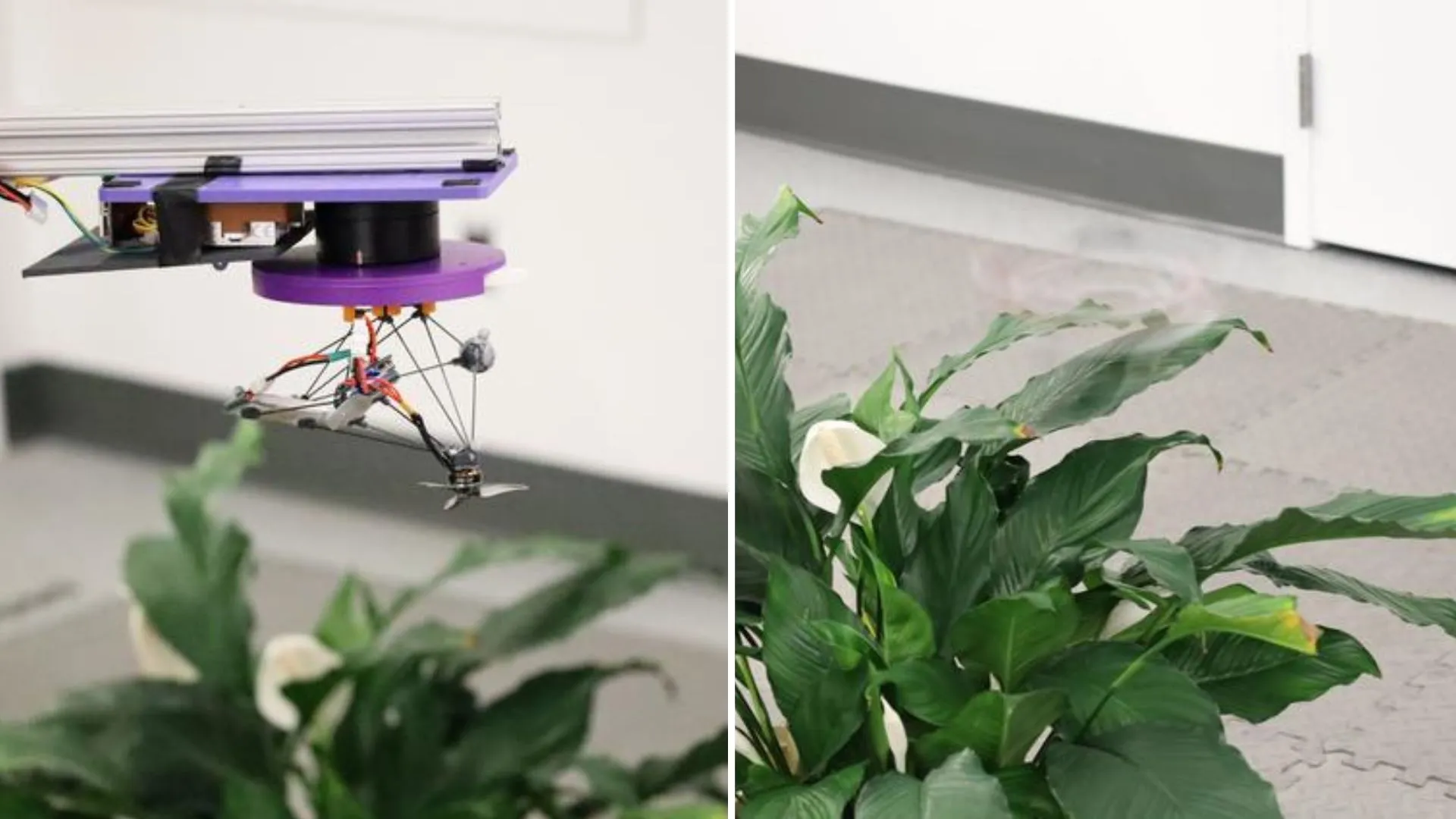
Researchers at Northwestern University have developed a low-visibility drone called Phantom Twist that spins its entire airframe at up to 25 revolutions per second, generating a motion-blur effect that causes the craft to effectively 'vanish' from sight.
Importantly, the effect does not achieve full invisibility. Instead, it transforms the drone into a hazy, semi-transparent halo that blends naturally with the surrounding environment.
"Most research on making drones inconspicuous focuses on making them look like their surroundings," said Michael Rubenstein, the lead researcher on the project. "We asked whether we could redesign the drone itself based on how humans perceive motion. Using continuous movement to reduce visibility is a concept that has rarely been explored."
Hiding in Plain Sight
The mere presence of a conventional drone is often enough to disturb wildlife behavior and disrupt everyday human activities.
Scientists have tried various approaches — from high-tech light-refracting optics to transparent plastics and realistic camouflage paint — but the Northwestern robotics team chose a different angle: rather than trying to hide the drone, they set out to change how people see it.
The core of the research lies in redesigning the drone's physical form to alter visual perception. The conventional static-body quadrotor configuration was replaced with a single-motor system in which the propellers and the entire airframe rotate in opposite directions, minimizing visual detectability.
A standard quadrotor is highly recognizable because its bulky central body remains completely stationary while only the rotors spin. Phantom Twist draws inspiration from a rapidly spinning ceiling fan: the entire structural body rotates along with the mechanism, blurring the airframe visually into a semi-transparent disc.
Computer vision expert and co-author Emma Alexander explained that the human eye operates much like a camera.
"The eye needs time to accumulate light signals, similar to a camera's exposure time," Alexander said. "When an object rotates rapidly, we perceive a blurred afterimage and the object's sharp outline disappears. Because the new drone's airframe is almost entirely transparent, the small number of opaque components visually merge with the background, giving the overall craft a slightly hazy appearance."
AI Refines the Design
The development process was far from straightforward. Components cannot simply be mounted on a spinning rod and expected to fly; balancing the entire rotating structure is an enormous engineering challenge.
To overcome this, the team turned to artificial intelligence to assist with the design process.
The automated design pipeline first generated 20,000 mathematically stable structural configurations. An optimization algorithm then iteratively adjusted the positions of key components — including batteries, circuit boards, and counterweights — to ensure they would not visually overlap one another during rotation.
The AI subsequently tested these designs against 100 real-world background scenarios in simulation, evaluating them using a scoring metric modeled on human visual perception: the lower the score, the harder the drone is to detect.
According to the research results, the new design achieved a visibility level 10 times lower than that of a conventional quadrotor.
Potential Applications: Ecological Surveys and Industrial Inspection
Drones are already valuable tools for counting bird nests, mapping wetlands, and inspecting bridge cracks. However, the loud, buzzing mechanical presence of a drone often startles wildlife, altering their natural behavior. A drone that blends into the sky could conduct observations without disturbing animals.
Looking ahead, this class of drone holds promise for broad deployment in ecological surveys and industrial inspections.
The current prototype is not without limitations. The sound of the propellers remains clearly audible, and on close inspection, the faint outline of the carbon-fiber support arms can occasionally be discerned.
Nonetheless, the research team is already developing a next-generation model, with goals that include noise dampening and the use of fully transparent materials — bringing the drone closer to truly disappearing from view.
The research was officially presented at the Robotics: Science and Systems (RSS) 2026 conference held in Sydney, Australia.
原文來源: 查看原文
FAQ
Reviewed and published by the LAETimes editorial desk ·