South Korea Deploys Anti-Drone Netting During Recent Logistics Exercise
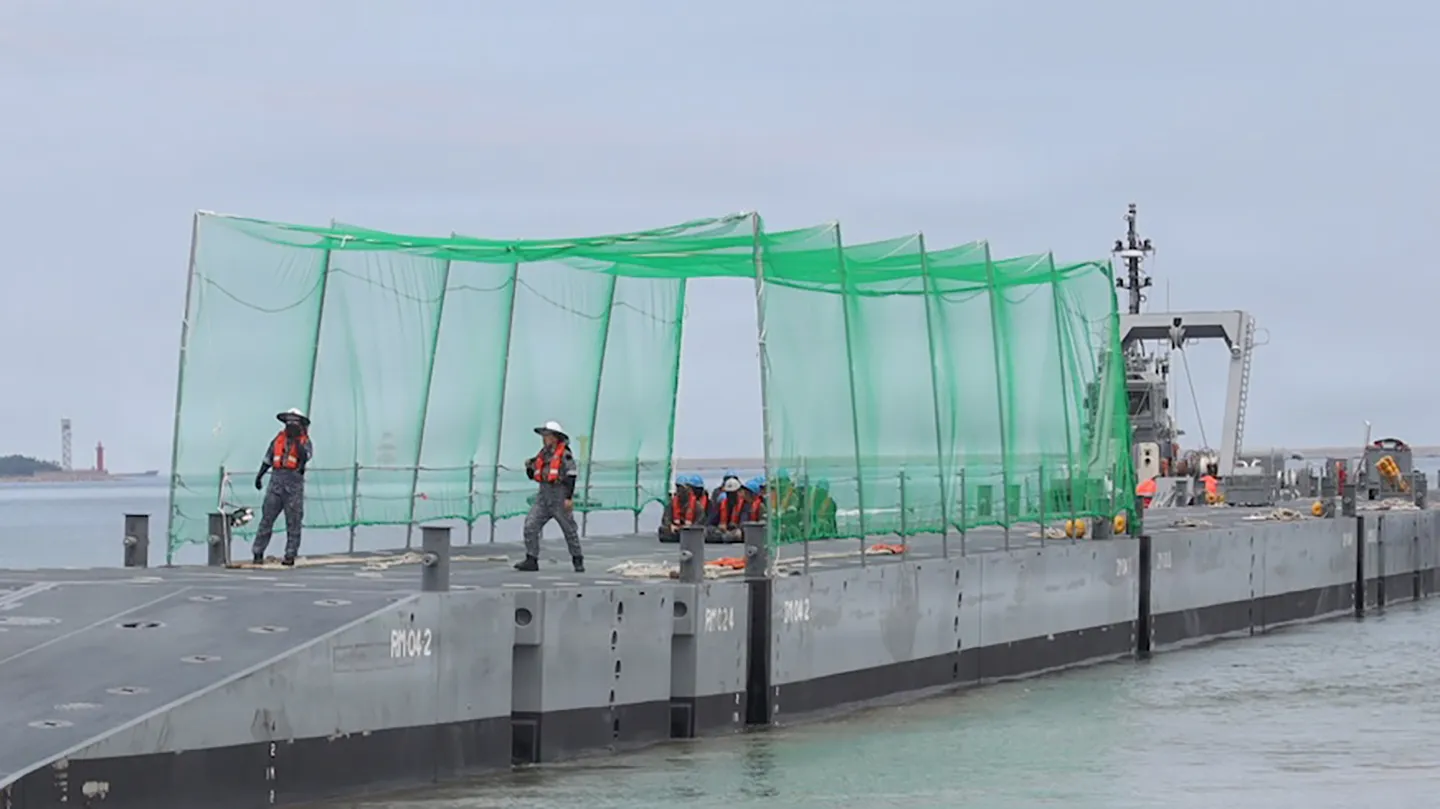
Photographs released from the Combined Joint Logistics Over-the-Shore 26 (CJLOTS 26) exercise at Dokok Beach, Pohang, South Korea on July 9, 2026, appear to show anti-drone netting installed on ship-to-shore floating platforms. The imagery aligns with a growing global military trend of using passive mesh barriers to counter small attack drones, seen previously in Ukraine, the Netherlands, Taiwan, and elsewhere.
Highlights
- Photographs taken on July 9, 2026 at Dokok Beach, Pohang, South Korea during CJLOTS 26 appear to show anti-drone netting installed on Improved Navy Lighterage System (INLS) floating platforms.
- U.S. Forces Korea / Combined Forces Command confirmed that CJLOTS 26 specifically incorporated enhanced protection measures against hostile drone attacks, reflecting evolving battlefield conditions.
- Pentagon task force JIATF 401, established in August 2025, has formally advocated for greater use of netting, cables, and passive physical barriers to protect critical infrastructure from drone threats.
- Anti-drone netting has been observed in at least six countries or conflict zones — Ukraine, South Korea, Taiwan, the Netherlands, Israel, and the United States — indicating a broad global adoption trend.
- III MEF noted post-publication that the INLS platform is ROK-owned and that U.S. Marines do not typically paint anti-drone netting in bright colors, leaving the structure's exact purpose unconfirmed.
South Korea Deploys Anti-Drone Netting During Recent Logistics Exercise
As the threat from small attack drones continues to proliferate, military forces worldwide have been adopting large-scale netting solutions at an accelerating pace — and that trend now appears to have reached the South Korean armed forces.
Suspected Netting Spotted at Exercise Site
Following a recent logistics training exercise in South Korea, photographs published on the Pentagon's imagery distribution platform appear to show anti-drone netting installed on ship-to-shore floating platforms used to transport cargo and personnel ashore. While alternative explanations cannot be entirely ruled out, the mesh structures closely resemble drone-defense installations documented in Ukraine, the Netherlands, and other locations.
The photographs were taken on July 9, 2026, at Dokok Beach in Pohang, South Korea, during the Combined Joint Logistics Over-the-Shore 26 (CJLOTS 26) exercise.
How the Netting Works — and Its Limitations
Anti-drone netting is designed to entangle drones in nylon or metal mesh, rendering them immobile, or to detonate them at a safe standoff distance before they can harm personnel.
However, the netting observed in this instance would offer limited protection against high-maneuverability FPV drones, as both ends of the platform remain open — though it may provide some defense against light munitions dropped by "bomber" drones. The netting also covers only a portion of the floating platform (presumably the cargo or vehicle staging area), leaving the remainder of the platform, the vessel itself, and the wheelhouse fully exposed.
About CJLOTS 26
CJLOTS 26 is designed to train U.S. Marine Corps and Republic of Korea (ROK) forces in delivering supplies from vessels anchored offshore to land without relying on existing port infrastructure such as piers.
The U.S. Marine Corps stated: "This offload is a maritime pre-positioning force exercise where the 3rd Marine Logistics Group (3rd MLG) distributes equipment from an established port of debarkation and supports III Marine Expeditionary Force units training throughout the Republic of Korea, while also testing and validating 3rd MLG's ability to execute integrated logistics operations in complex environments."
U.S. Forces Korea / Combined Forces Command also noted that the exercise specifically incorporated drone threats: "Reflecting the evolving nature of battlefield conditions, training also incorporated enhanced protection measures for logistics nodes against threats such as hostile drone attacks."
The Improved Navy Lighterage System (INLS)
The photographs show ROK personnel operating aboard the Improved Navy Lighterage System (INLS) — described by the U.S. Navy as a Sea State 3-capable causeway system resembling a floating pier composed of interchangeable modules. The INLS is used to transfer cargo from Military Sealift Command (MSC) vessels to shore when conventional port facilities are unavailable or insufficient.
The maneuver performed by the troops is known as "beach stabbing" — securing modules to the beach to allow vehicles and personnel to come ashore.
The Drone Threat to Logistics Operations
There is ample justification for incorporating counter-drone measures into logistics operations. The war in Ukraine has demonstrated that drone attacks have made front-line resupply missions extremely hazardous, driving increased use of ground robots for such tasks.
In a conflict scenario involving South Korea against China or North Korea, both nations possess substantial drone arsenals and the operational expertise to deploy them at scale. North Korea has also received Russian assistance with drone technology and gained real-world experience from the Ukrainian battlefield.
Amphibious operations are particularly vulnerable to short-range drone attacks. Approaching a contested beach from offshore in open water means commanders must assume their assets will face mass FPV and other short-range drone strikes.
U.S. Military Stance and Global Trends
A newly published handbook from the Pentagon's Joint Interagency Task Force 401 (JIATF 401) states: "Two proven methods to disrupt drones are altering their physical environment and disrupting their signals. Obstacles such as fencing, nets, or overhead structures can alter flight paths, block common approach routes, and force drones into visible or disadvantageous routes, while also degrading control links, GPS, or navigation timing."
JIATF 401 was established by the Pentagon last August to coordinate counter-drone efforts across all branches. In February of this year, the task force called for greater use of netting, cables, and other passive physical countermeasures to protect critical infrastructure.
Separately, the U.S. Air Force at Langley Air Force Base studied installing anti-drone netting to protect F-22 Raptor stealth fighters on the flight line — nearly a year after the base experienced a series of mysterious drone incursions.
Elsewhere, Taiwan is using anti-drone netting to protect air defense systems; Dutch forces employed anti-drone "net tunnels" similar to those used in Russia and Ukraine during last month's Fighter Lion exercise in Germany; and Israeli forces erected netting in Lebanon to defend against Hezbollah FPV drone attacks.
Whether the netting observed during South Korea's recent logistics exercise represents an emerging trend or a one-off experiment remains unclear. What is certain is that while netting is no silver bullet, it is increasingly regarded by militaries worldwide as an indispensable passive countermeasure.
Editor's note: This article was updated after publication. Following the initial release, III Marine Expeditionary Force (III MEF) responded to a pre-publication media query, clarifying that the platform is ROK-owned and noting that while it could not confirm the structure is anti-drone netting, the U.S. Marine Corps does not typically paint such devices in such bright colors.
原文來源: 查看原文
FAQ
Reviewed and published by the LAETimes editorial desk ·