Cyborg Cockroaches Go Amphibious: Researchers Develop Miniature Diving Suit for Bio-Hybrid Insects
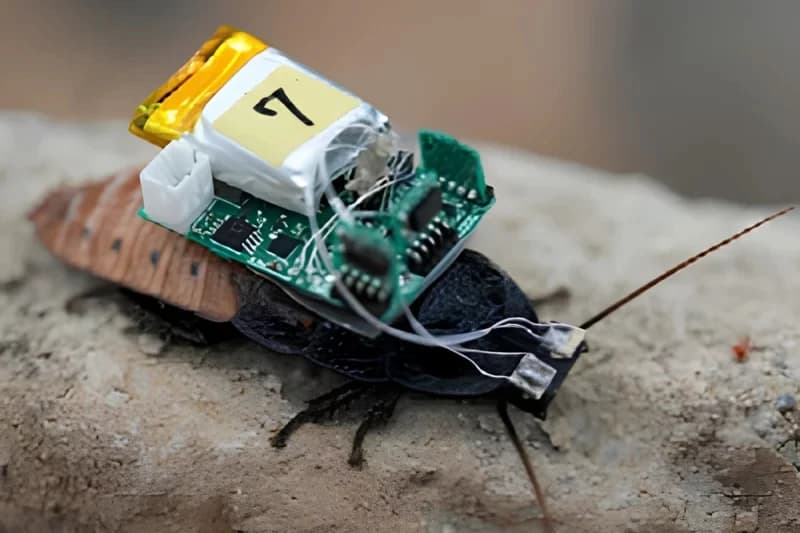
Scientists from Nanyang Technological University (NTU) in Singapore and Waseda University in Japan have developed a flexible miniature diving suit for cyborg cockroaches. Equipped with a micro oxygen generator, the suit allows the insects to survive underwater or in low-oxygen environments for up to three hours, opening potential applications in disaster search-and-rescue, environmental monitoring, and infrastructure inspection.
Highlights
- NTU Singapore and Waseda University Japan jointly developed a flexible miniature diving suit for cyborg cockroaches, published in a peer-reviewed academic journal.
- The suit's onboard micro oxygen generator enables the cockroach to survive underwater or in low-oxygen environments for up to three hours.
- The flexible material design allows full limb movement while maintaining a watertight seal, making the device practical for real-world deployment.
- Target applications include disaster search-and-rescue in flooded environments, environmental monitoring in confined waterways, and underwater infrastructure inspection.
- Both research teams are continuing to refine the technology for future use in emergency response and scientific exploration.
What could be more unsettling than a half-cockroach, half-robot cyborg creature? The answer is straightforward: a cyborg cockroach that can also breathe underwater. That is precisely what researchers have now created — though they prefer to frame the achievement not as terrifying, but as genuinely useful.
A Flexible Diving Suit for a Six-Legged Cyborg
Scientists from Nanyang Technological University (NTU) in Singapore and Waseda University in Japan have jointly engineered a soft, flexible miniature diving suit for cyborg cockroaches. The suit incorporates a micro oxygen generator capable of sustaining the insect in submerged or low-oxygen conditions for up to three hours.
From Unsettling to Useful
Research into cyborg insects is not new, but granting them amphibious capability represents a significant breakthrough. The research teams believe that remotely controlled insects able to operate both on land and underwater could prove valuable across a range of challenging scenarios, including:
- Disaster search-and-rescue: Navigating flooded or earthquake-hit environments to detect survivors
- Environmental monitoring: Accessing narrow or confined waterways that are unreachable by humans or conventional equipment
- Infrastructure inspection: Surveying underwater structures such as pipelines and drainage channels
Technical Highlights
The diving suit is fabricated from flexible materials, ensuring the cockroach retains full freedom of limb movement while maintaining a watertight seal. The onboard micro oxygen generator provides a continuous supply of oxygen — addressing the most critical survival challenge for any underwater operation.
The findings have been published in an academic journal, and both research teams are continuing to refine the technology with the goal of deploying it in real-world emergency response and scientific exploration contexts.
Fields covered: Robotics, Engineering
原文來源: 查看原文
FAQ
Reviewed and published by the LAETimes editorial desk ·