Cornell Undergraduates Win Farm Robotics Challenge with Electric Weeding Robot, Take Home $50,000 Prize
A team of Cornell University undergraduates beat 95 competing teams at the Farm Robotics Challenge on May 21, winning first place and a $50,000 prize with an autonomous electric weeding robot. The robot navigates vineyards and orchards without human input, killing weeds using low-level electrical current—no herbicides required. The team is now founding startup Rootline Robotics and has secured an accelerator residency with agtech company Reservoir at its Sonoma, California facility.
Highlights
- A Cornell University undergraduate team won first place at the Farm Robotics Challenge on May 21, beating 95 other teams with an autonomous electric weeding robot.
- The robot kills weeds using low-level electrical current while navigating vineyards and orchards without human input, eliminating the need for herbicides.
- The team built a fully functional prototype in four months and received a $50,000 prize, which they are investing in new startup Rootline Robotics.
- Agtech company Reservoir is sponsoring the award and has offered Rootline Robotics a residency at its accelerator in Sonoma, California.
- Existing commercial electric weeding machines average $150,000 and still require an operator; Rootline aims to deliver an autonomous, lower-cost alternative for mainstream growers.
By Holly Hartigan
A team of Cornell University undergraduates defeated 95 rival teams at the Farm Robotics Challenge on May 21, claiming first place with an autonomous robot capable of killing weeds using electricity.
The robot navigates vineyards and orchards without any human input, eliminating weeds through precisely targeted low-level electrical current. The system saves labor and energy, prevents crop loss, and operates entirely without herbicides.
A Working Prototype Built in Four Months
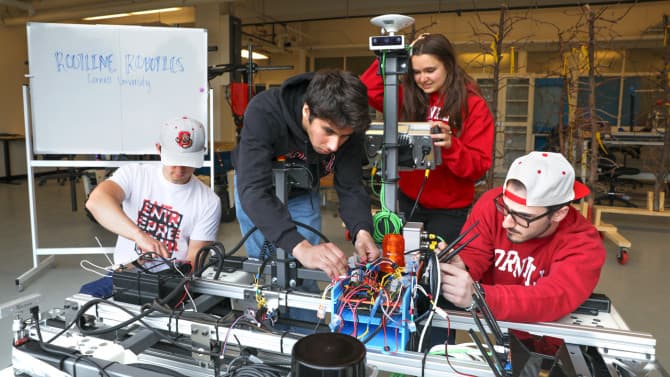
The team is led by Andrew James, an agricultural sciences major at Cornell's College of Agriculture and Life Sciences (CALS), and draws on a mix of agricultural and engineering expertise. After studying existing electric weeding technologies in depth, the group developed their own low-energy system and completed a fully functional prototype in an intensive four-month development sprint.
Natalia Kurz, a biological engineering major on the team, recalled many late nights. "We all had this fear in the back of our minds—what if it just doesn't work out?" she said.
James and his co-founders are now channeling the $50,000 prize into a new startup, Rootline Robotics, to continue advancing the technology. Agtech company Reservoir—one of the competition's sponsors—has also offered the startup a residency at its accelerator in Sonoma, California.
"I've always been interested in starting a company in agricultural robotics," James said. "Winning this competition and seeing the strong support from industry stakeholders makes it all the more reason to keep moving forward on this exciting journey."
Weeds: A Persistent Challenge for Growers
According to Steve Selin, owner of South Hill Cider, an apple cider operation in Ithaca, New York, weeds are a significant problem in orchards and vineyards because they compete with crops for water and nutrients—particularly in spring.
"The weed pressure is intense. Grass grows right up to the base of the trees, and we just don't have the manpower to weed or mulch frequently enough," Selin said. "Once the trees are under too much stress, fruit can drop prematurely."
For organic growers, current weed control methods typically include string trimming, mowing, and mulching—all extremely labor-intensive. James noted that existing commercial electric weeding machines require an operator, consume significant power, and carry an average price tag of $150,000, putting them out of reach for most farmers.
Selin provided user feedback during the robot's development and said he looks forward to trialing Rootline's technology.
"If you can keep weeds from competing with your trees in May and June, you're set for the rest of the year," he said. "Letting weeds grow back naturally afterward actually provides ground cover that helps build a healthier soil microbiome."
Robotics as Inherently Interdisciplinary
"Robotics is the integration of multiple systems—it's interdisciplinary by definition," Kurz said.
Looking ahead, the Rootline team plans to refine the technology further and work with growers on field validation before evaluating a path to market. Kurz and fellow team member Michael Neiss will complete their degrees during this period.
Neiss reflected that the team coming together felt almost serendipitous.
"When people from many different backgrounds are in the same room, you find the most feasible and effective solutions," he said.
原文來源: 查看原文
FAQ
Reviewed and published by the LAETimes editorial desk ·