Spider-Shaped Drone Becomes Nearly 'Invisible' at High Spin Speeds — Researchers Demonstrate Stunning Visual Effect
Researchers have unveiled a slim-framed drone called the 'Phantom Twist' that nearly vanishes from the naked eye when spinning at extremely high speeds. The wingless craft uses downward-tilted motors for lift and relies on a high-speed control system for stability. It is launched by hand-spinning it up to speed before release, producing a visually striking near-invisibility effect.
Highlights
- The Phantom Twist is a wingless, spider-framed research drone that nearly disappears from the naked eye when spinning at high rotational speeds.
- The drone generates lift using downward-tilted motors and maintains flight stability through a high-speed control system — requiring no wing or blade surfaces.
- The craft must be pre-spun using a handheld launcher before release, as it can only remain stable while rotating at high speed.
- Unlike earlier spinning single-motor drones, the Phantom Twist does not use wing structures or the Magnus Effect to achieve lift.
- The project is currently at the research demonstration stage, with full hardware specifications not yet publicly disclosed.
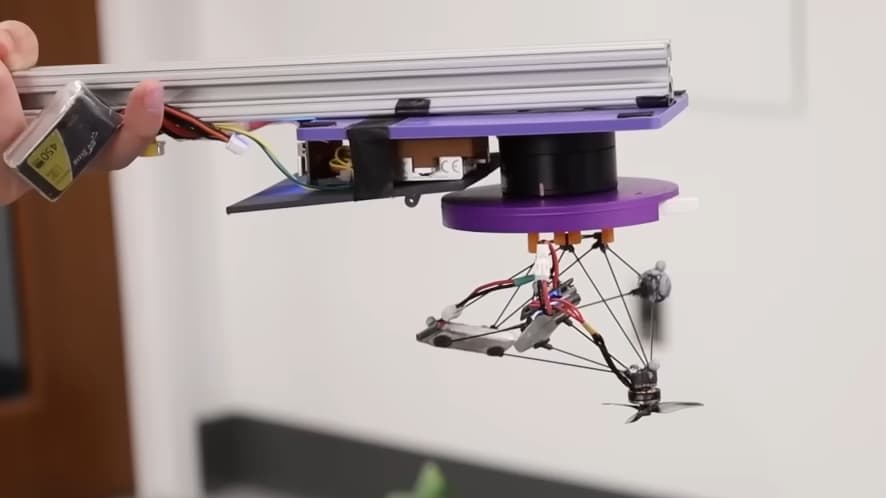
Researchers have recently demonstrated a fascinating phenomenon: a small drone with a slender, skeletal airframe that almost completely disappears from view when spinning at extremely high speeds. The spider-like device can be seen mounted on a launch stand in the image above — the dark, blurred area on the far right is a ventilation outlet on the wall behind the drone, not motion blur caused by the craft itself.
What Is the Phantom Twist?
This drone is called the Phantom Twist. While single-motor drones that rotate about a central axis have appeared before, they have typically featured wing-like structures or cleverly exploited the Magnus Effect to generate lift.
Full hardware details of the Phantom Twist remain limited, but based on its appearance, the aircraft appears to use downward-tilted motors to provide lift, relying on a high-speed control system for maneuvering and altitude maintenance.
The Trade-Offs of a Wingless Design
The key advantage of this design is the complete elimination of wing or rotor-blade surfaces. The trade-off, however, is that the craft can only maintain stability while spinning at high speed. As might be expected, this also makes the design highly sensitive to balance and extremely demanding to tune.
In terms of flight procedure, a user must first spin the aircraft up to speed using a handheld launcher before releasing it into free flight. Once airborne, the Phantom Twist delivers a genuinely striking visual effect — the fuselage spins so rapidly that it almost entirely disappears from the naked eye.
While the noise signature presents an obvious challenge to overcome, the near-invisibility effect achieved through high-speed rotation is undeniably impressive.
Full flight footage is available in the officially released video, and the visual impact speaks for itself.
Outlook
The Phantom Twist demonstrates an alternative paradigm for drone design — abandoning conventional wing surfaces in favour of pure rotational dynamics to achieve flight. Although the project remains at the research demonstration stage, the technology's visual 'invisibility' characteristic is worth watching to see whether it could find practical applications in specific use cases going forward.
原文來源: 查看原文
FAQ
Reviewed and published by the LAETimes editorial desk ·


