Aurora Supercomputer Powers Autonomous Platform to Automate Complex Chemical Simulations
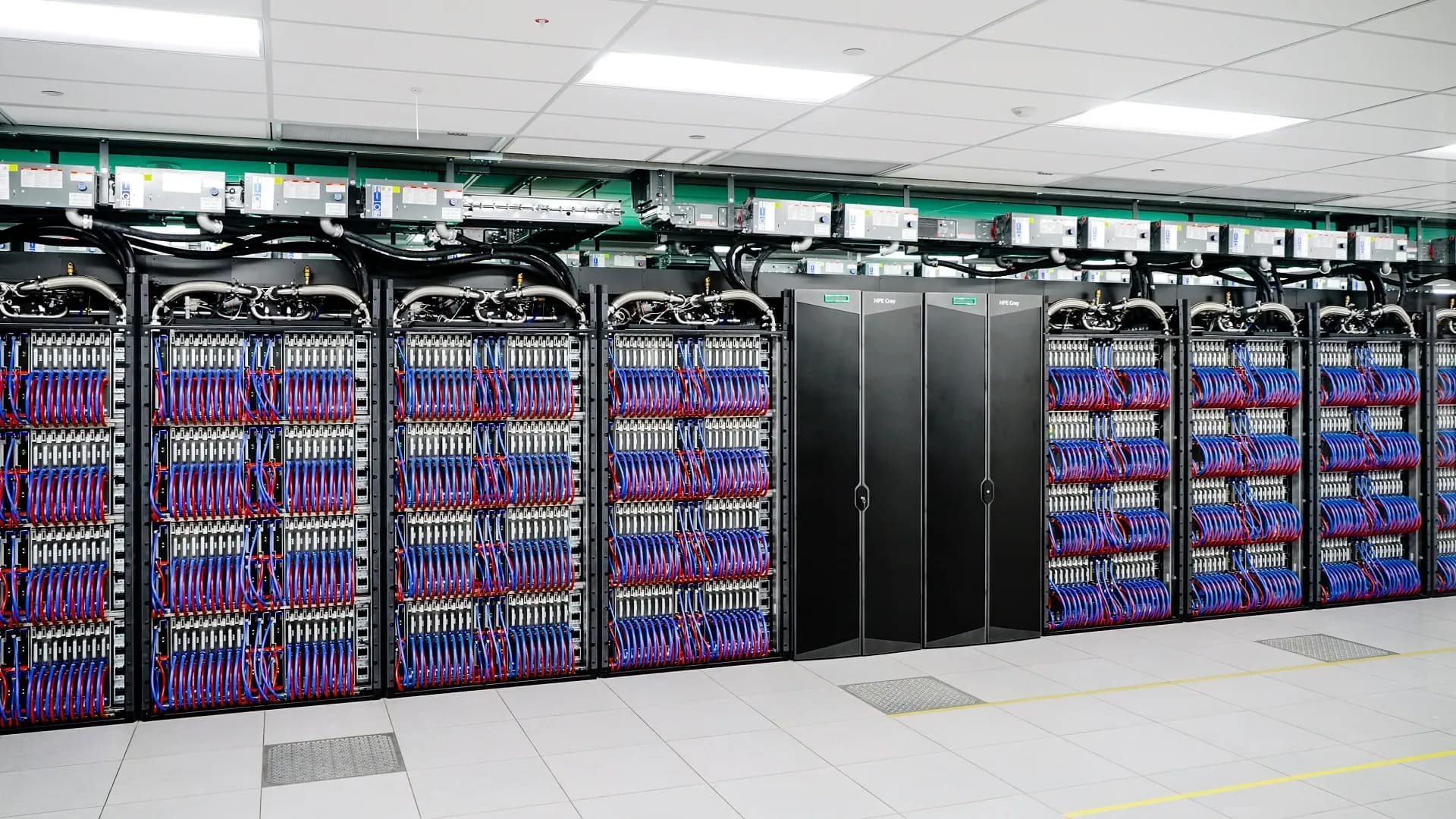
Researchers at Argonne National Laboratory have developed ChemGraph, an open-source AI framework that combines large language models with autonomous agents to automate complex chemical simulations. Built on Argonne's Aurora exascale supercomputer, the system allows scientists to describe problems in plain language and receive simulation results without manual workflow preparation. Applications include battery design, combustion optimization, and critical materials discovery. The work has been published in Communications Chemistry.
Highlights
- Argonne National Laboratory developed ChemGraph, an open-source framework that automates computational chemistry simulations using LLMs and AI agents, published in Communications Chemistry.
- ChemGraph runs on Aurora, the ALCF's exascale supercomputer, enabling physics-based quantum chemistry simulations without users manually preparing complex workflows.
- The framework uses larger LLMs for workflow planning and smaller models for task execution, reducing computational cost and resource consumption.
- Applications include battery design, combustion optimization, critical materials discovery, XANES spectral simulation, and automated high-throughput materials screening.
- Argonne plans to offer ChemGraph as a chatbot-based service to ALCF users, with a long-term goal of increasing autonomous operation for scientific research.
Aurora Supercomputer Powers Autonomous Platform to Automate Complex Chemical Simulations
Computational chemistry has long demanded deep specialist knowledge, proficiency with multiple software tools, and the ability to manage intricate workflows. Researchers at the U.S. Department of Energy's Argonne National Laboratory have developed an open-source framework called ChemGraph that automates much of the simulation process using AI agents, making advanced simulations more accessible to scientists and students alike.
The framework is designed to help researchers tackle materials science and chemistry problems without manually executing every technical step. Potential applications include designing higher-performance batteries, improving combustion systems, and supporting the discovery of critical materials.
ChemGraph combines large language models (LLMs) with agent-based automation. Researchers simply describe a scientific problem in everyday language, and the system translates that description into a sequence of computational tasks, software tools, and analysis steps—automatically generating the required results without users having to build complex simulation workflows themselves.
The project is built on the Aurora exascale supercomputer at the Argonne Leadership Computing Facility (ALCF) and the ALCF Inference Service, which gives researchers cloud-style access to large language models running on high-performance computing systems.
Lowering the Barrier to Research
Running a computational chemistry simulation typically involves selecting an appropriate scientific method, identifying compatible software, preparing input files, performing calculations, analyzing results, and iterating through parameter adjustments multiple times.
ChemGraph distributes these tasks among AI agents dedicated to workflow planning, execution, and data management. Rather than having the language model generate answers directly, the framework is designed to call appropriate scientific software and libraries first, then return the results.
"We don't want the large language model to just answer the question," said Thang Duc Pham, an Argonne postdoctoral researcher and co-developer of ChemGraph. "We want it to run physics-based simulations to get the answer for you, rather than relying solely on knowledge stored within the model itself."
The team also deploys different model sizes depending on task type: larger models handle workflow planning while smaller models manage execution tasks, reducing computational costs and improving overall efficiency.
"If you use the same LLM for everything, you risk wasting funds and computing allocations," said Murat Keçeli, a computational scientist at Argonne. "We found we could use a large model for workflow planning, then switch to a smaller model for task execution."
Built for Scalability
The Aurora supercomputer handles the computationally intensive quantum chemistry simulations integrated into ChemGraph, while the ALCF Inference Service provides access to open-weight language models hosted on Argonne's own systems. Running models locally also helps reduce costs and addresses data security concerns more effectively than relying on external cloud services.
Because ChemGraph is open source, researchers have already begun extending its applications beyond computational chemistry. Recent collaborations have applied the framework to X-ray absorption near-edge structure (XANES) spectral simulations and to running automated high-throughput materials screening workflows on Aurora.
The team also sees significant educational potential: faculty can use the framework to demonstrate advanced computational chemistry techniques, while students gain a more accessible way to explore research questions.
"Our vision for ChemGraph is to offer it as a service to ALCF users through a chatbot interface," said Keçeli. "In the long run, we want to make it increasingly autonomous… so that scientists can focus on the scientific questions they actually want to answer."
The research has been published in the journal Communications Chemistry.
原文來源: 查看原文
FAQ
Newsletter
Subscribe to our Low-Altitude Industry Newsletter
Daily curated news on low-altitude economy and drone industry, delivered to your inbox.
Reviewed and published by the LAETimes editorial desk ·