Utilities Brace for BVLOS Regulations While Navigating Post-DJI Transition
Electric utilities, among the earliest adopters of drone technology, now face a dual challenge: preparing for the FAA's forthcoming BVLOS regulations that will transform large-scale infrastructure inspection, while simultaneously responding to government pressure to replace Chinese-made DJI equipment with compliant alternatives. Success will require balancing operational continuity, regulatory readiness, and procurement strategy.
Highlights
- Electric utilities were among the earliest commercial drone adopters, building deep operational expertise but also creating heavy dependency on DJI platforms that now complicates equipment transitions.
- The FAA is expected to release new BVLOS regulations that will enable automated, observer-free inspection of power lines, transmission towers, and pipelines across large service territories.
- U.S. government security concerns over Chinese-made drones are pressuring utilities to replace DJI equipment with compliant, non-Chinese alternatives, raising procurement, retraining, and integration costs.
- Industry analysts say utilities that complete platform transitions and obtain BVLOS operational certifications ahead of formal rulemaking will gain a first-mover advantage in automated grid inspection.
- The recommended near-term strategy is to adopt government-compliant drone platforms while engaging with FAA BVLOS pilot programs to build the operational record needed for future certification.
By Jim Magill, Contributing Editor, DRONELIFE
Managers of electric utility assets were among the earliest adopters of drone technology across any industry. Yet as the regulatory environment and geopolitical landscape shift rapidly, these operators now face an unprecedented set of challenges — and opportunities.
Two Parallel Challenges
Utility drone programs are currently contending with two converging issues:
-
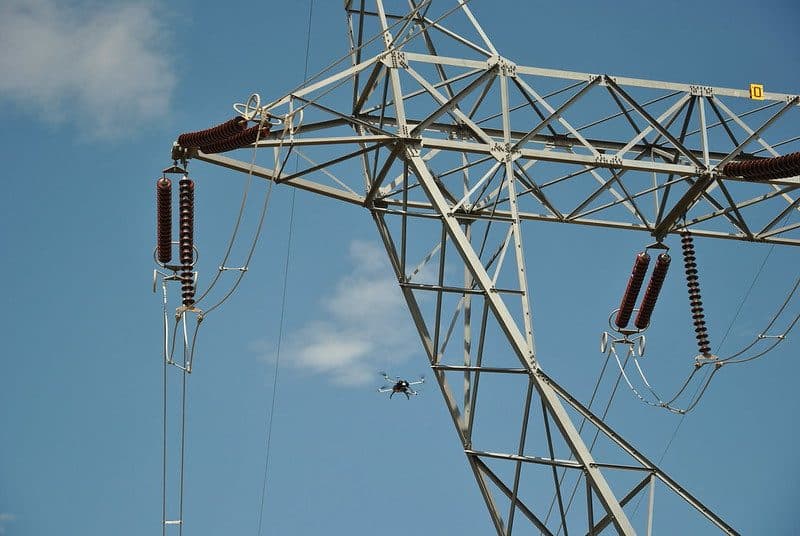
Imminent BVLOS Regulations: The U.S. Federal Aviation Administration (FAA) is expected to introduce new Beyond Visual Line of Sight (BVLOS) flight rules that will unlock entirely new possibilities for automated inspection of power lines, transmission towers, pipelines, and other large-scale infrastructure. At the same time, the regulations will require operators to complete technical upgrades and compliance preparations well in advance.
-
The Post-DJI Equipment Transition: Driven by U.S. government concerns over the cybersecurity risks posed by Chinese-manufactured drone platforms, utilities that have long relied on DJI equipment are under mounting pressure to identify and adopt non-Chinese alternatives. This transition carries significant implications for procurement costs, pilot retraining, and systems integration.
Early Adopter Advantage — and Its Costs
Because their infrastructure inspection needs are well-defined and flight operations are routine, utility companies were early and enthusiastic adopters of drone technology, accumulating substantial operational experience and data assets over the years. Paradoxically, however, this head start has also created a deep dependency on specific platforms — particularly DJI — making the cost of transition considerably higher than it might otherwise be.
Industry analysts note that once BVLOS rules are formally enacted, operators that can swiftly complete equipment upgrades and obtain the relevant operational certifications will gain a decisive competitive edge in the race toward automated grid inspection.
Outlook: Opportunity Meets Disruption
Despite the pressures of transition, the opening of BVLOS operations is widely regarded as a landmark milestone for utility drone applications. Looking ahead, drones will be capable of conducting long-range power line patrols, thermal imaging equipment inspections, and rapid post-disaster damage assessments — all without a visual observer present — dramatically improving inspection efficiency and reducing risks to personnel.
The optimal near-term strategy for utility operators is to prioritize procurement of platforms that meet U.S. government security requirements, while actively engaging with FAA BVLOS pilot programs to build the operational track record needed when formal rules take effect.
原文來源: 查看原文
FAQ
Reviewed and published by the LAETimes editorial desk ·