U.S. Military Deploys Kamikaze Surface Drones Against Iran for the First Time — Is CENTCOM Replicating Ukraine's Naval Tactics in the Middle East?
U.S. Central Command (CENTCOM) employed one-way attack uncrewed surface vehicles (USVs) in combat against Iran on July 12, marking the first operational use of such systems by the U.S. military. The strike targeted Iranian coastal air defense systems, radar stations, and missile facilities. The vessel used is suspected to be Red Cat's Variant 7, a U.S.-built USV closely modeled on Ukraine's Magura V7, as CENTCOM expands its unmanned maritime warfare capabilities in the Middle East.
Highlights
- CENTCOM於2025年7月12日首度在對伊朗作戰中動用一次性攻擊型海面無人機(USV),打擊伊朗海岸防空系統、雷達站及飛彈設施。
- 疑似使用機型為Red Cat Variant 7,最大航程800海里、續航逾60小時、載荷650公斤,設計靈感來自烏克蘭Magura V7,並於2025年啟動全面量產。
- 美軍第59特遣隊(TF 59)上月已使用Saronic Corsair USV在荷莫茲海峽成功救援兩名阿帕契直升機飛行員,為全球首次有記錄的USV實戰救援任務。
- 烏克蘭Magura V5於2025年5月以R-73飛彈擊落俄羅斯Su-30SM戰鬥機,創下人類史上首次由海面無人機摧毀軍用戰機的紀錄。
- 自2024年起,葡萄牙、英國、日本、沙烏地阿拉伯、卡達及阿聯酋已相繼與烏克蘭簽署海面無人機合作或聯合生產協議,顯示相關技術正快速全球擴散。
U.S. Military Deploys Kamikaze Surface Drones Against Iran for the First Time
The United States employed one-way attack uncrewed surface vehicles (USVs) — commonly referred to as "kamikaze" surface drones — in combat against Iranian military targets on July 12, as part of ongoing operations against Iran.
Notably, this marks the third major weapons system to see its operational combat debut in the current Iran conflict, following LUCAS (Low-Cost Unmanned Combat Attack System) and the Precision Strike Missile (PrSM).
CENTCOM Official Statement
The CENTCOM Public Affairs Office issued an official statement regarding the operation:
"CENTCOM forces conducted strikes on Iranian military air defense systems, coastal radar stations, missile and drone facilities, and small boat vessels using U.S. fighter aircraft, naval vessels, one-way attack aerial drones, and for the first time, one-way attack surface drones."
While the U.S. military has previously deployed USVs for surveillance and intelligence, surveillance, and reconnaissance (ISR) missions, this marks the first time the U.S. has used one-way attack USVs in actual combat — underscoring the military's accelerating integration of unmanned systems, both aerial and surface, into offensive operations.
Surface Drones Used in Combat Rescue
USVs have also played a critical role in high-risk rescue operations during the Iran conflict.
Last month, a Corsair USV manufactured by Saronic successfully rescued two U.S. Army helicopter pilots in the Strait of Hormuz off the coast of Oman after their Apache helicopter was shot down. CENTCOM subsequently confirmed it was the first publicly documented instance of an uncrewed surface vehicle performing a rescue mission in active combat.
The operation was conducted by U.S. Naval Forces Central Command's Task Force 59 (TF 59), which has expanded its USV portfolio beyond strike and surveillance to encompass high-risk support missions — including operations in areas deemed too dangerous for crewed vessels.
TF 59 has publicly stated, for example, that it deployed multiple USV types — including Corsair-class vessels — for mine detection and neutralization in waters considered too hazardous for crewed ships.
TF 59 serves as the unmanned systems force for U.S. Naval Forces Central Command (NAVCENT) and is the U.S. Navy's primary hub for integrating drones and AI-enabled maritime platforms.
U.S. Unmanned Maritime Strategy
In April, CENTCOM announced the deployment of underwater drones to help clear obstacles in the Strait of Hormuz.
CENTCOM Commander Admiral Brad Cooper stated at the time: "Today, we begin establishing a new lane; we will soon share that safe passage with the shipping industry to encourage the free flow of trade. Additional U.S. forces, including underwater drones, will join the clearance operation in the coming days."
In March, the U.S. Navy cancelled its Modular Attack Surface Craft (MASC) program — launched the previous year — in favor of a Medium Uncrewed Surface Vehicle (MUSV) market survey, signaling a revised procurement strategy for unmanned naval vessels.
Red Cat Variant 7 Suspected
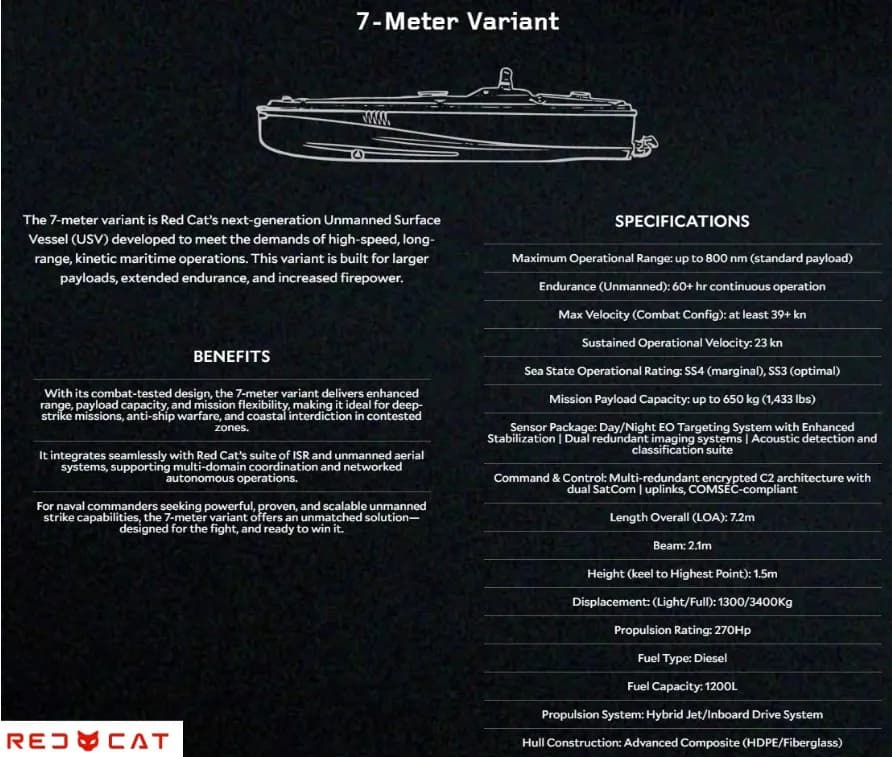
CENTCOM has not disclosed the specific model used in the July 12 strikes. However, Ukrainian media reports suggest the vessel may be the Variant 7, developed by Red Cat Holdings — a U.S.-built USV whose design closely mirrors Ukraine's Magura V7.
Red Cat first announced a production partnership with an undisclosed company in May 2025, and last month announced the commencement of full-rate production of the Variant 7. While Red Cat emphasizes that the V7 is "designed, built, and assembled in the United States," the company has acknowledged that the program involved collaboration from the outset with a manufacturer that tests its maritime drones in real-world combat conditions daily — almost certainly a reference to the maker of the Magura V7.
Variant 7 Key Specifications:
- Maximum range: 800 nautical miles
- Maximum endurance: 60+ hours
- Maximum speed: 39+ knots
- Payload capacity: up to 650 kg
- Sensors: day/night electro-optical targeting system (with enhanced stabilization), dual-redundant imaging system, acoustic detection and classification system
Red Cat states that the V7 integrates U.S.-developed autonomous control, command-and-control communications, and mission systems, with production prioritizing NDAA-compliant American-made components.
How Ukraine's Magura USVs Rewrote Naval Warfare
Ukrainian surface drones have set multiple historical precedents in the Russia-Ukraine war, profoundly influencing global naval strategy.
In December 2024, Ukraine's Defence Intelligence Directorate (HUR) announced the first-ever shoot-down of a Russian Mi-8 helicopter by a surface drone — the Magura V5 — marking the world's first air kill achieved by a USV. HUR reported that Special Forces Unit 13 launched an R-73 "SeeDragon" missile from a Magura V5, destroying the helicopter over the Black Sea off the western coast of Crimea.
The Magura V5 features a streamlined hydrodynamic hull with near-stealth characteristics and exceptional maneuverability. Its automated control system significantly reduces the need for human intervention during missions, making it suitable for combat operations, mine countermeasures, patrol, search and rescue, surveillance, and coastal defense.
Key Magura Series Combat Milestones:
- July 2023: Ukraine's Security Service (SBU) used SeaBaby USVs armed with explosives to attack the Crimea Bridge (Kerch Bridge), simultaneously damaging road and rail sections and disrupting a critical Russian supply route
- August 2023: SBU-operated USVs struck the Russian landing ship Olenegorskiy Gornyak in Novorossiysk Bay
- February 2024: Five Magura V5 USVs attacked the Russian amphibious assault ship Tsezar Kunikov
- May 2025: A Magura V5 shot down a Russian Su-30SM fighter jet using an R-73 air-to-air missile — the first time in history a surface drone destroyed a military aircraft
Global Proliferation of Ukrainian USV Technology
The battlefield success of Ukrainian surface drones has spurred multiple nations to pursue cooperation agreements with Ukraine:
- December 2024: Ukraine signed a joint production agreement for surface drones with Portugal
- 2025: The United Kingdom signed an agreement supporting Ukraine's development and deployment of long-range USVs capable of open-ocean operations, encompassing joint production lines, R&D cooperation, AI integration, and maritime unmanned systems capacity building
- 2025: Ukraine extended a surface drone cooperation proposal to Japan
- March 2026: During President Zelensky's visit to Gulf states, Ukraine signed 10-year defense partnership agreements with Saudi Arabia, Qatar, and the UAE, explicitly covering the supply of Ukrainian surface drones
Conclusion: Unmanned Naval Warfare Goes Global
The U.S. military's first combat employment of one-way attack surface drones in the Iran conflict marks a significant shift in naval warfare — one directly inspired by the operational success of Ukraine's Magura USVs.
As Task Force 59 integrates these low-cost, expendable unmanned systems for strike, surveillance, and high-risk mission sets, surface drones have evolved from experimental tools to a core capability of modern naval forces.
With combat USVs now active in the Middle East theater, unmanned naval warfare has become a global military reality.
原文來源: 查看原文
FAQ
Reviewed and published by the LAETimes editorial desk ·


