U.S. Pilot's 'Jellyfish' Drone Swarm Account Meets Intelligence Community Skepticism
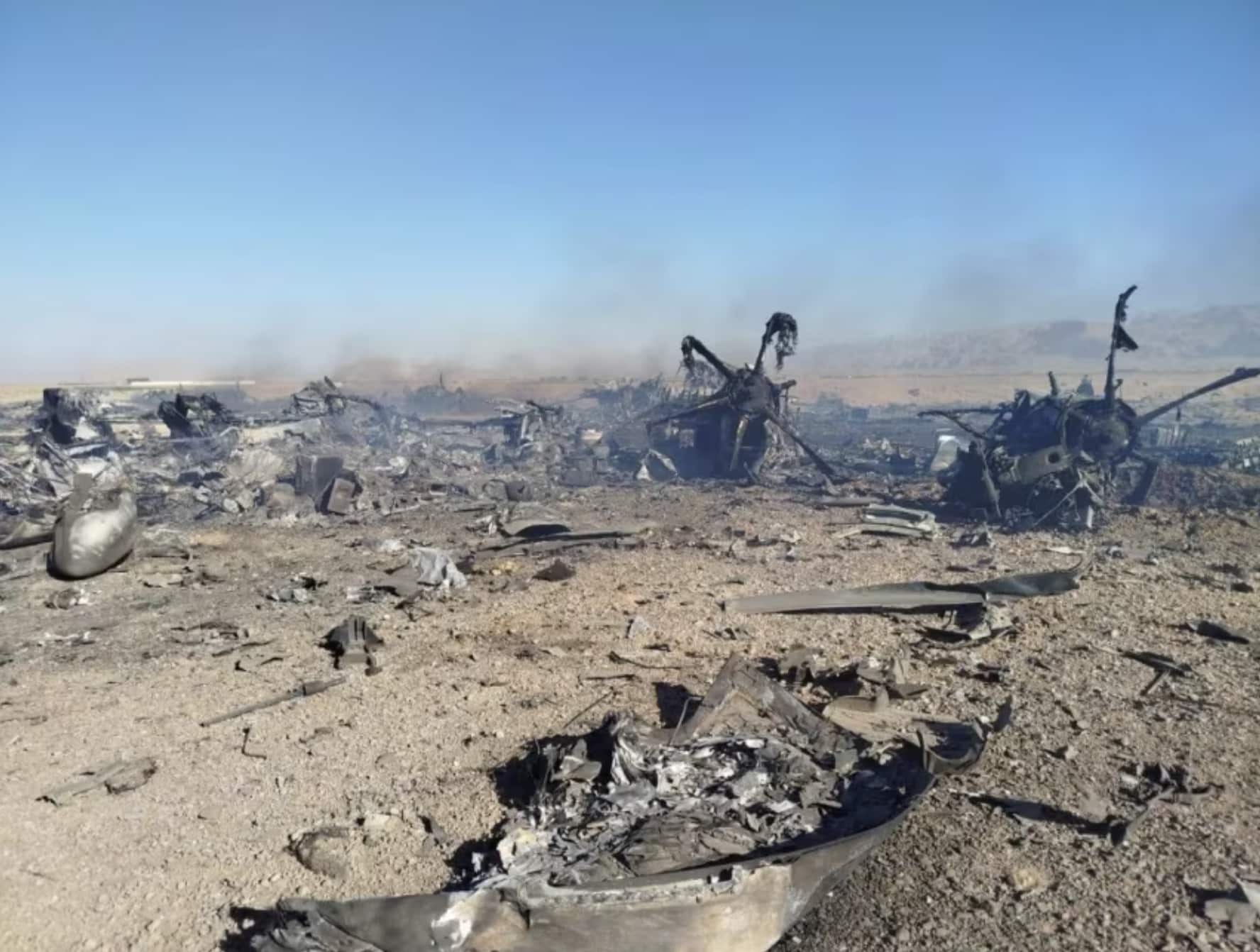
A U.S. Air Force F-15E pilot downed over Iran on April 3 reported witnessing Iranian drones moving in a coordinated 'jellyfish-like' swarm formation seconds before ejecting. Intelligence analysts are skeptical: the pilot had a concussion and was ejecting for the second time in the same war, with no imagery or sensor data to corroborate the account. A more evidenced explanation points to a Chinese-made MANPADS. Analysts note that true coordinated drone swarm technology remains experimental—but its battlefield arrival is a matter of when, not if.
Highlights
- A U.S. Air Force F-15E pilot downed over Iran on April 3 described Iranian drones moving in a coordinated 'jellyfish-like' swarm, but the U.S. intelligence community does not corroborate his account.
- The pilot had a concussion at the time and was completing his second ejection of the same war; no imagery, sensor data, or second witness supports the swarm description.
- U.S. officials assessed the F-15E was most likely struck by a Chinese-manufactured MANPADS, with China possibly also supplying Iran's YLC-8B early-warning radar.
- CSIS analysis of Ukraine confirms that fully coordinated drone swarming—where drones communicate and adapt collectively in combat—remains experimental and has not been operationally fielded by any military.
- The swarm narrative emerged days before the White House submitted an $87.6 billion supplemental defense appropriation request to Congress, including funds explicitly tagged for drone manufacturing and munitions replenishment.
U.S. Pilot's Iranian Drone Swarm Claim Meets Intelligence Community Skepticism
A U.S. Air Force F-15E Strike Eagle pilot shot down over southwestern Iran on April 3 told debriefers that in the seconds before ejecting he witnessed a cluster of interconnected drones moving as a "single living entity"—large drones flying above, with smaller ones hanging beneath them "like tentacles," the entire formation holding shape through maneuvers. A source familiar with the description called it a "drone minefield"; another person who spoke to CNN compared it to "a jellyfish—the whole thing looked like something genuinely alien."
CNN reporters Zachary Cohen and Katie Bo Lillis broke the story on June 23, and the significance was immediately apparent. This was the first U.S. crewed aircraft lost to hostile fire over Iran during Operation Epic Fury, a conflict that began on February 28. If Iran had fielded a coordinated drone swarm that U.S. intelligence had never flagged and that proved resistant to electronic jamming, it would represent a deeply unsettling battlefield development.
But buried beneath the word "jellyfish" is a critical detail: the intelligence community does not believe the pilot saw what he described. After nearly a decade tracking the drone industry and separating genuine technical breakthroughs from "sky-is-falling" narratives, this case sits in a troubling grey zone—a credible witness, a dramatic claim, and almost nothing verifiable underneath it.
Concussed Pilot, Second Ejection of the War
The pilot's testimony carries two complicating factors that any honest reading must acknowledge. First, he sustained a concussion when his aircraft went down. Debriefers reportedly asked him directly: "Are you certain what you saw is what you're describing?" Memory formed under that kind of trauma is not a clean, high-fidelity record.
The second complication is more unusual. This was the same aircrew member's second ejection in the span of a few weeks. He was one of three F-15E crew members shot down over Kuwait in early March—a friendly-fire incident caused by Kuwait's layered air-defense systems failing to communicate with one another and engaging their own aircraft, an event this publication covered at the time. Retired Lt. Gen. David Deptula, who planned the air campaign for Desert Storm, told CBS News that being shot down twice is like being struck by lightning twice; he hadn't seen anything like it since Vietnam. An unlucky witness is not an invalid witness—but he is a witness whose two worst days of the war both ended with a pull of the ejection handle.
There is no imagery, no sensor data, no gun-camera footage, no corroborating account from another crew member confirming the formation's existence, and no official assessment from U.S. Central Command or the Office of the Director of National Intelligence—both of which declined to respond to CNN's inquiries. The entire "jellyfish swarm" account rests on one person's memory of his worst thirty seconds.
A Chinese-Made MANPADS Is the Better-Evidenced Explanation
While the swarm story spread widely, a quieter, better-sourced explanation for the actual shootdown had already been reported. NBC News reported in late May that U.S. officials assessed the F-15E was most likely struck by a Chinese-manufactured man-portable air-defense system (MANPADS), and that China may also have supplied Iran with the YLC-8B early-warning radar—a system capable of tracking low-observable aircraft. President Trump stated the point more bluntly: Iran used MANPADS, and they got lucky.
This matters because it separates one question into two. What the pilot saw in the air and what actually downed his aircraft need not be the same thing. A MANPADS round launched from the ground is a mundane, well-documented, repeatedly observed method of killing low-flying attack aircraft at night. An autonomously coordinated drone swarm directed by ground controllers is something categorically different. When a prosaic explanation and an extraordinary explanation compete, and only the prosaic one has corroborating evidence, the burden of proof falls squarely on the extraordinary claim.
The Technology the Pilot Described Is Real—and the U.S. Is Actively Developing It
Skepticism about this specific sighting should not collapse into blanket denial of the underlying capability. Sources in the CNN report gave a real technical name to the behavior described: "one-to-many meshed networking"—a single operator commanding multiple drones with built-in resilience against electronic jamming. This is not science fiction; it is a well-documented engineering objective being actively pursued by multiple militaries, including the United States.
This publication has been reporting on the core distinction for months. Iran's Shahed-136—the defining drone of this conflict—has no coordination capability whatsoever. It flies to a GPS coordinate and detonates; a wave of Shaheds overwhelms defenses through sheer volume and timing, a "dumb flood" that wins by economic advantage rather than intelligence. The U.S. LUCAS program is an engineered departure from that paradigm. As detailed when it was first used operationally during Epic Fury, this Arizona-built drone is designed so that swarm members communicate in flight and reallocate targets based on which objectives are defended and where sensor blind spots lie. The qualitative gap between a Shahed flood and a coordinated LUCAS swarm was laid out in March; the architecture exists, but operational validation had not yet arrived.
The honest position, therefore, is not "Iran cannot do this" but rather "no party has demonstrably done this in combat yet, including the one building the most advanced version." The Center for Strategic and International Studies (CSIS) analysis of autonomous warfare programs in Ukraine reaches the same conclusion: swarm technology remains in small-scale experimental stages, and a fully realized swarm—drones communicating with each other, making decisions, and adapting coordinately—has not been fielded. Ukraine has absorbed more than 57,000 Shahed strikes and built the most sophisticated counter-drone doctrine on earth; even so, true coordinated swarming remains on the workbench.
The Russian and Chinese Assistance Thread Is Real, but Proves Less Than the Headlines Suggest
CNN's sources point to Russia or China as the vector for any leap in Iranian capability, and that thread is genuine. Iran supplied Russia with Shaheds and full production blueprints; Russia mass-produced them and fed components and battlefield know-how back. This publication has documented Russian-made components appearing inside Iranian drones and Russia providing satellite imagery of U.S. naval vessel positions to Iran during the conflict.
Component supply and doctrine transfer, however, are not the same as a deployed autonomous swarm. One U.S. official told NBC News that whatever China provided before the war, its wartime assistance has not made a material difference on the battlefield. The thread explains how Iran could climb the ladder; it does not establish that Iran had reached the top of it over the Zagros Mountains on April 3. The capability that has genuinely reshaped this conflict is the cheap, dumb, difficult-to-stop Shahed flood—and the answer to it remains the $2,500 interceptor drone that Gulf states spent months ignoring rather than the missile that costs a thousand times more.
The Threat Narrative Now Carries an $87.6 Billion Price Tag
Stories like this do not stay in briefing rooms. On June 24, the White House formally asked Congress for an $87.6 billion supplemental appropriation, roughly $67 billion of which is earmarked to replenish Pentagon stockpiles drawn down during Operation Epic Fury, with funds explicitly tagged for munitions, drone manufacturing, and cybersecurity. Defense Secretary Pete Hegseth had floated figures as high as $200 billion back in March before the number settled here.
The request landed in a hostile room. Republican fiscal hawks such as Rep. Chip Roy demanded dollar-for-dollar offsets; Democrats have treated any vote as a referendum on a war they opposed. A vivid, frightening picture of Iranian drone superiority is precisely the kind of thing that greases defense appropriations. This is not an accusation that anyone fabricated the pilot's account—it is a reminder to track which claims get amplified, by whom, and immediately before which votes.
Analysis
Skepticism about this incident is warranted. But those who dismiss the underlying capability as impossible will look foolish within a few years. Both things can be true simultaneously.
On this specific sighting, follow the evidence. A concussed pilot completing his second ejection of the war, with no imagery, no sensor data, no second witness, and a perfectly plausible MANPADS-shaped explanation sitting right next to him—that is not the foundation on which to build a threat assessment. CNN reported the claim responsibly and noted the skepticism within the story. The problem is what happened downstream: "pilot describes possible drone swarm" was compressed into "Iran has alien drone swarms" by the time it reached cable-news chyrons and budget hearings. That compression is itself sky-is-falling thinking in uniform. Not every strange thing seen by a frightened, concussed person in a combat airspace is a revolution in warfare. Sometimes it is a missile and the fog of war.
Here, however, is where this analysis parts ways with pure debunkers. The capability the pilot described is coming, and the timeline is short. Ukraine's interceptor program went from volunteer-built prototypes to Pentagon procurement discussions in roughly sixteen months. LUCAS went from Hegseth holding one up at a press conference to executing live combat missions over Iran. The line between a dumb Shahed flood and a thinking swarm is being erased in real time by engineers who publish their progress openly. The first confirmed, evidence-backed case of coordinated drone swarming in combat is a question of when, not whether—and that proof will come from sensor data and imagery, not a lone shaken eyewitness. When that day arrives, the jellyfish story's lasting lesson will be this: wait for the evidence before believing the most dramatic version, because the real thing will be frightening enough on its own.
Sources: CNN, NBC News, CBS News, PBS NewsHour / Associated Press, CSIS.
原文來源: 查看原文
FAQ
Newsletter
Subscribe to our Low-Altitude Industry Newsletter
Daily curated news on low-altitude economy and drone industry, delivered to your inbox.
Reviewed and published by the LAETimes editorial desk ·


