First-Ever USV Rescue: U.S. Navy's Saronic Corsair Saves Apache Helicopter Crew in Gulf of Oman
A Saronic Corsair unmanned surface vessel (USV) operated by U.S. Navy Task Force 59 successfully recovered two U.S. Army AH-64 Apache helicopter crew members from the Gulf of Oman — marking the first known use of an unmanned boat for personnel rescue. The Corsair had only been deployed to the Middle East theater in March 2025. President Trump stated the helicopter was shot down by Iranian forces.
Highlights
- A Saronic Corsair USV operated by U.S. Navy Task Force 59 rescued two AH-64 Apache crew members from the Gulf of Oman, marking the first known personnel recovery by an unmanned surface vessel.
- The Corsair had been deployed to the Middle East theater only at the end of March 2025, weeks before executing the historic rescue mission.
- The U.S. Navy awarded Saronic a $392 million OTA production contract for the Corsair USV in December of the previous year; the vessel measures 24 feet, reaches 35 knots, and has a 1,000-nautical-mile range.
- The two Apache pilots spent approximately two hours in the water before being recovered by the Corsair and subsequently hoisted to safety by a helicopter.
- Saronic's larger Marauder USV prototype — 180 feet long with a 4,100-nautical-mile range and 150-metric-ton payload — is under U.S. Navy evaluation as part of the Medium Unmanned Surface Vehicle (MUSV) program.
USV Performs First-Ever Personnel Rescue, Recovering Apache Crew
U.S. Central Command (CENTCOM) has confirmed that a Corsair unmanned surface vessel (USV) manufactured by Saronic Technologies successfully recovered two crew members of a downed U.S. Army AH-64 Apache attack helicopter from the Gulf of Oman during a nighttime operation. President Donald Trump subsequently stated the helicopter had been shot down by Iranian forces and pledged a response. The incident marks the first known instance of an unmanned vessel being used to recover personnel in a search-and-rescue (SAR) mission — a milestone with significant implications for future maritime operations.
Corsair Only Deployed to the Middle East in March
U.S. Navy Captain Tim Hawkins, a CENTCOM spokesman, told reporters: "The unmanned surface vessel that assisted in rescuing the Apache crew members off the coast of Oman last night was a U.S. Navy Corsair USV operated by Task Force 59 of the U.S. Fifth Fleet. That task force only began deploying these unmanned vessels in theater at the end of March this year."
A $392 Million Contract Behind the Unmanned Speedboat
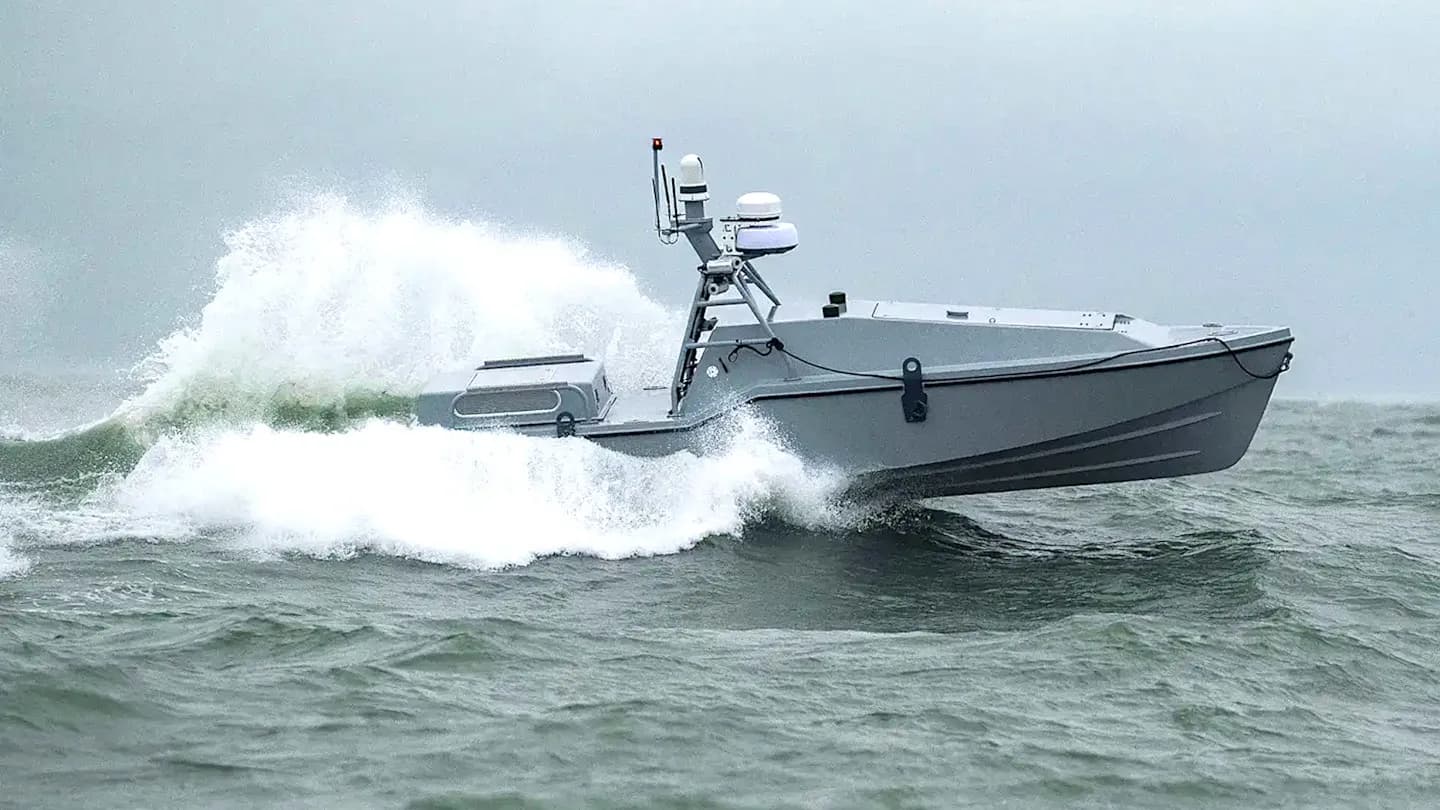
The U.S. Navy confirmed in December last year that it had awarded Saronic a $392 million Corsair USV production contract under an Other Transaction Authority (OTA) agreement. The Corsair — a 24-foot (approximately 7.3-meter) speedboat-style unmanned vessel that made its public debut in 2024 — has a stated maximum range of 1,000 nautical miles, a top speed of 35 knots, and a payload capacity of 1,000 pounds (approximately 454 kg).
How the Rescue Unfolded
Spokesman Hawkins elaborated on the recovery sequence: "The Corsair brought them [the Apache crew] aboard and transported them to another location on the surface, where they were then hoisted by helicopter for onward transfer." According to an earlier CENTCOM statement, the two pilots had been in the water for approximately two hours before being safely recovered.
Task Force 59: The Vanguard of Unmanned Operations
Since its establishment in 2021, U.S. Navy Task Force 59 has been the primary driver of unmanned platform integration and AI/machine-learning-enabled capabilities across the Middle East region, operating a wide variety of USVs and drone systems over the years.
The exact number of Corsair vessels currently in Task Force 59's inventory and their precise configurations remain undisclosed. Based on imagery and video released by Saronic, the Corsair is primarily configured for surveillance and reconnaissance, featuring a camera turret mounted atop a central mast frame, along with commercial navigation radar, additional situational awareness cameras, and various antenna systems. Saronic has also previously indicated plans to integrate additional capabilities, including loitering munition launchers.
High Autonomy and Proven Endurance
Saronic states that the Corsair is highly autonomous and has accumulated more than 100,000 nautical miles of operational sailing to date, including multi-day missions. The vessel can operate independently or be deployed in a networked swarm configuration, with operators remaining in the loop via a data link.
In a 2024 press release, Saronic noted: "Corsair can be assigned a mission and, whether acting alone or as part of a collaborative swarm, execute that mission with minimal human intervention — deterring or countering adversary threats across a 1,000-nautical-mile range. Leveraging redundant communications and passive sensing capabilities, Corsair can autonomously detect, track, trail, and intercept targets in contested and communications-degraded environments."
Revolutionary Implications for Future Maritime SAR
These capabilities align directly with immediate U.S. Navy needs in the Middle East, particularly in support of ongoing blockade operations targeting Iranian ports. The Corsair provides a lower-risk means of closely monitoring vessels attempting to enter or exit the region. Its automated object-detection and tracking capabilities also proved critical in locating and recovering the downed Apache crew.
This rescue operation powerfully demonstrates the value of USVs in future global maritime search-and-rescue missions. Unmanned assets can be more readily pre-positioned in a distributed manner — for example, across the vast Pacific Ocean, USVs could be forward-deployed at multiple points along specific flight routes, dedicated specifically to this type of rescue role.
CENTCOM's Hawkins also told The Wall Street Journal: "In a search-and-rescue operation, you use the best asset that is closest and fastest — that was the case here. We have practiced this scenario in exercises, but not exactly like this."
Saronic's Broader Ambitions
The Corsair's high-profile operational debut in the Middle East could prove a significant boost for Saronic as it pursues future sales to U.S. military and international customers. The Corsair is already being evaluated by the Pentagon's Defense Innovation Unit (DIU) under its Production-Ready, Inexpensive, Maritime Expeditionary (PRIME) program, and was a finalist in the Army's xTechPacific 2025 innovation challenge.
Beyond the Corsair, Saronic offers several larger USV variants. The company recently launched the first prototype of its largest vessel to date — the Marauder — currently under development. At 180 feet (approximately 55 meters) in length, the Marauder is designed for a range of 4,100 nautical miles and can carry 150 metric tons of containerized payload.
The U.S. Navy has already planned to evaluate the Marauder alongside designs from six other companies as part of the first round of prototype testing under its latest Medium Unmanned Surface Vehicle (MUSV) program — one element of a broader strategy unveiled in March to accelerate and scale USV deployment.
Meanwhile, Saronic's Corsair is already in the field in the Middle East, having demonstrated the ability to execute complex, real-world missions.
原文來源: 查看原文
FAQ
Reviewed and published by the LAETimes editorial desk ·


