Nuclear Waste-Powered Drones: DARPA's 'Rads to Watts' Program Aims to Keep UAVs Airborne for 30+ Years
DARPA's 'Rads to Watts' program, backed by $3.37 million in funding, is developing radioisotope betavoltaic batteries that convert nuclear waste directly into electricity. Led by Morgan State University in partnership with Northrop Grumman, Pacific Northwest National Laboratory, and Project Omega, the initiative targets power densities exceeding 10 W/kg to enable drones, satellites, and other defense systems to operate continuously for decades without refueling. A working prototype is expected by early 2027.
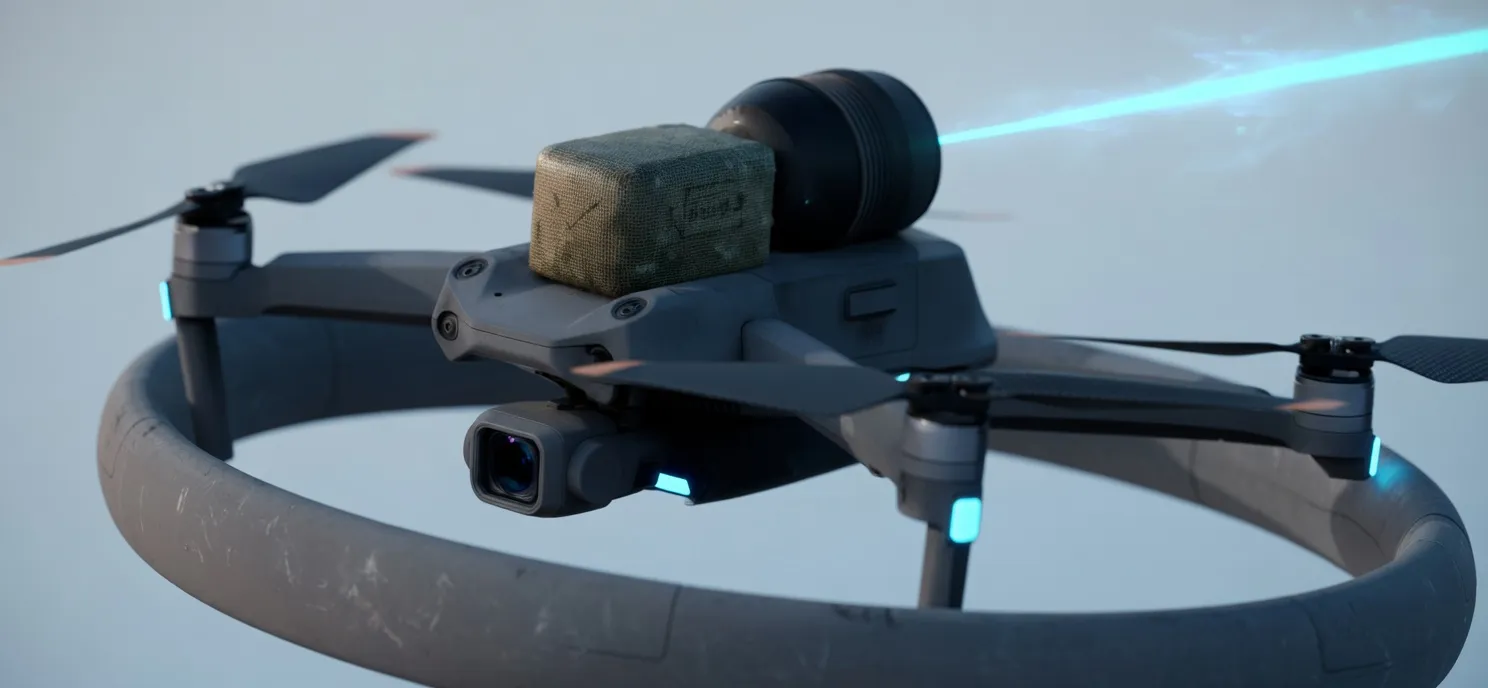
Highlights
- DARPA's 'Rads to Watts' program has received $3.37 million to develop betavoltaic batteries targeting power output exceeding 10 W/kg using Strontium-90 extracted from nuclear waste.
- Morgan State University leads the program as prime contractor, partnering with Northrop Grumman, Pacific Northwest National Laboratory, and Project Omega; a working prototype is expected by early 2027.
- The U.S. currently stockpiles more than 100,000 metric tons of nuclear waste across 52 reactor sites, which the program aims to repurpose as an energy source for long-endurance defense systems.
- Betavoltaic-powered drones could theoretically remain airborne for 30+ years without refueling, enabling persistent surveillance and strike capabilities that would fundamentally alter military planning.
- In the Russia-Ukraine conflict, drones are responsible for approximately 80% of front-line casualties; Ukraine struck Russian bombers worth over $7 billion using drones costing only hundreds of thousands of dollars, illustrating the strategic stakes of long-endurance UAV technology.
Nuclear Waste-Powered Drones: DARPA's 'Rads to Watts' Program Aims to Keep UAVs Airborne for 30+ Years
Imagine a fleet of small drones, each capable of staying aloft for more than thirty years — silently monitoring adversary movements around the clock, collecting intelligence, and ready to strike high-value targets on command. Now imagine not just one, but hundreds of such platforms hovering silently in the atmosphere, never landing, never refueling, waiting to act. Every military base, airfield, aircraft carrier, and ammunition depot would be a permanent target, at risk of attack from drones deployed decades earlier.
For military planners, that scenario is a nightmare. And the United States is actively working to make it a reality.
DARPA's 'Rads to Watts' Program
Scientists, defense experts, and researchers from multiple U.S. universities are collaborating to develop a new class of battery that converts nuclear waste directly into electricity — potentially enabling drones, satellites, and other defense systems to operate for decades without refueling or recharging.
The effort falls under DARPA's 'Rads to Watts' program, which aims to create lightweight, compact batteries that harness energy from radioactive isotopes such as Strontium-90 (Sr-90), turning nuclear waste into high-density, long-duration power.
The program has recently secured $3.37 million in funding to develop a proof-of-concept device capable of delivering more than 10 watts per kilogram (W/kg).
"The Rads to Watts program is centered on developing a new class of betavoltaic devices that dramatically increase power density — the power produced per unit mass of the device, measured in W/kg. Achieving high power density while maintaining long operational lifetimes could unlock entirely new application possibilities." — Morgan State University, lead research institution
Partners and Roles
The program brings together a consortium of institutions with distinct responsibilities:
- Morgan State University — Prime contractor, leading fundamental research
- Pacific Northwest National Laboratory (PNNL) — Nuclear material handling and testing; responsible for delivering a working prototype by early 2027
- Northrop Grumman — Applying AI-driven computational modeling to rapidly evaluate materials and device designs, ensuring prototypes meet performance benchmarks
- Project Omega — Developing generators that extract isotopes from existing nuclear waste stockpiles rather than newly produced radioactive materials
"Solar cells convert sunlight directly into electricity… Our technology converts radiation directly into electricity." — Stafford Sheehan, CEO and Founder, Project Omega
Nuclear Waste: An Abundant and Problematic Energy Source
Leveraging existing nuclear waste is a central advantage of this approach. Researchers estimate that more than 100,000 metric tons of nuclear waste are currently stored across 52 reactor sites in the United States. That stockpile could provide ample fuel for drones and other defense systems while simultaneously addressing the long-standing challenge of safe waste disposal.
"Simply put, we take nuclear waste and recycle it into two products: one is reactor fuel… the other is energy isotopes — isotopes that can be used to power various devices." — Stafford Sheehan
"The federal government faces billions of dollars in litigation every year due to improperly managed nuclear waste." — Stafford Sheehan, speaking to Defense One
Betavoltaic batteries derived from waste-sourced energy isotopes, paired with ultra-thin semiconductors, are designed to deliver sustained, high-density power for decades.
"Continuous power is a foundational requirement for next-generation defense systems." — Matt Hicks, Director of Foundry, Test, and Advanced Packaging, Northrop Grumman
Technical Characteristics and Safety Considerations
The program's use of Strontium-90 presents a lower hazard profile than Plutonium-238 (Pu-238), the isotope commonly used in space missions. The radioisotope power systems are also engineered to function in extreme thermal environments, supporting military operations in harsh conditions.
"We've been using these radioisotope power systems in space for decades. We're essentially taking the space-rated systems and adapting them with different isotopes." — Stafford Sheehan
Beyond defense applications, betavoltaic batteries could serve any scenario where battery depletion is unacceptable — satellites being a prime example: "Once a satellite loses power, the satellite is lost."
However, researchers must still confirm that deploying isotope-powered drones in the open environment poses no radiation risk to people or ecosystems — a critical hurdle that must be cleared before any operational or commercial deployment.
A New Dimension in Drone Warfare
Drones have already become a defining weapon of modern conflict. In the Russia-Ukraine war, drones account for an estimated 80% of front-line casualties, with both sides launching thousands of sorties daily. Ukraine has developed drones capable of flying more than 2,500 kilometers, and last June's 'Operation Spider Web' demonstrated the extraordinary asymmetric potential of low-cost UAVs: dozens of drones were smuggled into Russia concealed in trucks, then autonomously guided by AI software to destroy Russian strategic bombers valued at more than $7 billion — at a drone cost of only a few hundred thousand dollars.
If nuclear waste-powered drone technology matures, future operations of that kind would require no smuggling at all. Drones could loiter silently in uncontested airspace for decades, ready to strike high-value targets anywhere on earth at a moment's notice. In that future, there may be no such thing as a truly safe location.
原文來源: 查看原文
FAQ
Newsletter
Subscribe to our Low-Altitude Industry Newsletter
Daily curated news on low-altitude economy and drone industry, delivered to your inbox.
Reviewed and published by the LAETimes editorial desk ·