China Releases Rare Footage of DF-17 Hypersonic Missile Launch Alongside Upgraded 'Guam Killer' DF-26
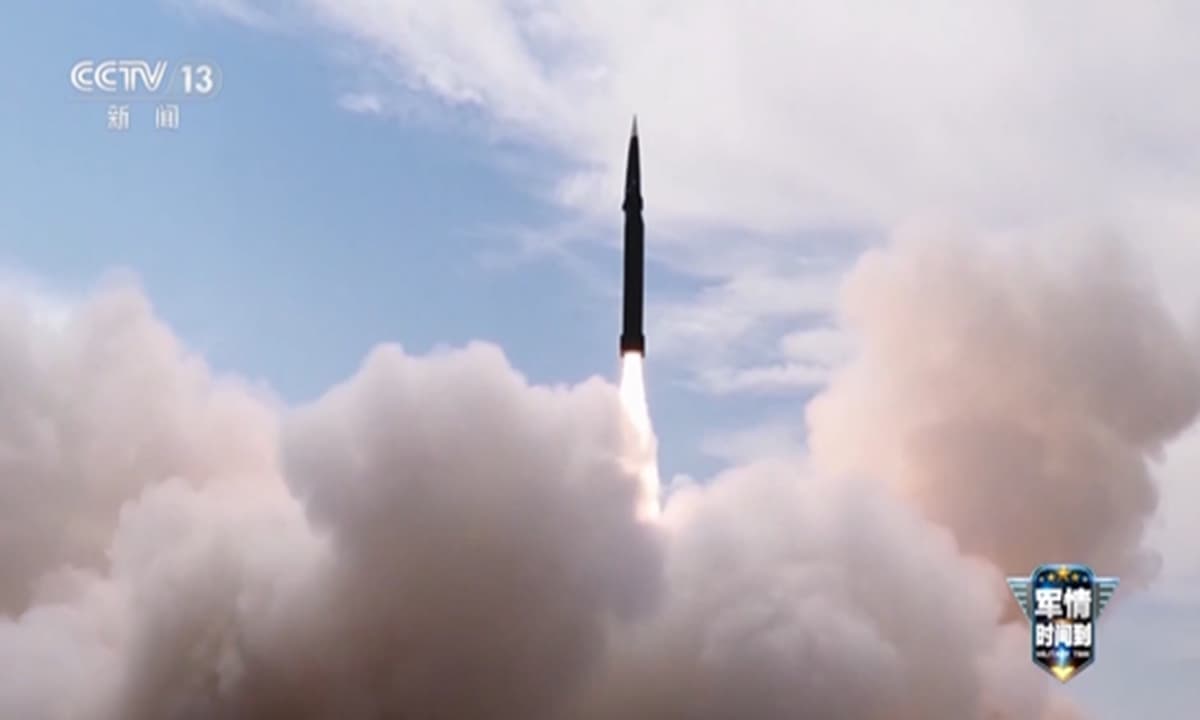
Chinese state broadcaster CCTV aired the first-ever publicly released launch footage of the DF-17 hypersonic glide vehicle missile on June 20, alongside what analysts identified as an upgraded variant of the DF-26 'Guam Killer' ballistic missile. The exercise was conducted in China's northwestern Gobi Desert, just days before the opening of RIMPAC 2026, and is being interpreted as a deliberate deterrence signal directed at the United States and its allies.
Highlights
- CCTV broadcast the first-ever public launch footage of China's DF-17 hypersonic glide vehicle missile on June 20, during a joint PLARF exercise in the Gobi Desert.
- An upgraded DF-26 'Guam Killer' variant featuring terminal-phase control fins for enhanced maneuverability and missile-defense penetration was displayed in the same broadcast.
- The exercise took place days before RIMPAC 2026 opened on June 24, with analysts interpreting it as a deliberate deterrence signal to the U.S. and its allies.
- Analyst Srikanth Kondapalli cited three Chinese strategic objectives: pressuring U.S. policy recalibration, deterring military aid to Taiwan including a pending $14 billion arms sale, and signaling the ability to interdict Guam-based U.S. support.
- The DF-17 has a range of 1,800–2,500 km and can threaten the First Island Chain; the DF-26 exceeds 4,000 km range and can strike U.S. assets across the Second Island Chain including Guam.
Chinese state broadcaster CCTV has aired what is believed to be the first-ever publicly released launch footage of the DF-17 hypersonic glide vehicle (HGV) missile, while also showcasing what military analysts have identified as a newly upgraded variant of the DF-26 'Guam Killer' intermediate-range ballistic missile.
Joint Combat Exercise
The footage, broadcast on June 20, shows People's Liberation Army Rocket Force (PLARF) personnel conducting joint training exercises with army and air force units in China's northwestern Gobi Desert. The drills involved multiple missile types and were intended to demonstrate the Rocket Force's diverse arsenal across a range of threat scenarios and operational environments. The exercise was first reported by the Global Times.
First Public Launch Footage of the DF-17
The DF-17 launch sequence drew significant attention as the first time such footage has been made available to the public. CCTV's main news segment showed the missile — featuring its distinctive wedge-shaped waverider HGV — consistent with the DF-17 systems displayed at the 2019 and 2025 PLA military parades. The footage shows the DF-17 launching vertically from a road-mobile transporter-erector-launcher (TEL).
A separate military channel segment also showed another TEL erecting a missile with a biconic (cone-shaped or double-cone) aerodynamic profile similar in appearance to the DF-17, which analysts noted had not previously been publicly revealed.
Upgraded DF-26 and Terminal Maneuverability
The broadcast also featured what appeared to be an upgraded variant of the DF-26 medium-range ballistic missile, reportedly fitted with control fins near the warhead section.
Military commentator Du Wenlong explained that control fins positioned near the warhead are designed to alter the missile's flight path in both horizontal and vertical planes during the terminal phase. This capability allows the missile to decelerate, perform course corrections, and improve its ability to strike maneuvering targets while defeating missile defense systems. He added that warheads equipped with such fins typically possess terminal maneuverability, substantially enhancing their ability to penetrate air and missile defense networks.
CCTV's footage did not disclose the exact specifications of the missile. The DF-26, nicknamed the 'Guam Killer,' has a range sufficient to strike the U.S. territory of Guam in the Western Pacific in the event of a conflict.
Analysts: A Key Signal for Deterrence
Former PLA instructor Song Zhongping stated that the DF-17 and DF-26 "have been in service for some time, and the Rocket Force may need exercises to confirm their performance and reliability." He emphasized: "This exercise demonstrated the ability to launch from any location at any time without relying on fixed positions — a key element in enhancing deterrence."
The exercise reportedly involved multiple simulated strike waves under demanding operational conditions, including intense electromagnetic jamming and scenarios involving the threat of precision strikes. According to CCTV, missile units were able to rapidly switch between operational modes during combat patrols in response to changing orders.
CCTV reporting highlighted that current systems are configured for flexible deployment, reducing dependence on fixed launch sites. The latest missile systems are described as more automated, more mobile, more accurate, capable of operating in all weather conditions, independent of permanent infrastructure, and equipped with improved penetration capabilities.
Du Wenlong told the Global Times: "This launch exercise was not conducted under ideal conditions — it was carried out amid various forms of interference. Successfully completing different combat missions, launching missiles on schedule, and achieving effective strikes under such conditions is an important benchmark for operational capability."
Deterrence Timing Ahead of RIMPAC
Some analysts view the public disclosure as a deliberate signal to the United States and its allies, coming just days before the opening of RIMPAC 2026 on June 24.
Analysts noted that the timing and context of the exercise suggest China's intention to send a deterrence message to Washington by emphasizing strike capabilities — particularly against the backdrop of escalating tensions in the Taiwan Strait, the First Island Chain, and the South China Sea. Notably, the display came just weeks after U.S. President Donald Trump's visit to Beijing, which had produced signs of a diplomatic 'thaw' between the two nations.
Srikanth Kondapalli, Professor of Chinese Studies at Jawaharlal Nehru University in India, told The Eurasian Times: "China is not satisfied with the status quo with the United States and wants more concessions." He identified three strategic objectives behind the display: first, to pressure Washington to recalibrate its China policy; second, to deter the U.S. from providing military assistance to Taiwan — a pending $14 billion arms sale awaits approval by President Trump; and third, to signal through the DF-26 that China possesses the capability to interdict U.S. military support flowing from Guam to Taiwan or Japan.
DF-17 and DF-26 Capabilities in Detail
DF-17 Hypersonic Missile
The DF-17 is China's first road-mobile medium-range ballistic missile (MRBM) equipped with a hypersonic glide vehicle (HGV), with an estimated range of 1,800 to 2,500 kilometers. It is regarded as Beijing's most mature hypersonic strike system and is considered capable of defeating nearly all existing missile defense systems worldwide.
Unlike conventional ballistic missiles, which follow fixed and predictable trajectories, the DF-17 can execute extreme maneuvers and evasive actions, making it significantly more difficult to detect and intercept by systems such as the Patriot, Aegis, and THAAD. This gives it the potential to suppress enemy missile defenses in the early stages of a conflict, clearing the way for follow-on strikes.
The DF-17 made its public debut at the PRC's 70th National Day parade in October 2019. In 2021, the PLA conducted its first known hypersonic test involving the DF-17 glide vehicle, an event that drew significant concern in Washington.
The Pentagon's 2022 China Military Power Report identified the DF-17 as an HGV-powered MRBM designed to strike foreign military installations and fleets in the Western Pacific, stating: "The DF-17 has been successfully tested and is deployed operationally. While primarily intended as a conventional platform, it may be capable of carrying a nuclear warhead."
The DF-17 can penetrate U.S. missile defense systems in the region and potentially threaten the First Island Chain — stretching from the Japanese archipelago through Taiwan to the Philippines — as well as portions of the Second Island Chain extending from Japan through Guam, Micronesia, and Palau. This makes it a threat to Taiwan, the Philippines, and Japan, and a central element of China's sophisticated anti-access/area-denial (A2/AD) network.
DF-26 'Guam Killer'
The DF-26 is a two-stage, solid-fueled, road-mobile intermediate-range ballistic missile (IRBM) with an estimated range exceeding 4,000 kilometers. It is capable of striking U.S. military bases on Guam, naval assets along the Second Island Chain, and carrier strike groups operating in the Philippine Sea.
The missile earned the nickname 'Guam Killer' due to its extended range and reported ability to target Guam. The system can rapidly switch between conventional and nuclear warheads, is designed for precision strikes against both land and maritime targets, and carries an estimated payload of approximately 1,200 to 1,800 kilograms.
The DF-26 is equipped with advanced guidance systems including multispectral sensors, an active radar seeker, and electronic warfare (EW) countermeasures such as decoys and electronic jamming. The upgraded DF-26 variant seen in the CCTV footage is assessed to further enhance missile performance, increasing the threat it poses to potential adversaries.
原文來源: 查看原文
FAQ
Reviewed and published by the LAETimes editorial desk ·