DJI AP100 Parachute Officially Launched: Unlocking Populated-Area Flight Certification for European Matrice 400 Operators
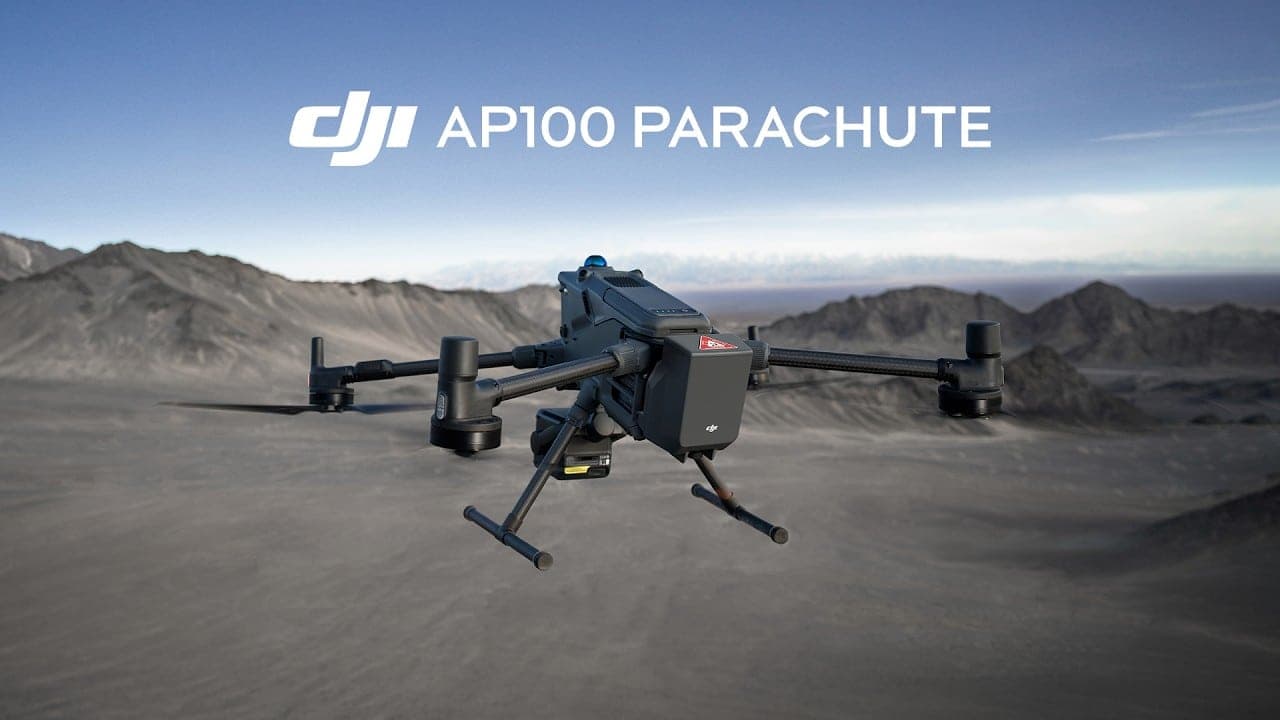
DJI officially launched the AP100 parachute on July 8, 2026, designed exclusively for the Matrice 400. The rear-mounted emergency recovery system deploys within 600 milliseconds, slowing descent to under 5 m/s. Weighing approximately 935 grams, it meets EASA C5/C6 and UK CAA UK5/UK6 certification requirements, enabling operators to legally fly over populated areas and conduct BVLOS missions in Europe and the UK. No U.S. availability is planned due to FCC restrictions.
Highlights
- DJI 於 2026 年 7 月 8 日發布 AP100 降落傘,專為 Matrice 400 設計,可在 600 毫秒內展開,將下降速度控制在每秒 5 公尺以下。
- AP100 重 935 公克,安裝後讓 Matrice 400 符合 EASA C5/UK5 認證要求,可合法執行 STS-01 人口密集區任務;C6/UK6 等級需新機或送廠升級。
- AP100 配備獨立飛控、感測器與電源,內建雙電容器提供最長 1 小時備援電力,不依賴飛行器 E-Port 或主電源運作。
- DJI 因 2025 年 12 月 22 日起被列入 FCC 涵蓋清單,AP100 目前無美國上市計畫,該產品明確針對歐盟與英國市場設計。
- AP100 直接競爭 AVSS、ParaZero 等第三方降落傘廠商,並以原生 E-Port V2、Pilot 2 健康監控及 FlightHub 2 遠端觸發形成整合優勢。
DJI officially launched the DJI AP100 parachute on July 8, 2026 — a rear-mounted emergency recovery system designed exclusively for the Matrice 400. The system deploys in under 600 milliseconds, slowing the aircraft to a descent speed of less than 5 m/s (16.4 ft/s). The release went live at 8:00 a.m. ET, as DJI had previously signaled, under the tagline "For the Priceless Below" — the same phrase used in a cryptic teaser DJI Enterprise published six days earlier.
It is worth noting that many observers — including this reporter — had speculated from the teaser's dark silhouette that DJI was about to reveal a successor to the Matrice 30. Instead, DJI unveiled a parachute. While comment sections were filled with users hoping for a new aircraft, for European enterprise operators the AP100 may ultimately prove the more consequential product.
Core Specifications
The AP100 weighs approximately 935 g (2.1 lb) and mounts to the rear of the aircraft, adding roughly 6 minutes of flight time cost. Once installed, it brings the Matrice 400 into compliance with EASA C5 and UK CAA UK5 class identification requirements — the critical threshold for legally operating over people in Europe and the United Kingdom.
An Independent Backup System Built to Survive Aircraft Failure
The AP100 features its own independent flight control system, independent sensors, and an independent power supply. Even if the Matrice 400's battery, flight controller, or control link fails completely mid-mission, the AP100 continues to monitor flight attitude and can trigger deployment autonomously.
According to DJI, the system begins self-checking its gas generator and communication links the moment the drone powers on, and continuously cross-references flight data between the aircraft and the parachute unit to reduce the risk of accidental deployment. The system does not rely on the aircraft's power supply or E-Port connection; dual built-in capacitors provide up to 1 hour of independent backup power.
When the system detects abnormal attitude or velocity, an independent Flight Termination System (FTS) cuts motor power within 600 milliseconds, halting the rotors before ejecting the canopy — preventing suspension lines from becoming entangled with spinning propellers. When deployed at 30 m (98 ft) or higher, the parachute stabilizes descent to below 5 m/s. After deployment, the AP100 emits a loud audible alarm and high-intensity strobe light for approximately 1 hour, alerting bystanders and helping operators recover the aircraft.
In DJI Enterprise's launch video, pilots can trigger manual deployment by swiping within the DJI Pilot 2 interface, or remotely via the FTS page in FlightHub 2. The AP100 carries the same IP55 rating as the Matrice 400 itself, operates in temperatures from -20°C to 50°C (-4°F to 122°F), maintains a maximum takeoff weight of 15.8 kg (34.8 lb), and can still fit inside the original carry case after installation.
C5 Is a Retrofit Upgrade; C6 Requires a New Aircraft
Adding the AP100 to an existing Matrice 400 satisfies the operational safety requirements for C5 or UK5 classification, enabling STS-01 operations (flight over populated areas). However, C6 and UK6 class labels apply only to factory-certified systems — meaning operators must purchase the new Matrice 400 (C6) Worry-Free Plus Combo, which includes the parachute from the factory.
This distinction is critical for BVLOS operations. STS-02 — the European standard scenario covering beyond visual line of sight missions such as road surveys and pipeline inspections — requires C6 or UK6 certification. According to DJI authorized reseller Heliguy, existing M400 owners can purchase the AP100 and send both the unit and their aircraft to DJI for C6 or UK6 class upgrade certification. The system also complies with MOC 2511 and MOC 2512 declarations and the ASTM F3322 small UAS parachute system standard.
In the EU, UK, and other supported regions, the parachute will deploy automatically if the drone crosses a Geocaging boundary set within DJI Pilot 2.
Operators should note that installing the AP100 automatically disables the M400's downward- and rear-facing millimeter-wave radar, reducing obstacle detection in those directions. In addition, the pyrotechnic ejection system is single-use — it must be replaced after deployment before the next flight. DJI also recommends retiring the AP100 three years after activation, regardless of self-check results.
No U.S. Market Access for Now
Every compliance pathway the AP100 unlocks runs through EASA or the UK CAA. DJI's announcement makes no mention of the FAA, U.S. pricing, or U.S. availability timelines, stating only that the product will be sold through authorized DJI Enterprise resellers.
This is not coincidental. Since December 22, 2025, DJI has been listed on the FCC Covered List, barring new DJI wireless equipment from obtaining the equipment authorization required to legally sell in the United States. The AP100 contains independent sensing and communications electronics — launching it under these circumstances makes clear exactly which market DJI built this product for.
DroneXL Analysis
For European utility teams or urban survey operations, the AP100 may be worth far more than a brand-new aircraft. The certification class itself is the product. A new drone requires navigating a full EASA review process from scratch; the AP100 converts an M400 operators already know and trust into a machine that can legally operate over people and fly STS-02 BVLOS missions in a factory-certified configuration. Unremarkable hardware, real operational capability.
The AP100's launch also has implications for third-party parachute manufacturers. Just one day before DJI's announcement, DroneXL reported that AVSS had surpassed 2,000 cumulative system deliveries this year — AVSS being the company that announced a parachute recovery system for the Matrice 400 within days of the aircraft's June 2025 debut. ParaZero has similarly built its business model around this niche. With DJI now entering the field on its own flagship aircraft, backed by native E-Port V2 integration, Pilot 2 health monitoring, and FlightHub 2 remote deployment, third-party vendors struggle to fully match that level of integration on DJI platforms.
The one moat these companies retain is one DJI cannot cross: the U.S. market. In the United States, Category 2 over-people operations rely on ASTM declarations, and the FCC Covered List blocks DJI's own accessories from entry. How AVSS and ParaZero position themselves over the coming months — whether they pivot more aggressively toward U.S. operators and non-DJI platforms — will reveal how much room DJI's first-party push has actually left in Europe.
Sources: DJI Media Center, DJI Enterprise (YouTube), Heliguy
Automated tools were used to assist with research and data extraction. All reporting and editorial commentary by Haye Kesteloo.
原文來源: 查看原文
FAQ
Reviewed and published by the LAETimes editorial desk ·


