DJI Matrice 4 Drones Help German Volunteers Rescue 20x More Fawns Before Mowing Season
Bavarian wildlife rescue group Rehkitz-Rettung Mangfalltal has increased annual fawn rescues from 10–15 to 300–350 after deploying DJI Matrice 4T and 4TD thermal drones. Germany's Federal Ministry of Agriculture has allocated €2.1 million in 2026 subsidies for thermal drone purchases, with eligible registered associations receiving up to €3,000 per unit.
Highlights
- Rehkitz-Rettung Mangfalltal increased annual fawn rescues from 10–15 to 300–350 — nearly 20 times — after deploying DJI Matrice 4T and 4TD thermal drones.
- Missions begin before dawn when the cool ground maximises the thermal contrast between a fawn's body heat and surrounding vegetation, enabling clear infrared detection.
- Pilot Tim Rau reports the Matrice 4 platform covers roughly 50% more field area per mission day than the previous drone generation, using RTK positioning and onboard AI detection.
- Germany's BMLEH has allocated €2.1 million in 2026 subsidies for thermal drones, with eligible registered associations receiving up to €3,000 per unit.
- The Matrice 4TD's IP55 weather resistance and approximately 10-second deployment time make it the preferred model for pre-dawn, multi-field rescue operations.
A Bavarian wildlife volunteer group that once saved just 10 to 15 fawns per year before the mowing season now rescues 300 to 350 — and the difference comes down to a thermal camera in the sky.
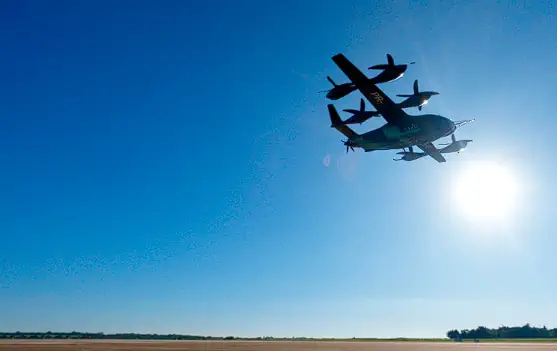
Rehkitz-Rettung Mangfalltal, a volunteer rescue organization based in the Mangfall Valley south of Munich, has integrated the DJI Matrice 4T and the weatherproofed Matrice 4TD into its operations, enabling crews to locate newborn deer hidden in tall grass before farm machinery arrives and relocate them to safety.
Each spring, thousands of fawns, hares, and ground-nesting birds across Germany are killed by mowing equipment. A newborn fawn's survival instinct is to freeze and press flat against the ground when danger approaches — a reflex that fools predators but offers no protection against a 12-metre (39-foot) wide mower moving at speed. For years, the only countermeasure was volunteers walking shoulder-to-shoulder across fields, yet even systematic sweeps missed animals, because day-old fawns emit almost no scent and are visually indistinguishable from surrounding grass at ground level.
DJI published a case study and operational workflow video in late June 2026 walking through the full methodology. The rescue figures come from the responders themselves, and the roughly 20-fold improvement is attributed almost entirely to replacing foot searches with aerial thermal detection.
Cool Morning Air Makes the Thermal Signal Stand Out
Missions begin before dawn, and the timing is deliberate. In the early morning, the ground is still cold, maximising the temperature differential between a fawn's body heat and the surrounding vegetation — the contrast that allows infrared sensors to clearly register warm objects. Flying over vegetation at midday, after the sun has warmed the ground, causes the fawn's thermal signature to blend into the background.
Pilots fly at 80 to 100 metres (262 to 328 feet) above the field, running either pre-planned automated missions or manual flight, with the drone's thermal camera reading body heat directly through dense grass that blocks ground-level observers.
When a heat source appears, the pilot uses a shortcut on the DJI RC Plus 2 controller to switch to a split-screen view, placing the thermal feed alongside the zoom-camera image and magnifying from cruise altitude to confirm whether the object is a fawn or a molehill or a warm stone. This avoids descending and climbing again for confirmation, saving both time and battery. Once the animal is positively identified, the pilot marks a centimetre-accurate Pinpoint location and shares the GPS coordinates with the ground team.
"We can keep the drone in the air longer without intermediate landings, cover more area, and survey fields faster," said Tim Rau, pilot and chairman of Rehkitz-Rettung Mangfalltal, crediting RTK positioning and onboard AI detection — and noting that the current hardware covers roughly 50% more area per mission day than the previous generation. RTK (Real-Time Kinematic) positioning is what delivers centimetre-level accuracy for each animal's location, a capability built into the AI-driven Matrice 4 series that DJI launched in early 2025.
Image credit: DJI Enterprise and KR-Copter
Handling Determines Whether the Fawn Survives
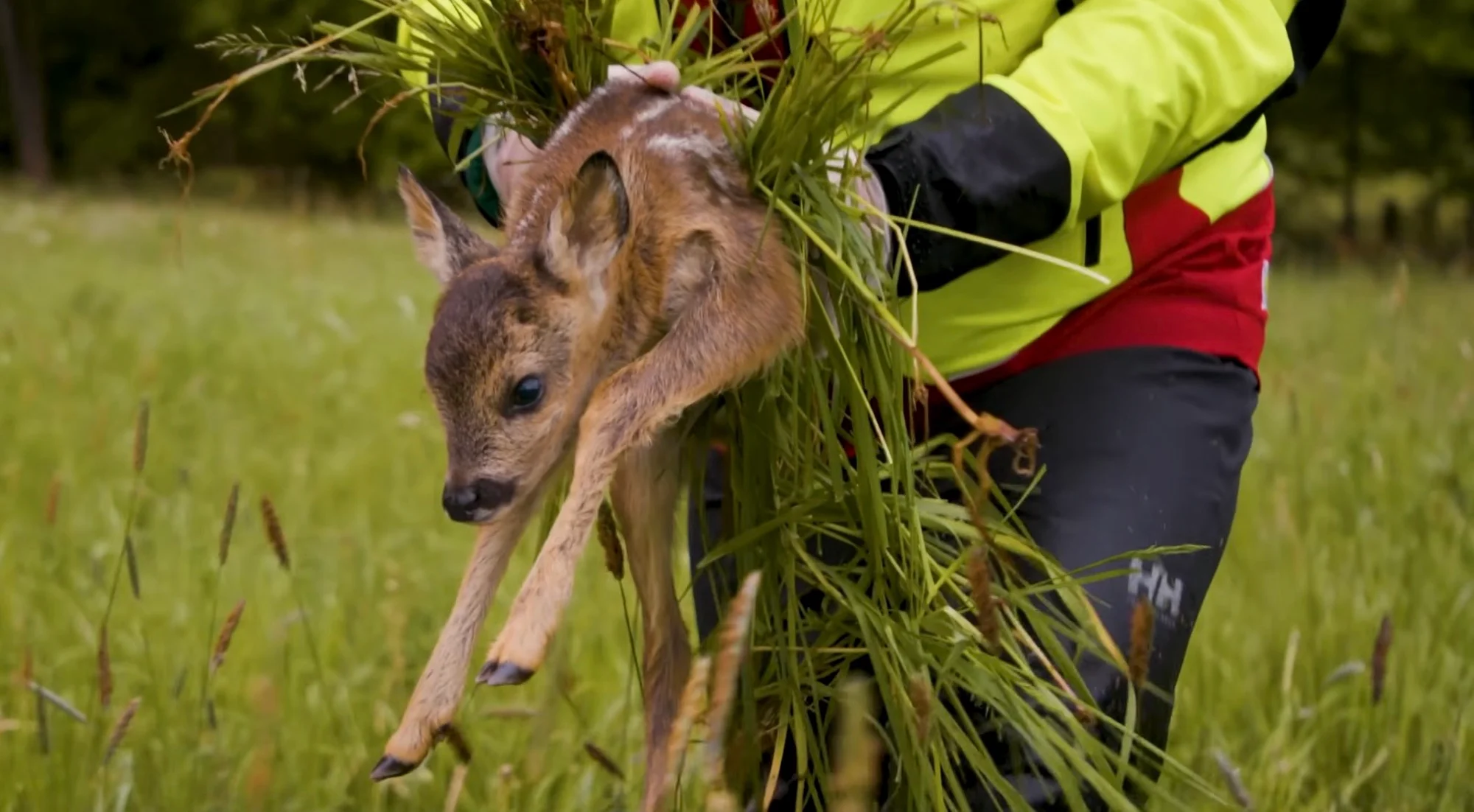
Locating a fawn is only half the task; incorrect handling can also prove fatal. A rescued fawn must carry no human scent, because a doe that detects human smell on her offspring will abandon it. Ground crew wear gloves and grab a handful of grass to pad their hands, ensuring skin never touches the fawn's coat. The animal is placed in a grass-lined box, the lid secured with zip ties and ventilation gaps left open; because does typically place two fawns together, siblings can share one box if it is large enough.
The box is set in shade at the field's edge — preferably against a hedgerow or woodland border — to await completion of the mowing run. Timing is again critical: fawns require regular feeding and cannot remain boxed for long, so responders stress tight coordination between farmers and volunteers to minimise waiting time. Once the field is cut and the hazard has passed, the fawns are released; the doe locates them quickly by following their calls.
Matrice 4TD: Weather Resistance for All-Conditions Endurance
Both models carry identical thermal and optical sensors, but they serve different operational contexts. The foldable Matrice 4T prioritises portability and suits manual search work. The Matrice 4TD is a fixed-arm rugged variant whose IP55 rating allows it to keep flying in rain, whereas the standard 4T carries no official water resistance rating. The 4TD requires no arm unfolding before deployment and is airborne in approximately 10 seconds; batteries provide up to 54 minutes of flight time. For teams crossing multiple fields before sunrise, the ready-to-fly design and extended endurance are the reasons to choose the weatherproof model. The same all-weather tolerance led a search-and-rescue team in Timmins, Ontario, Canada, to adopt the 4TD for snow and darkness operations earlier this year.
Both models feature a 640×512 thermal camera with up to 1280×1024 infrared super-resolution, a 48-megapixel telephoto lens, and a laser rangefinder. More operationally significant for this use case: the Matrice 4 platform supports organisations training and deploying their own visual and thermal detection models, enabling algorithms built specifically for fawn identification — a high-value, narrow-domain task where generic object detection often falls short.
Image credit: DJI Enterprise and KR-Copter
German Government Subsidises the Hardware
Thermal drones are expensive, but Germany treats fawn rescue as subsidisable public infrastructure. The Federal Ministry of Food, Agriculture and Home Affairs (BMLEH) Rehkitzrettung programme continues into 2026 with €2.1 million earmarked for thermal drone purchases in support of wildlife rescue. Eligible registered associations can claim a flat subsidy of up to €3,000 per drone, provided their statutes explicitly list fawn rescue as an organisational mission. Germany has also eased the regulatory environment, having relaxed drone flight rules for agricultural fawn rescue in 2024.
Editor's Note
This is the clearest possible answer to the argument that drones are simply a nuisance buzzing over parks. The 20-fold rescue improvement is not a marketing figure invented by DJI; it is a number the responders calculated themselves, and it aligns precisely with what better sensors, RTK accuracy, and trainable AI can deliver in a pre-dawn meadow.
The wider policy implication is worth sitting with: the most capable and cost-effective tool currently available for this task is a DJI drone — the same brand the United States is moving to legislate out of its market, while Germany is choosing to fund with public subsidies so more volunteers can afford one. When policy makes the best lifesaving hardware harder to obtain, the cost is not paid by DJI. It is paid in a field at five in the morning, one life at a time.
Sources: DJI via PR Newswire; DJI Enterprise and KR-Copter operational workflow video. Written report: Haye Kesteloo (DroneXL).
原文來源: 查看原文
FAQ
Reviewed and published by the LAETimes editorial desk ·