DJI Mimo 2.10.10 Update Is Built Around a Camera Americans Can't Buy
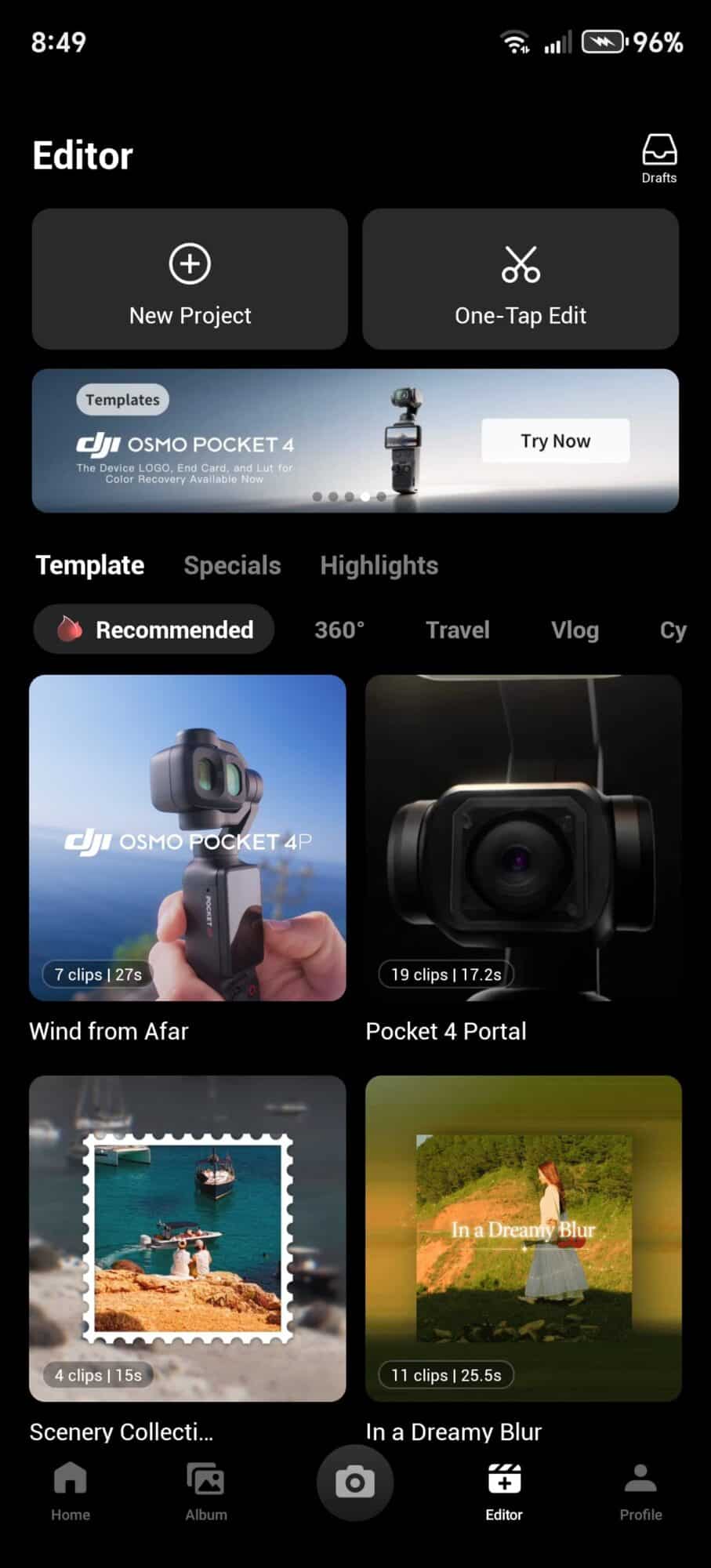
DJI released Mimo app version 2.10.10 on July 1, adding four Master Filters, full D-Log 2 support in Color Presets, a preset share-code system, and a customizable three-panel live-stream layout — all centered on the Osmo Pocket 4P, a dual-lens gimbal camera that remains unavailable in the U.S. due to FCC Covered List restrictions.
Highlights
- DJI released Mimo app version 2.10.10 on July 1, 2025, primarily adding features for the Osmo Pocket 4P dual-lens gimbal camera.
- The update introduces four Master Filters, full D-Log 2 Color Preset support, an edit-preset share-code system with expiration dates, and a customizable three-panel live-stream layout.
- The Osmo Pocket 4P launched in China on June 15 at RMB 3,799 (~USD 525) and expanded to Japan, Indonesia, and Vietnam on June 29, with no U.S. launch date announced.
- DJI's inclusion on the FCC Covered List since December 22, 2025 blocks new wireless-capable hardware from receiving U.S. equipment authorization, making the Pocket 4P the second consecutive Pocket-series product to skip the U.S. market.
- Mimo 2.10.10 is freely available on the U.S. App Store and fully functional for U.S. users with existing supported DJI cameras, as the Covered List does not restrict software distribution.
DJI pushed Mimo app version 2.10.10 to the Apple App Store on July 1, with release notes focused almost entirely on the Osmo Pocket 4P — a dual-lens pocket gimbal camera that still has no announced U.S. launch date.
The update introduces four Master Filters, full D-Log 2 support in Color Presets, an edit-preset share-code system, a customizable three-panel live-stream layout, and the ability to import ride data from a Chinese cycling app. The download size on the App Store is 1.9 GB.
Mimo 2.10.10 Revolves Around the Osmo Pocket 4P
The centerpiece of this update is the Osmo Pocket 4P — a 230 g (8.1 oz) dual-lens gimbal camera unveiled by DJI in China on June 15. It features a one-inch primary sensor, a 60 mm f/1.8 telephoto lens, 17 stops of dynamic range, and 103 GB of built-in storage.
The Osmo Pocket 4P is the first dual-lens model in the Pocket line. DJI positions the 60 mm telephoto as a portrait focal length, offering less facial distortion and stronger background separation than the primary wide-angle lens. The main sensor supports up to 4K 240fps video recording.
DJI first showed the Pocket 4P at the Cannes Film Festival on May 14, but did not reveal full specs and pricing until the China launch a month later. The Mimo update completes the software side of that product rollout.
The app adds four Master Filters named Vista Pro, Grace Pro, Radiant Pro, and Retro Pro. DJI lists them under Pocket 4P support in the release notes, allowing creators to apply cinematic color styles without leaving their phone.
Color Presets now include full D-Log 2 support in the same update. D-Log 2 is the 10-bit flat color profile used by the Pocket 4 generation. Prior to this release, the app's one-tap presets did not fully support that format. Creators chasing 17 stops of dynamic range no longer need to route footage through desktop software to complete a color grade.
Preset Share Codes Expand Beyond Color Grading
The preset sharing and import feature can now generate share codes for custom edit presets. Another Mimo user can apply an entire editing configuration with a single tap. This share-code system builds on the color-grading and edit-effect sharing mechanism that DroneXL covered on June 1.
The underlying mechanics follow the existing system. Mimo stores presets in five local slots (C1 through C5), and generated share codes carry an expiration date to prevent specific looks from circulating indefinitely online.
A customizable three-panel live-stream layout is another major editing addition in this release, letting users freely arrange, move, or resize each panel. This is particularly useful for creators editing vertical multi-angle content on their phones.
All of these editing features work on footage from cameras already supported by Mimo — which is the most relevant detail for users on the other side of the Pacific.
The Feature List Is Also a Roadmap of DJI's Market Focus
Beyond the filters, this update makes DJI's current target markets clear. The Sports Dashboard now supports ride-data imports from Xingzhe, a Chinese cycling app built on Baidu Maps that is only available on Chinese app stores. When its developer sought to expand into North America, it launched a separate brand called Xoss. This integration was not built for a U.S. audience.
The Osmo Pocket 4P's launch strategy tells the same story. DJI opened sales in China on June 15 at RMB 3,799 (approximately USD 525) for the standard kit, followed by Japan, Indonesia, and Vietnam on June 29. No U.S. release date has been announced, and no related statement has been made.
There is a clear reason for that silence. DJI was added to the FCC Covered List on December 22, 2025, blocking new wireless-capable hardware from obtaining the equipment authorization required for legal sale in the United States. As DroneXL noted in a June 29 comparison of the Pocket 4, Pocket 4P, and Insta360 Luna Ultra, the Luna Ultra is currently the only legally purchasable option in the U.S.
Insta360 launched the Luna Ultra in the U.S. on June 10. For consumers in the U.S. who want a new dual-lens pocket camera this summer, there is one legal option — and the box does not carry the DJI logo.
The paradox is that the FCC Covered List restricts hardware authorization, not software distribution. Mimo 2.10.10 went live on the U.S. App Store today without restriction or delay. U.S. users who own a Pocket 3 or Osmo Action 6 can access every new editing tool with a single tap. The U.S. App Store listing shows approximately 19,000 reviews and a 4.5-star rating — this is not a forgotten corner of DJI's app catalog.
For U.S. users, opening Mimo and watching it be continuously optimized for a camera they cannot legally purchase must be a frustrating experience. It is reminiscent of DJI refusing to acknowledge a drone's existence until it appeared in DJI Fly — except that situation involved no sales ban, only an unannounced product.
DroneXL's Take
What deserves more attention than the headline features is a broader pattern: DJI's software footprint and its hardware footprint no longer overlap, and DJI appears unconcerned. The Osmo Pocket 4P is the second consecutive Pocket-series product to skip the U.S. market, following the Pocket 4 — yet the app serving both cameras updates U.S. users on the same schedule as everyone else.
That suggests DJI is playing a long game with U.S. users that the FCC Covered List cannot reach. Your Pocket 3 keeps getting better. Your editing workflow stays inside the Mimo ecosystem. If and when the Covered List no longer blocks FCC equipment authorization, DJI will be welcoming back a user base that never really left.
Whether the Osmo Pocket 4P will eventually receive a U.S. launch date remains unknown rather than expected. DJI has made no announcement, and nothing on the regulatory calendar compels one.
Over the longer term, there is a credible path for DJI to sell Osmo-category products in the U.S. again — along with a meaningful portion of its broader catalog. The drone side of the business is more complicated, and the outcome will depend heavily on how effectively DJI's legal team can argue its case.
原文來源: 查看原文
FAQ
Reviewed and published by the LAETimes editorial desk ·