DJI Osmo Pocket 4, 4P vs. Insta360 Luna Ultra: Only One Is Legal to Buy in the U.S.
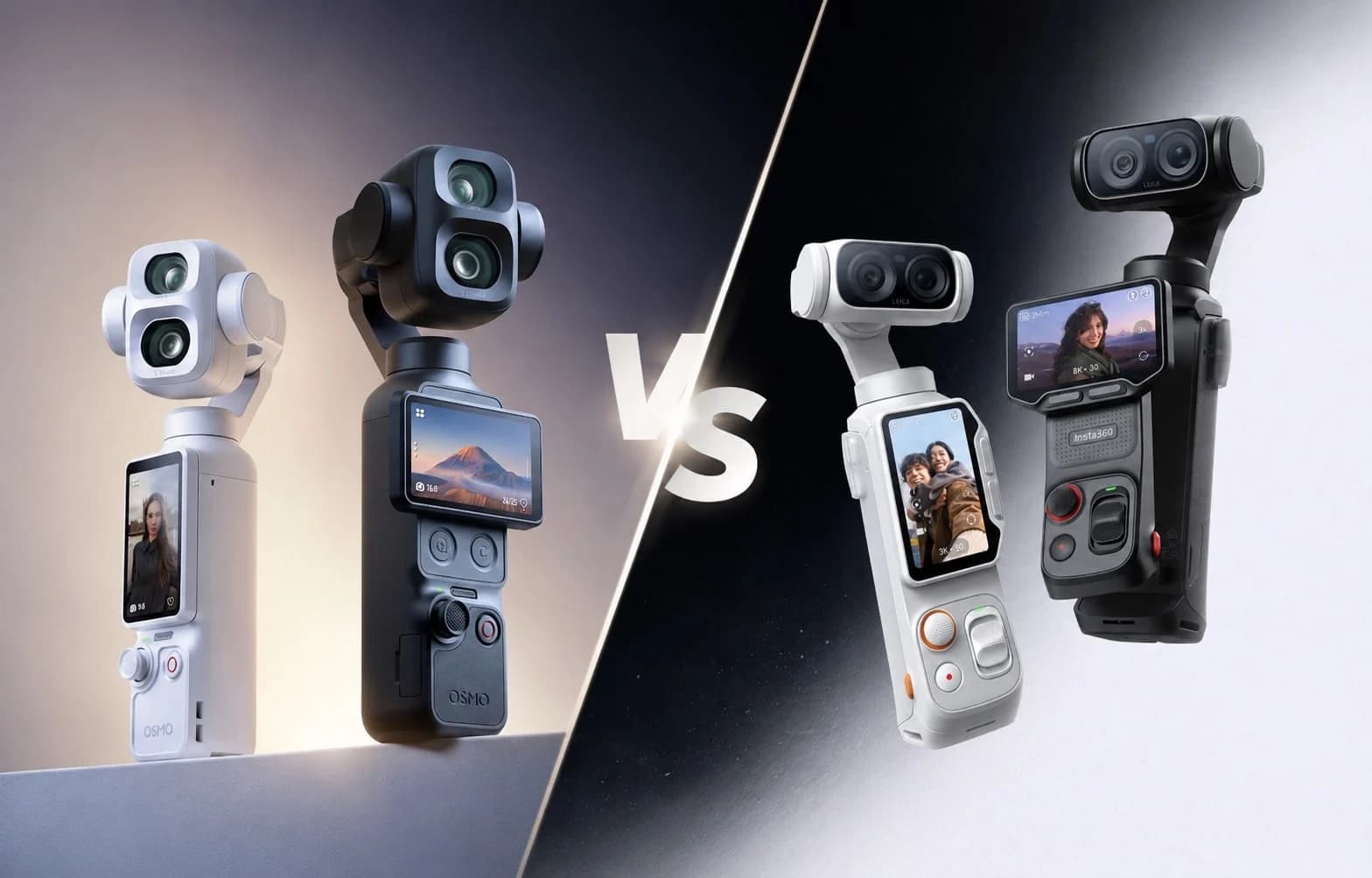
Of three flagship pocket gimbal cameras competing in 2025, only the Insta360 Luna Ultra—co-developed with Leica—can be legally sold in the United States. DJI's Osmo Pocket 4 and the dual-lens Pocket 4P are blocked by FCC Covered List restrictions dating from December 22, 2025. This article compares all three cameras on specs and unpacks the patent lawsuits DJI and Insta360 have filed against each other in a Texas federal court.
Highlights
- DJI's FCC Covered List designation, effective December 22, 2025, prevents the Osmo Pocket 4 and Pocket 4P from obtaining equipment authorization for legal U.S. sale.
- The Osmo Pocket 4P features a 1-inch LOFIC sensor with 17 stops of dynamic range and 4K/240fps slow motion, outperforming the Luna Ultra's 14-stop sensor and 4K/120fps limit.
- The Insta360 Luna Ultra is the only one of the three cameras supporting 8K/30fps with Dolby Vision and features a detachable 2-inch OLED screen usable as a wireless remote monitor up to 20 meters away.
- Luna Ultra's 32-bit float audio requires the separately purchased Insta360 Mic Pro (from USD 199.99); the built-in microphone array does not support float recording.
- DJI filed patent lawsuits in Texas federal court on June 10–11, 2025 targeting the Luna Ultra and Luna Pro; Insta360 filed a five-patent counterclaim on June 12, 2025.
Of the three pocket gimbal cameras currently defining the high-end creator market, U.S. buyers can legally purchase only one. The single-lens DJI Osmo Pocket 4 went on sale globally on April 16, 2026, while the dual-lens Osmo Pocket 4P launched in China on June 15. The dual-lens Insta360 Luna Ultra, co-developed with Leica, was announced on June 10 and is the only one of the three available on U.S. store shelves.
The barrier is not price or performance—it is a list. DJI has been on the FCC's Covered List since December 22, 2025, and neither the Pocket 4 nor the 4P has obtained the equipment authorization required for legal sale in the United States. DroneXL has tracked every development since the Pocket 4's April launch, resulting in a paradox: the higher-spec DJI cameras are the ones Americans cannot buy, while the one they can buy costs more than either DJI model.
What follows is two comparisons in one: a spec-for-spec breakdown of three capable cameras, and an honest look at the only question that matters at checkout in the United States—an answer that diverges sharply from what the spec sheets suggest.
The Most Capable Camera Is the One DJI Cannot Sell in America
On paper, the Osmo Pocket 4P is the strongest of the three. Its 1-inch primary sensor uses LOFIC technology to deliver 17 stops of dynamic range, compared with 14 stops on both the standard Pocket 4 and the Luna Ultra. A dedicated 60mm telephoto lens provides true 3× optical zoom, and the camera uses DJI's latest D-Log 2 color profile. The starting price at launch was approximately CNY 3,799 (roughly USD 525), undercutting the Luna Ultra. Full Chinese launch specs confirmed these figures.
The telephoto lens is the decisive differentiator. The Pocket 4 simulates telephoto reach through sensor crop; both the 4P and the Luna Ultra carry a second physical lens. DJI's telephoto pairs with a 1/1.28-inch sensor at f/1.8, officially positioned as a "golden portrait" focal length capable of sharper facial detail and stronger background separation. None of that matters to U.S. buyers, however: the Pocket 4P received FCC authorization on the same day DJI was placed on the Covered List, missing the regulatory deadline by hours.
Luna Ultra Counters with 8K, Leica Color, and a Detachable Screen
The Luna Ultra pushes hard where it can win. It is the only one of the three capable of 8K/30fps recording with Dolby Vision support, the only one with a 200-megapixel panorama mode, and the only one to offer Leica color profiles (Natural, Vivid, and Chrome) with ACES support. The 1-inch primary lens runs at f/1.8; the 1/1.3-inch 60mm telephoto enables 6× lossless zoom.
Its standout mechanical feature is a 2-inch OLED touchscreen that detaches from the body and functions as a wireless monitor and remote control at distances up to 20 meters (approximately 65 feet). One of the camera's four microphones is embedded in the detachable screen itself. A filmmaker can mount the camera on a tripod, step away, and still frame shots and capture audio using the handheld screen—a significant advantage for solo creators, and one competitors may replicate in their next generation. Per Insta360's documentation, removing the screen prompts a manual confirmation to switch to remote-microphone mode; the transition is not automatic. No current Osmo Pocket model offers comparable functionality.
The 32-Bit Float Audio Caveat
Here is an important detail that received little attention at the Luna Ultra's launch: the built-in four-microphone array does not record 32-bit float audio. That capability lives exclusively in the separately sold Insta360 Mic Pro—USD 199.99 for a 1TX + 1RX kit, USD 329.99 for a 2TX + 1RX kit—and the float recording occurs inside the transmitter itself, not in the camera file.
The practical workflow: pair the Mic Pro, enable float recording on the receiver, then sync the transmitter's internal recording in post. Buyers who assumed the Luna Ultra natively records clipping-proof float audio will find they need roughly USD 200 in additional hardware and an extra post-production step to achieve that result. The built-in microphones are competent—three pickup modes, mono or stereo, wind cover included—but they fall well short of the safety-net effect that marketing language implies. Read the manual before reading the box.
DJI Retains Advantages in Slow Motion and Storage
DJI's cameras lead on video speed and onboard capacity. Both the Pocket 4 and the 4P support 4K/240fps slow motion; the Luna Ultra tops out at 4K/120fps, requiring a drop to 1080p to reach 240fps. For creators who use slow motion regularly, that is a meaningful advantage for both DJI bodies.
Storage follows the same pattern. The DJI Pocket 4 ships with 107GB of internal storage; the 4P offers 103GB; the Luna Ultra provides approximately 47GB of usable internal space. Shooting 8K/30fps will fill 47GB quickly, making a high-speed microSD card a day-one purchase—the Luna Ultra supports cards up to 1TB. DJI's bodies emphasize high-capacity internal storage combined with 800MB/s USB 3.1 transfer speeds.
The Legal Battle: From Spec Sheets to Federal Court
The rivalry moved into litigation this month. On June 10—the same day the Luna Ultra went on sale in the United States—DJI filed a utility patent lawsuit in the U.S. District Court for the Eastern District of Texas. On June 11, DJI added two design patent claims. The suits name both the Luna Ultra and the lower-priced Luna Pro; DJI is seeking a permanent injunction barring the Luna line from U.S. retail sale.
On June 12, Insta360 filed a counterclaim asserting five utility patents covering gimbal stabilization, gimbal orientation control, camera smooth stabilization, telemetry data overlay, and panoramic video stabilization, with DJI's Osmo Pocket, Ronin and RS, Osmo Mobile, and Osmo 360 product lines named as accused products. DroneXL covered the initial complaint in detail when DJI first filed in Texas.
DJI's claims are not without foundation. As reported by CineD, the complaint points to specific elements introduced with the original Osmo Pocket in 2018 and the rotating touchscreen added with the Pocket 3 in 2023—including the elongated body design, scroll-wheel control zone, and gimbal-arm attachment structure. Insta360 counters that Luna development began in 2020, drawing on its own ONE R, Link, and Flow products rather than DJI's designs. The choice of the Eastern District of Texas is itself notable: the court has a well-documented history of plaintiff-friendly outcomes, which is part of why DJI filed there.
DroneXL's Take
Two Chinese companies are suing each other in American courts over a market the U.S. government has half-closed to one of them. That sentence is worth pausing on, because it compresses the entire story.
The Pocket 4P is the most capable camera in this comparison, and you cannot legally buy it in the United States. Not because it flies—it does not. Not because it surveils you in some meaningful way—a USD 769 Insta360 is equally Chinese-made. The reason is that DJI appears on a restricted list designed for drones, and a handheld camera that never leaves your palm has been swept into the same regulatory framework as a Mavic. This argument has been made here at every escalation of the ban, and the 4P is the clearest example yet. The policy does not hurt DJI—they are selling the 4P on every other continent. It hurts American creators, who pay more money for fewer slow-motion frames and less storage, a trade-off branded as national security.
Look at who actually filled the gap. Not an American manufacturer—another Shenzhen company, Insta360, which walked into the vacancy and reached the top of Amazon's camera category on its first day of sale. A rule designed to keep Chinese hardware out of American hands produced one Chinese company replacing another in American shopping carts, with no domestic competitor anywhere in the frame. The same market vacuum is already generating near-clone products chasing the Pocket 4P formula precisely because DJI cannot ship. DJI may win a round in Texas; a well-founded design patent claim and a fair competitive market are two different things, and both ideas can be true at once.
If you are buying in the United States, the honest shortlist contains one option—unless you are also considering the Luna Ultra, which you should be. It wins on 8K resolution, the detachable screen-and-microphone combination, and Leica color science. It loses on slow motion, storage, and the beautiful fiction that the body itself records 32-bit float audio. Let the cameras compete on a level market. Let the patents be adjudicated in court. And stop asking American creators to absorb the collateral damage of a fight that has nothing to do with them.
Sources: DJI Osmo Pocket 4 specifications; Insta360 Luna Ultra product page; Insta360 counterclaim statement (PR Newswire); CineD; PetaPixel.
DroneXL uses automated tools to assist with research and data retrieval. All reporting and editorial commentary is written by Haye Kesteloo.
原文來源: 查看原文
FAQ
Reviewed and published by the LAETimes editorial desk ·