DJI Unveils EV50 eVTOL Cargo Drone After 8,861-Meter Everest Flight — No Price or Release Date Yet
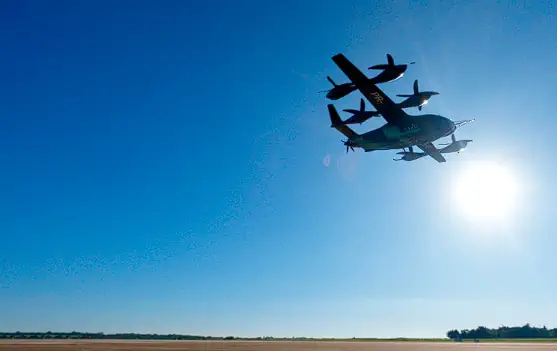
DJI officially revealed its first eVTOL cargo drone, the EV50, on July 9, 2026, announcing that the aircraft had already completed a flight to 8,861 meters (29,072 ft) on Everest's north face, delivering ozone-measurement equipment for a Peking University research team. The lift-and-cruise drone carries up to 50 kg over 150 km, but DJI has not disclosed pricing or a commercial launch date.
Highlights
- DJI officially unveiled the EV50 eVTOL cargo drone on July 9, 2026, with no price or commercial release date disclosed.
- The EV50 reached 8,861 meters (29,072 ft) on Everest's north face — above the summit — during a 12-mission research operation for Peking University.
- The lift-and-cruise EV50 carries up to 50 kg over 150 km, with an 11-motor redundant system and a standard emergency parachute targeting BVLOS certification.
- On Everest's south face, the FlyCart 100 transported 10,073 kg of supplies and waste between Base Camp and Camp 1 in 8-minute flights vs. 6–8 hours on foot.
- The Matrice 4E mapped over 3 km² of the Khumbu Icefall to centimeter-level accuracy at 6,450 meters in temperatures below −20°C.
DJI officially unveiled its first eVTOL cargo drone — the DJI EV50 — on July 9, 2026, announcing its existence with a remarkable record: the fixed-wing cargo aircraft had already reached an altitude of 29,072 feet (8,861 meters) on the north face of Mount Everest. During a 12-day mission inside the China Mount Qomolangma National Nature Reserve, the EV50 carried ozone-measurement equipment for researchers from Peking University, completing 12 transport flights in one of the most demanding operating environments on Earth.
The EV50 is one of three DJI drones featured in the Everest mission announcement. On the Nepal south face, the DJI FlyCart 100 transported 22,207 lbs (10,073 kg) of supplies and waste between Base Camp and Camp 1, while the DJI Matrice 4E produced centimeter-accurate maps of the Khumbu Icefall.
EV50: Fixed-Wing Design Comes to Cargo Drones
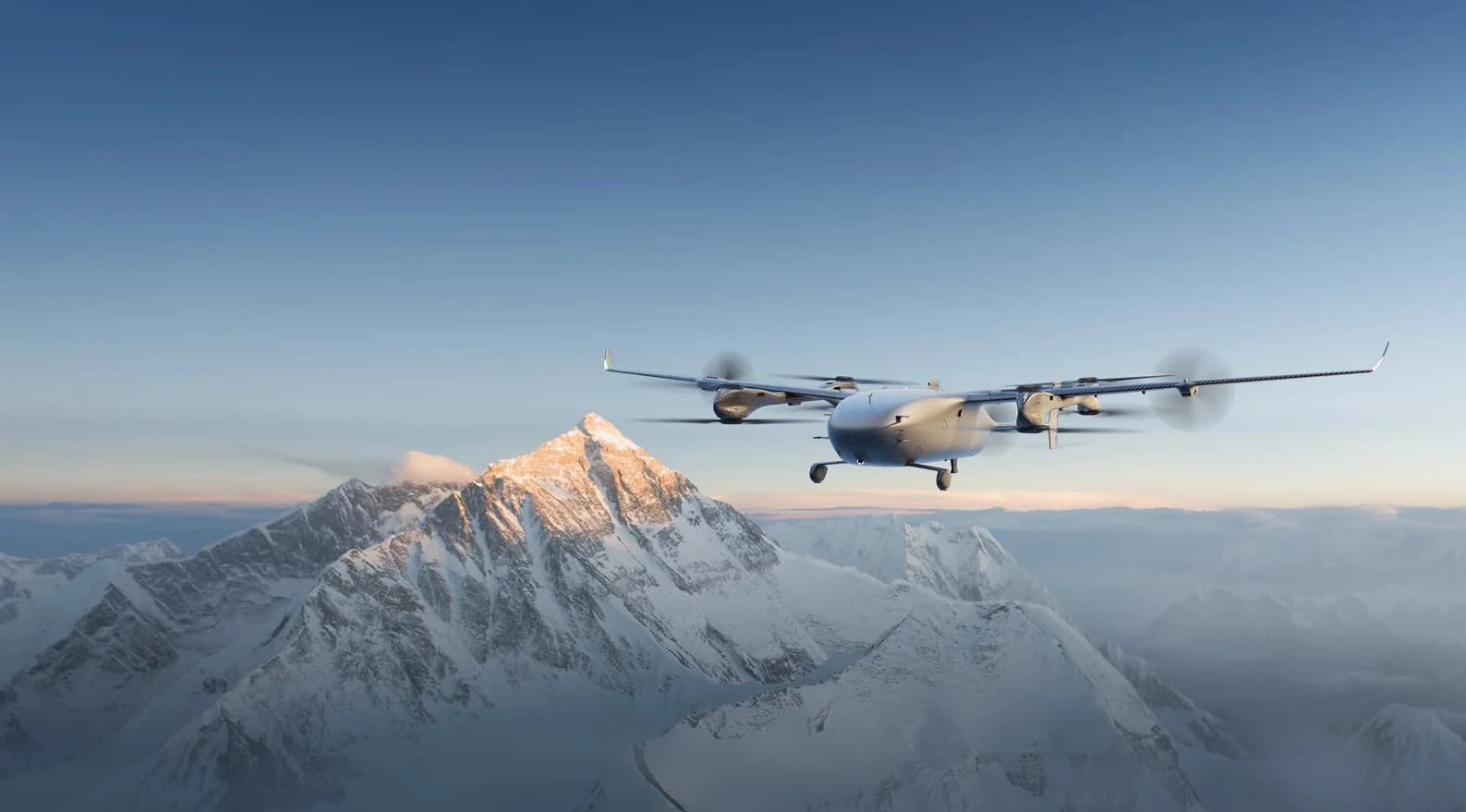
The DJI EV50 is a lift-and-cruise eVTOL cargo drone designed for medium-to-long-range delivery. Key specifications include:
- Rotor configuration: 8 vertical lift rotors + 3 pusher propellers
- Wingspan: 23 ft (7 m)
- Maximum payload: 110 lbs (50 kg)
- Maximum range: 93 miles (150 km)
- Fuselage length: 12.1 ft (3.7 m)
- Top speed (unloaded): 99 mph (160 km/h)
- Cargo bay volume: 270 liters — 59 × 15.7 × 17.7 in (1,500 × 400 × 450 mm) — with support for standardized cargo modules
The detailed specifications were sourced from DJI's Chinese-market materials and first reported internationally by Italian drone outlet Quadricottero.
Several engineering choices on the EV50 clearly point toward BVLOS airworthiness certification. The 11-motor redundant configuration tolerates a single motor failure; pitot tubes feature redundant design with self-heating to prevent high-altitude icing; the 8 lift rotors can be locked into an aerodynamic position during cruise to reduce drag; and an emergency parachute is standard equipment. Two operators can fold the aircraft — without tools — to 7.9 × 4.6 × 3.9 ft (2.4 × 1.4 × 1.2 m) in five minutes. The EV50 also supports the DJI Payload SDK for third-party sensor integration.
EV50 Climbs 3,730 Meters in a Single Continuous Ascent
Working with Peking University's College of Environmental Sciences and Engineering, the EV50 flew 12 missions over 12 days, delivering ozone-measurement instruments to extreme altitudes to help researchers analyze atmospheric pollutants in the ultra-high-altitude troposphere. The drone used spiral ascent and back-and-forth flight paths to handle the powerful mountain winds. Its best flight reached a peak altitude of 29,072 feet (8,861 meters), with a maximum single continuous climb of 12,238 feet (3,730 meters).
It is worth noting that this peak altitude exceeds the summit of Everest itself (29,031.7 ft / 8,848.86 m). DJI has previously sent imaging drones to similar heights — a Mavic 3 flew over the summit in 2022 — but carrying scientific instruments with a cargo drone represents a significantly different technical challenge. DJI stated this was also the first time Peking University researchers had used a drone for high-altitude troposphere observations.
FlyCart 100 and Matrice 4E: Workhorses on the South Face
On the Nepal south face, the FlyCart 100, operating in partnership with Nepali drone company Airlift, transported 22,207 lbs (10,073 kg) of cargo between Base Camp and Camp 1 — 15,907 lbs (7,215 kg) of climbing supplies going up and 6,301 lbs (2,858 kg) of waste coming down. The FlyCart 100 made its Chinese debut in June 2025; this Everest operation ran above 20,669 feet (6,300 meters), with individual loads of up to 104 lbs (47 kg) in temperatures ranging from −15°C to 5°C.
Each one-way flight took just 8 minutes, compared to the 6–8 hours a Sherpa needs to traverse the same route across the Khumbu Icefall on foot. DJI said the FlyCart 100 will continue to support Nepal's goal of delivering approximately 5,000 oxygen cylinders per climbing season and clearing roughly 22,000 lbs (10,000 kg) of high-camp waste. DJI spokesperson Christina Zhang said the team is committed to making "the world's highest peak safer and cleaner for Sherpas and climbers around the globe."
The Matrice 4E, meanwhile, mapped more than 1.1 square miles (3 km²) of the core Khumbu Icefall zone to centimeter-level accuracy in 3.5 hours, operating at 21,161 feet (6,450 meters) in temperatures below −20°C. Airlift Technology CEO Raj Bikram Maharjan said this could be the first real-world glacier mapping operation of this scale in a high-altitude expedition environment. The data can provide climbing teams with real-time hazard monitoring and safer route planning, and the system also carries search-and-rescue capability — identifying people and movement across snowy terrain.
Editor's Perspective
One thing stands out about today's announcement by omission: the FlyCart 100 and Matrice 4E are shipping products with dealers and price tags; the EV50 has neither. DJI has validated a 110-lb-payload eVTOL at 29,000 feet without telling anyone when or where they can buy one.
This fits DJI's launch pattern of the past year-plus: the FlyCart 100 debuted in China in June 2025, then expanded globally six months later; the FlyCart 200 and T200 launched as China-only products in April of this year with no global timeline in sight. DJI's heavy-lift product line has consistently matured in the Chinese market well before the rest of the world gains access.
For U.S. operators, the wait carries additional risk. DJI is currently challenging its FCC "Covered List" designation before the Ninth Circuit Court of Appeals, and the political environment around Chinese drones remains unsettled. If the designation stands, future DJI products will face barriers at the equipment authorization stage. Meanwhile, U.S. cargo eVTOL operators are still working through the eVTOL Integration Pilot Program, which only completed its first round of project selection in March.
The gap is stark: one country's cargo eVTOL just served climate researchers at the top of Everest; the other's operators are still finalizing paperwork for demonstration corridors.
A ban is not the answer. Banning DJI will not conjure an American-made EV50 into existence — it will only guarantee that U.S. search-and-rescue teams and researchers wait the longest for this capability. Two things are worth watching: the outcome of DJI's Ninth Circuit case, and whether DJI announces an EV50 launch outside China. Those two answers will tell us whether the most capable cargo drone yet unveiled will ever fly an American mission.
Sources: DJI via PRNewswire, Quadricottero
Original reporting: Haye Kesteloo / DroneXL
原文來源: 查看原文
FAQ
Newsletter
Subscribe to our Low-Altitude Industry Newsletter
Daily curated news on low-altitude economy and drone industry, delivered to your inbox.
Reviewed and published by the LAETimes editorial desk ·