DJI and Insta360 Quietly Drop Texas Patent Suits — The Real Battle Remains in China
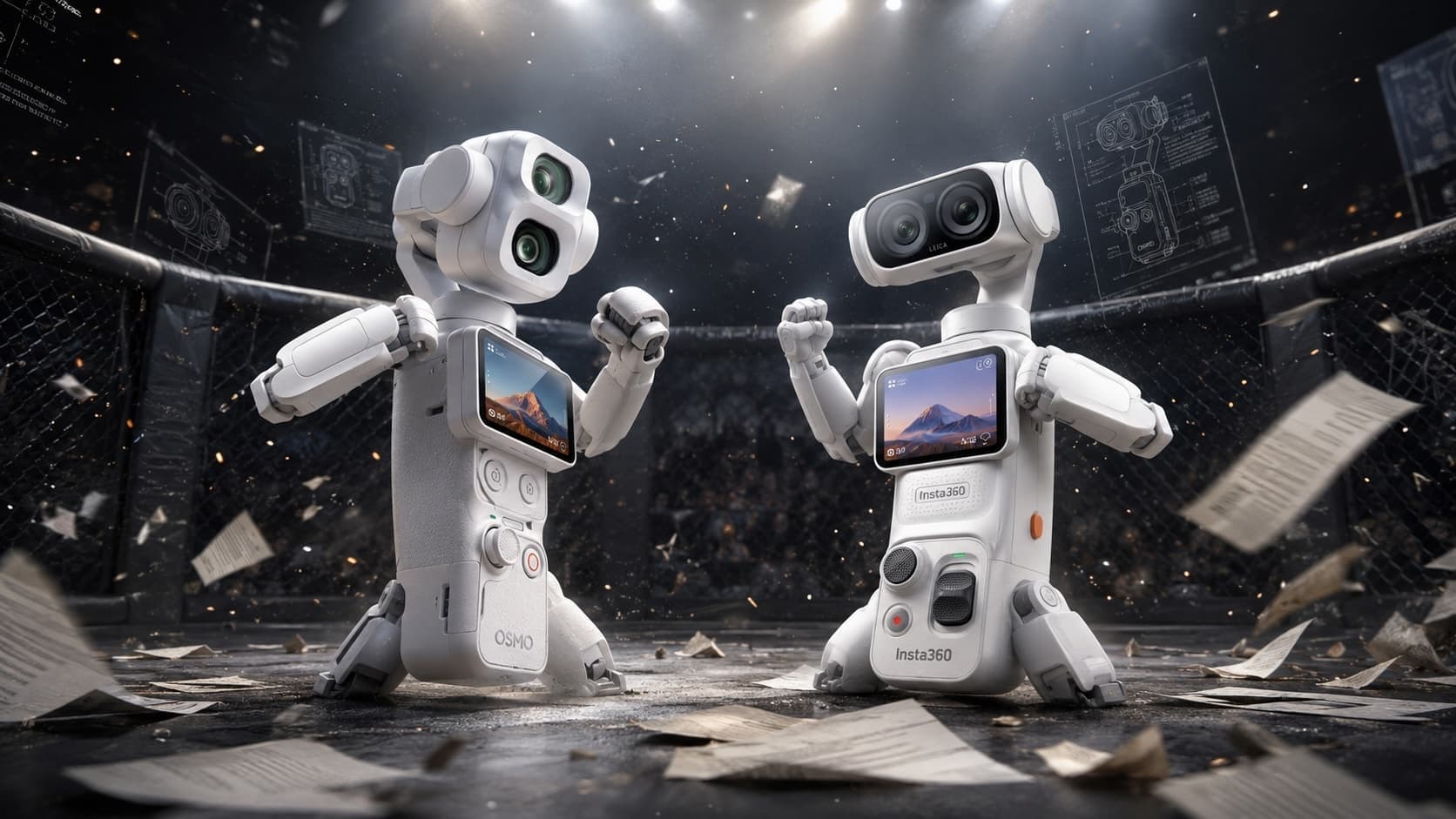
DJI and Insta360 mutually withdrew all four patent infringement lawsuits filed in the Eastern District of Texas on June 28, 2026, without announcing any settlement. The dismissals were entered without prejudice, leaving both parties free to refile. Meanwhile, DJI's patent ownership case against Insta360 parent Arashi Vision, filed in Shenzhen Intermediate Court in March 2026, continues and is widely seen as the more consequential proceeding. IDC data shows DJI held 62.4% global market share in smart handheld cameras in 2025, with Insta360 at 20.4%.
Highlights
- DJI和Insta360於2026年6月28日相互撤回德州東區全部四起專利訴訟,均為不附帶偏見撤案,無和解協議。
- DJI於2026年3月在深圳中院對Insta360母公司嵐視科技提起的專利歸屬訴訟目前仍在審理中,被視為更具影響力的關鍵案件。
- IDC數據顯示2025年智慧手持相機全球出貨量達1,670萬台,DJI以62.4%市占率領先,Insta360以20.4%位居第二且成長最快。
- Insta360因DJI被列入FCC受管制名單,在美國市場享有結構性優勢,DJI Osmo Pocket 4P至今無法在美國銷售。
- DJI的「職務發明」主張若在深圳勝訴,可能影響整個深圳無人機與相機產業中由前DJI員工創辦的所有競爭對手。
DJI and Insta360 have mutually withdrawn all four patent infringement lawsuits they filed against each other in the U.S. District Court for the Eastern District of Texas. Court records show both companies submitted voluntary notices of dismissal on June 28, 2026, covering cases 2:26-cv-00462 and 2:26-cv-00463 filed by DJI, and 2:26-cv-00466 and 2:26-cv-00467 filed by Insta360. The court ordered all four cases dismissed on June 29, 2026. Critically, all dismissals were entered without prejudice, meaning either party may refile the same claims at a later date.
Neither company has publicly announced a settlement agreement. The practical scope of these withdrawals is also far narrower than it may appear: the underlying dispute between the two Shenzhen-based rivals is far from over. DJI's patent ownership lawsuit against Insta360 parent company Arashi Vision, filed in Shenzhen Intermediate People's Court, has been ongoing since March 2026. That case — not the Texas litigation — is the one genuinely capable of reshaping the relationship between the two companies.
The Texas Suits Launched on Insta360's Product Launch Day
DJI opened its legal offensive on June 10–11 in the United States — precisely around the time Insta360 launched its new Luna Ultra handheld gimbal camera, which went on sale in the U.S. on June 10 at $769.99. As DroneXL reported at the time, DJI asserted four utility patents and two design patents against the Luna product line — including the Luna Ultra and the lower-end Luna Pro — alleging that the products copied the control interface, tracking system, and industrial design of the Osmo Pocket, down to details such as the scroll wheel and rotating screen.
DJI sought a permanent injunction to remove the Luna Ultra and Luna Pro from the U.S. market, along with damages and a disgorgement of Insta360's profits.
Insta360 responded quickly. As DroneXL reported on June 12, Insta360 filed counterclaims in the same Texas court asserting five utility patents covering gimbal stabilization, directional control, telemetry overlay, and panoramic video stabilization — technologies it alleged were used across DJI's Osmo Pocket, Ronin, RS, Osmo Mobile, and Osmo 360 product lines. Insta360 also filed three invalidation requests with China's National Intellectual Property Administration (CNIPA) targeting the Chinese counterpart patents of the specific patents DJI had asserted in Texas.
The Patents at Stake
DJI's six patents asserted in Texas:
- US11,009,181 — Gimbal control device
- US11,245,855 — Shooting control method for handheld gimbal
- US11,381,751 and US11,539,893 — Handheld gimbal control methods
- D1,072,023 and D1,110,390 — Design patents for stabilized camera devices
Insta360's five patents asserted in counterclaims:
- US11,388,339 — Panoramic video stabilization
- US9,554,045 — Constraint-based rotation smoothing
- US8,938,161 and US8,908,090 — Pointing control for actively stabilized cameras
- US9,154,910 — Terminal position tracking
Insta360's CNIPA invalidation requests targeted the following Chinese patents:
- ZL201880040270.1
- ZL201410179306.8
- ZL201811501687.1
All three are Chinese family members of the patents DJI asserted in the U.S. proceedings.
China Is Where Precedent Is Actually Being Set
DJI's Shenzhen lawsuit predates the Texas litigation by nearly three months. As DroneXL reported in March, DJI filed a patent ownership suit at Shenzhen Intermediate People's Court covering six patents related to drone flight control, structural design, and image processing.
The claim invokes a specific provision of Chinese intellectual property law: inventions completed by a former employee within one year of leaving employment, if related to that employee's previous role, may legally belong to the former employer. DJI alleges that several of Insta360's patents trace back to former DJI R&D personnel. Insta360 co-founder JK Liu publicly denied the allegations on Weibo the day the news broke, stating that Insta360 holds 28 patents it had not yet used in litigation that it believed were being infringed by DJI products — and that the company had chosen not to file suit.
The Shenzhen case remains active in the Chinese judicial system with no ruling date announced. It carries more weight than the Texas withdrawals because, if decided, it will establish how broadly Chinese employers can assert rights over inventions made by former employees — a question that affects not just these two companies, but every hardware manufacturer in Shenzhen's drone and camera ecosystem.
Market Context Explains the Urgency
According to IDC data covering global smart handheld camera shipments — encompassing panoramic, action, and gimbal camera categories — the segment shipped a combined 16.7 million units in 2025. DJI led with 10.4 million units and a 62.4% market share; Insta360 followed with 3.4 million units and a 20.4% share.
DJI's dominance is unambiguous, but Insta360 is the fastest-growing brand in the data. Insta360 also currently holds a structural advantage in the U.S. market: DJI's dual-lens Osmo Pocket 4P remains unavailable for sale in the United States after DJI was added to the FCC's Covered List in December 2025, blocking new product authorizations. Insta360 is not subject to that restriction — which is precisely why the Luna Ultra was able to launch freely in the market where DJI most urgently sought an injunction.
DroneXL's Take
Withdrawing from Texas without a settlement is not a ceasefire — it is a retreat from the weaker battlefield. DJI's real objective in June was never to win a jury verdict two years from now; it was to secure an injunction quickly enough to pull the Luna Ultra off U.S. shelves while launch momentum was still building. Once it became clear that a preliminary injunction was unlikely to materialize — and after Insta360's counterclaims put five DJI product lines in the defendant's chair — walking away from Texas cost DJI nothing and saved significant discovery expenses. The real leverage was always in Shenzhen.
DJI's odds may genuinely be better there. The "employee invention" claim — that a former employee's patent filed within a year of departure, in a field related to their prior role, belongs to the original employer — is a more concrete and demonstrable argument than "you copied my scroll wheel design," and Chinese courts have historically been more receptive to employer claims of this kind. If Shenzhen rules in DJI's favor, expect the company to assert patent ownership claims more aggressively against other Shenzhen competitors founded by former employees — not just Insta360.
None of this changes a deeply uncomfortable reality: the reason DJI needed to rely on courts to compete with Insta360 in the United States in the first place is that its own dual-lens camera, the Osmo Pocket 4P, is blocked by a national security designation originally aimed at drones — a device with no rotors and no wings. Insta360's ability to play challenger in the U.S. market is not purely a product story; it is partly because Washington cleared the path for it while sidelining DJI's equivalent product. Watch Shenzhen, not Texas — that is where this contest will actually be decided.
Source: Michael's Substack (PRIP)
Editorial perspective: Haye Kesteloo
原文來源: 查看原文
FAQ
Newsletter
Subscribe to our Low-Altitude Industry Newsletter
Daily curated news on low-altitude economy and drone industry, delivered to your inbox.
Reviewed and published by the LAETimes editorial desk ·