DJI Sues Insta360 Over Luna Pocket Camera Patents in Texas; Insta360 Fires Back with Countersuit
DJI filed two patent infringement lawsuits against Insta360 in the U.S. District Court for the Eastern District of Texas on June 11, 2026, alleging that the new Luna Pro and Luna Ultra gimbal cameras copy the design and core technology of the Osmo Pocket series. DJI asserted two design patents and four utility patents, seeking a permanent injunction and damages. Insta360 countersued the following day with five of its own patents.
Highlights
- DJI於2026年6月11日在德州東區聯邦法院對Insta360提起兩件專利侵權訴訟,主張兩項外觀設計專利與四項發明專利,要求永久禁令並索賠損害賠償。
- Insta360於6月12日提起兩件反訴,主張五項涵蓋雲台穩定與全景影片穩定的發明專利,指稱侵權產品包含DJI的Osmo Pocket、Ronin/RS及Osmo 360系列。
- Luna Ultra於2026年6月10日以769.99美元上市,搭載1吋8K感光元件與Leica聯合設計雙鏡頭,成功進入DJI因FCC涵蓋名單限制而無法觸及的美國零售通路。
- DJI同步提出故意侵權主張,此舉可能使法院依法將損害賠償金額提高至三倍。
- Insta360母公司Arashi Vision於2025年6月在上海科創板IPO,募資約2.7億美元,首日股價暴漲285%,估值突破96億美元;此次訴訟發生在其上市一週年前後。
DJI filed two patent infringement lawsuits against Insta360 in the U.S. District Court for the Eastern District of Texas on June 11, 2026, alleging that the rival camera maker's new Luna Pro and Luna Ultra gimbal cameras copied the design and core technology of its Osmo Pocket series. The first lawsuit asserts two design patents covering the Osmo Pocket's appearance; the second asserts four utility patents covering gimbal control and subject tracking. DJI is seeking a permanent injunction, compensatory damages, and a share of Insta360's profits. Insta360 filed a countersuit the following day, asserting five of its own patents.
DJI Accuses Luna Series of Copying Osmo Pocket's Design
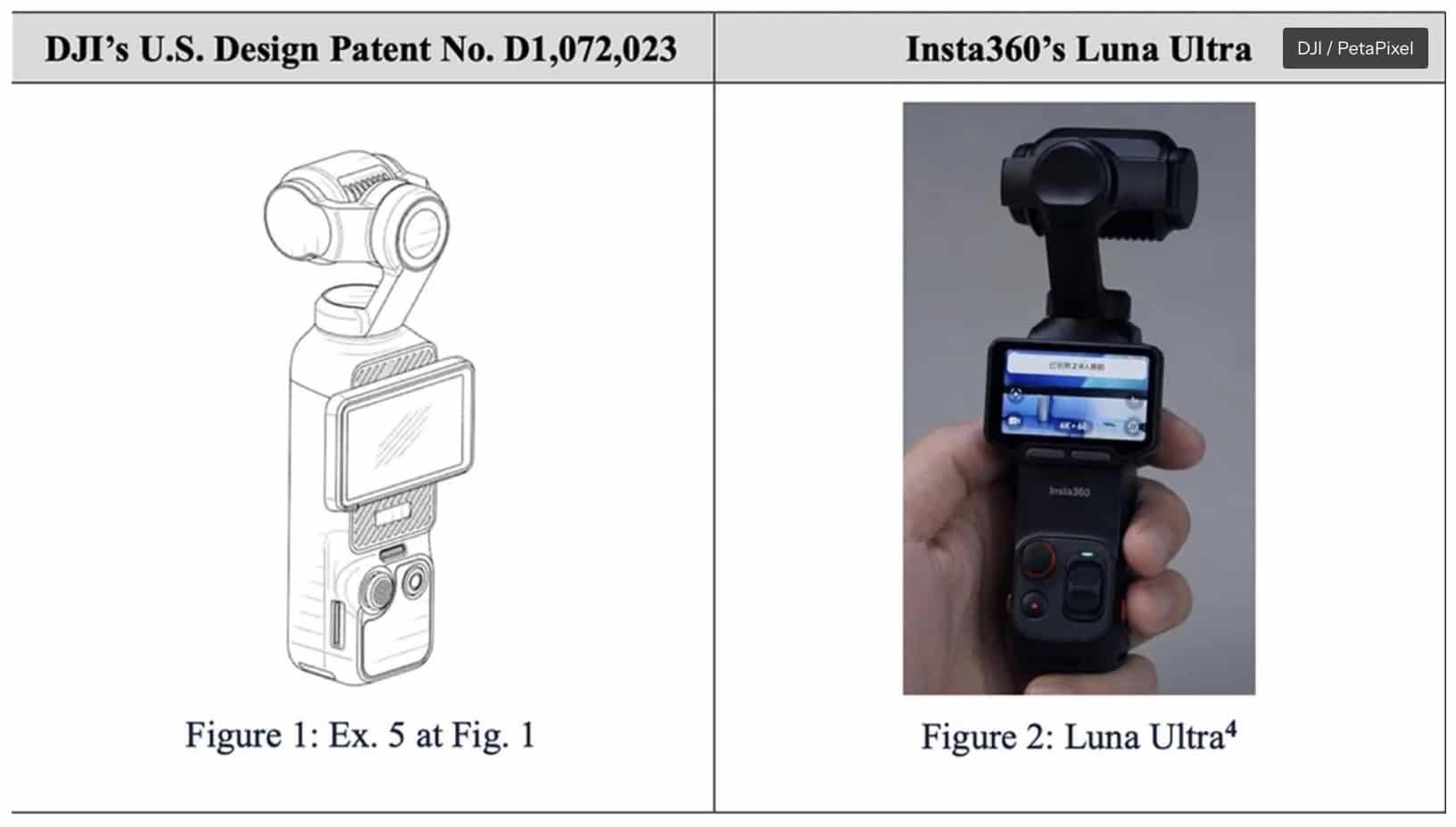
DJI's first complaint asserts two design patents covering the appearance of the Osmo Pocket camera, including U.S. Design Patent No. D1,072,023, and alleges that the Luna Pro and Luna Ultra reproduce the product's iconic slim handheld body, gimbal arm, rotating screen, scroll wheel, accessory slot, and bottom port. The complaint was filed in the Marshall Division of the court and names Arashi Vision Inc. (doing business as "Insta360") as the primary defendant, along with affiliated entities Arashi Technologie B.V., Istone Innovation Ltd., and Instone Technology (HK) Ltd.
DJI contends that the Luna cameras "brazenly copied DJI's patented inventions in their entirety" and adopted "the same product architecture pioneered by the DJI Osmo Pocket." DJI also cited Insta360's own marketing materials, product teasers, and a demonstration at the 2026 NAB Show to argue that Insta360 positioned the cameras as direct competitors to the Osmo Pocket. As first reported by PetaPixel, DJI launched the original Osmo Pocket in 2018 and added a rotating touchscreen to the Osmo Pocket 3 in 2023.
Second Lawsuit Targets Gimbal Control and Subject-Tracking Patents
DJI's second complaint asserts four utility patents describing how its pocket cameras operate, covering: a single control button for switching the gimbal between follow mode and lock mode; a handheld gimbal with built-in subject tracking and live display; an image-driven motor control method; and an autonomous tracking system that requires no separate smartphone app. DJI argues that the Luna series replicates these features that have set the Osmo Pocket apart in the market.
DJI also raised a willful infringement claim, which could significantly increase any damages award. "Insta360 has had actual knowledge of each Asserted Patent and its infringement thereof at least as of the service of this Complaint," DJI wrote in the filing. DJI added that continuing to import, manufacture, sell, and offer for sale the accused products with knowledge of the relevant patents "constitutes willful infringement warranting enhanced damages." DJI is asking the court to order Insta360 to pay compensatory damages, disgorgement of profits, and enhanced damages including pre- and post-judgment interest.
Insta360 Countersues DJI With Its Own Patents
Insta360 declined to comment publicly on June 11 and filed two countersuits on June 12, asserting five utility patents covering gimbal stabilization, gimbal orientation control, camera smooth stabilization, telemetry data overlay, and panoramic video stabilization — technologies Insta360 says appear in DJI's Osmo Pocket, Ronin/RS, Osmo Mobile, and Osmo 360 product lines. Insta360 said it "categorically rejects" DJI's allegations and framed the countersuit as a direct response.
Sources familiar with the matter told PetaPixel that the Luna series is the result of years of independent development, with work beginning as early as 2020 and shaped by earlier products including the ONE R, Link series, and Flow series. Insta360 founder JK Liu echoed that account. "Luna Ultra is the result of years of independent R&D and was not built in response to any competitor's product," Liu said, adding that DJI's decision to file suit on the day of the launch "says it all." Insta360 said DJI's pursuit of a permanent injunction was an attempt to disrupt the Luna Ultra's commercial launch.
Luna Ultra Enters U.S. Retail Channels Where DJI's Own Camera Cannot
The Luna Ultra launched on June 10, 2026, at $769.99, featuring a one-inch 8K sensor, a Leica co-designed dual-lens system, and a detachable 2-inch OLED touchscreen. It entered U.S. retail channels at a moment when DJI's latest Osmo Pocket cannot be sold there — a consequence of DJI's current placement on the FCC Covered List. The two lawsuits were filed less than one day after the camera went on sale, indicating that DJI had its legal filings prepared and was waiting for the U.S. launch date to proceed.
The timing is significant. DJI's dual-lens Osmo Pocket 4P remains blocked from official U.S. retail channels. The FCC's Public Safety and Homeland Security Bureau placed all foreign-manufactured drones and "drone critical components" on its Covered List on December 22, 2025, following an interagency national security determination dated December 21, 2025, finding them to pose an unacceptable risk to U.S. national security. The standard Osmo Pocket 4 obtained FCC authorization before the deadline, but the 4P did not. DJI is challenging the determination through proceedings at the Ninth Circuit Court of Appeals (Case No. 26-1029) and a petition for reconsideration filed with the FCC; in the meantime, DJI remains blocked from obtaining new authorizations while non-Chinese manufacturers continue to clear review. The practical result is that Insta360 has open access to the U.S. gimbal camera market while DJI does not. A lens comparison test by DroneXL found that the Luna Ultra's second lens performs more prominently at longer focal lengths.
The Texas Lawsuit Extends a Battle Already Underway in Shenzhen Courts
This is the second patent lawsuit DJI has filed against Insta360 in 2026. In March, DJI sued in the Shenzhen Intermediate People's Court, asserting that six patents covering drone flight control, structural design, and image processing should be assigned to DJI on the grounds that former employees developed them within one year of leaving the company. That case rests on provisions of Chinese patent law that treat such "employee inventions" as the property of a former employer.
Over the past year, the two companies have repeatedly encroached on each other's core markets. Insta360 incubated the Antigravity brand and launched the Antigravity A1 360-degree drone — a direct challenge to DJI's home territory — while DJI's Osmo 360 pushed into Insta360's 360-degree camera space. Shortly after the Shenzhen litigation became public, DJI also introduced its own panoramic drone, the Avata 360.
Insta360's parent company Arashi Vision (stock code: 688775.SH) listed on the Shanghai Stock Exchange's STAR Market on June 11, 2025, raising RMB 1.94 billion (approximately USD 270 million) in what was the largest IPO on the STAR Market that year. Shares surged 285% on the first day of trading, pushing the company's valuation above RMB 70 billion (approximately USD 9.6 billion). That capital has underpinned Insta360's subsequent expansion. When Insta360 first teased the Luna series and claimed it was not built on DJI technology, observers read it as a provocation. DJI has now responded in court.
DroneXL Analysis
This dispute is about far more than a pocket camera. Over the past two years, I have watched these two companies repeatedly cross into each other's territory: Insta360 backed a 360-degree drone aimed squarely at DJI's core business, while DJI struck back at Insta360's panoramic camera stronghold with the Osmo 360 and Avata 360. Once both sides have products to defend and a U.S. market worth fighting over, litigation becomes a near-inevitable next step. The Luna camera did not start this conflict — it simply provided a venue for it.
What I keep turning over is the irony of the role reversal. I have tracked DJI's regulatory battles all year — from its Ninth Circuit petition to the classified intelligence submitted in Pentagon proceedings — and the through-line has always been a Chinese company arguing that it deserves due process and a fair hearing in the United States. Now DJI has become a plaintiff, walking into U.S. federal court to assert its intellectual property rights against a competitor. A company fighting to stay in the U.S. market is using that same market's court system to protect its inventions. Both things are simultaneously true, and both feel oddly out of place.
There is also a blunt tactical reality: DJI cannot sell the Osmo Pocket 4P through U.S. retail channels, while Insta360 can freely sell the Luna Ultra. A permanent injunction would accomplish what DJI's own product currently cannot — clearing a competitor from American shelves. The choice of venue is also worth noting: the Eastern District of Texas remained the busiest patent litigation court in the United States through 2025, with 28.2% of all patent cases filed there in the first half of the year. Whether that court will find the alleged design overlap sufficient to grant the relief DJI seeks remains an open question, not a foregone conclusion.
Watch for the Marshall docket's scheduling order and the court's handling of Insta360's countersuit — and keep an eye on Ninth Circuit Case No. 26-1029 to see whether DJI can regain access to the U.S. market. If an injunction is granted while DJI itself remains locked out of U.S. retail, the outcome in America's gimbal camera market will have been decided by lawyers before it was decided by consumers.
Sources: PetaPixel, with additional reporting from Android Authority and court filings. DroneXL used automated tools to assist with research and source organization; all reporting and editorial commentary is by Haye Kesteloo.
原文來源: 查看原文
FAQ
Reviewed and published by the LAETimes editorial desk ·