DJI Extends Matrice 4D C6 Certification to Handheld Controller Operations, Dramatically Lowering the Bar for STS-02 BVLOS Missions
DJI has expanded the Matrice 4D series' C6 class marking to cover standalone flight with the RC Plus 2 Enterprise controller via firmware 17.1.5, decoupling the certification from mandatory Dock 3 deployment. Search-and-rescue and infrastructure inspection teams can now conduct compliant EU STS-02 BVLOS operations without investing in a fixed docking station costing over $20,000, significantly reducing the barrier to entry.
Highlights
- DJI firmware 17.1.5 extends the Matrice 4D and 4TD's EU C6 class marking to include standalone RC Plus 2 Enterprise controller operations, removing the mandatory Dock 3 requirement for STS-02 BVLOS compliance.
- The change takes effect via a software update with no hardware modifications required, as both airframes already met all C6 technical thresholds from the outset.
- Operators can now conduct compliant STS-02 BVLOS missions without a fixed docking station that costs over $20,000, significantly lowering the entry barrier for search-and-rescue and infrastructure inspection teams.
- C6 class marking satisfies only the aircraft-side requirement; operators must still obtain STS-02 theoretical and practical certificates, file declarations with national authorities, and produce compliant operations manuals.
- EASA is conducting a mid-term review of the Cx framework targeting completion before summer 2025, which could affect the scope of C6 permissions—M4D operators should verify the status with their national competent authority before submitting declarations.
DJI has expanded the C6 class-marking coverage for the Matrice 4D series to include standalone flight with the DJI RC Plus 2 Enterprise controller, removing the earlier requirement to launch from a DJI Dock 3 docking station in order to conduct compliant European BVLOS operations. The change applies to the Matrice 4D and 4TD running firmware version 17.1.5 or later and takes effect through a firmware update rather than any hardware modification.
The practical benefit is real, even if its scope is specific. When DJI originally obtained C6 certification for the Matrice 4D series, the approved operating configuration only applied when the drone was launched from a Dock 3. The airframe had already met every technical requirement for that class marking; what was missing was documentation covering the handheld-controller flight configuration. That gap has now been closed—and for operators who want to run mobile STS-02 missions without committing to a fixed docking installation at a site, it matters.
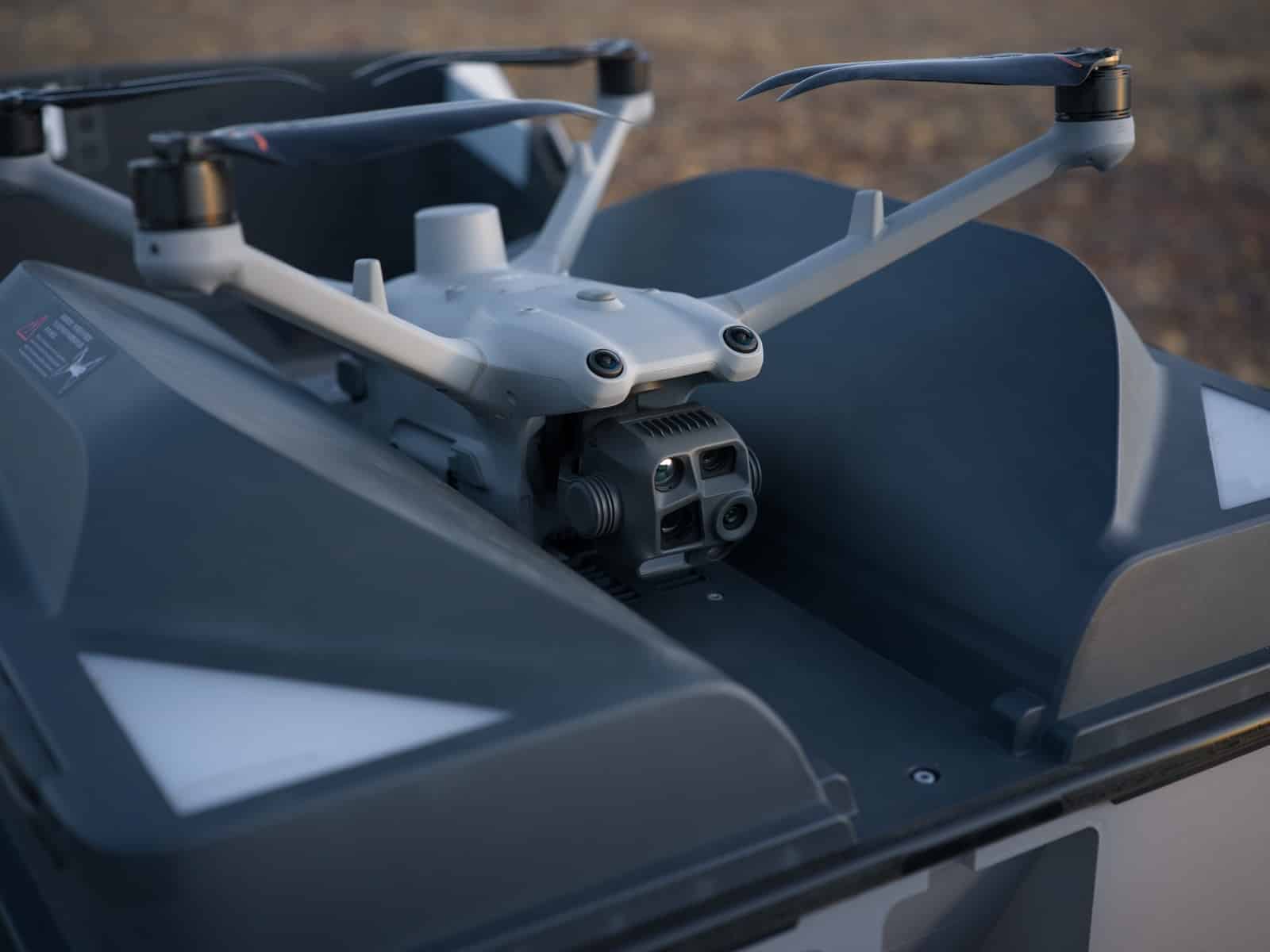
Image: DJI Matrice 4D with Dock station. Credit: DJI
DJI Decouples C6 Certification from the Dock 3
The Matrice 4D series can now conduct compliant C6 operations in two certified configurations: dock mode for automated missions via Dock 3, and manual flight mode for mobile deployments using the RC Plus 2 Enterprise. Before this firmware update, only the dock configuration carried the certification.
In April 2025, DJI announced that the Dock 3 had received C6 certification—the first EU C6 designation for a DJI system—developed alongside consultancy AirHub as a complete compliance package. But the certification was tied to the dock. Operators who chose to fly manually from a ground control station, rather than scheduling automated missions from a fixed installation, had no separate certified pathway on the same airframe. Firmware 17.1.5 extends the validated compliance framework to cover controller-based operations alongside the Dock 3 integration. Same aircraft, same class marking, two certified deployment modes.
This move is consistent with the direction DJI has been pushing across its enterprise line throughout the year. In October 2025, DJI made the obstacle-avoidance sensor module and Manifold 3 computer—previously exclusive to Dock-deployed Matrice 4D and 4TD units—available for the lower-cost Matrice 4T and 4E. The consistent logic: DJI continues to unbundle capabilities from infrastructure costing over $20,000 and return them to operators flying with a controller.
C6 Defines Containability, Not Performance
C6 is the UAS class marking under EU Delegated Regulation 2019/945 designed specifically for the Specific category STS-02 standard scenario. The marking certifies that the aircraft can be confined to a designated volume of airspace—a regulatory prerequisite for BVLOS flight over sparsely populated areas.
The technical thresholds for the class marking are precise: a C6 drone must have a maximum take-off weight below 25 kg (55 lb), a characteristic dimension below 3 metres (9.8 ft), and a maximum speed not exceeding 50 m/s (112 mph). It must also be equipped with a Flight Termination System (FTS) that operates independently of the flight controller and cannot be disabled, continuous command-and-control link monitoring, pre-programmed operational boundaries, and geofencing that physically prevents the aircraft from leaving its designated volume. The Matrice 4D and 4TD met all of these requirements from the outset—which is precisely why this update required no hardware changes.
The containability requirement is the core friction point European operators have been debating for two years. The mandatory independent FTS prompted third-party safety vendors such as AVSS to develop standalone flight-termination and parachute systems for the M4D series; the Dutch Certified Remote Pilot Operators Association (BVLOS NL) has also cited it as grounds to argue that the SORA 2.5 runaway aircraft assumption overstates actual risk. A factory-integrated FTS that satisfies the class-marking requirement on its own removes one contested element from that debate for M4D operators.
STS-02 Permits BVLOS Flight on Pre-Programmed Routes
STS-02 is the operational authorisation that C6 hardware unlocks. Unlike STS-01—which permits only visual line-of-sight flight over a controlled ground area—STS-02 allows BVLOS flight during the mission, provided the aircraft follows a pre-programmed route and both take-off and landing remain within visual line of sight.
Distance constraints are the operational core of the scenario. This is the regulatory framework that makes linear infrastructure work viable. Power lines, pipelines, railway corridors and roads that extend beyond visual range are the most obvious use cases for STS-02. An operator plans the route, deploys from a controller, and can fly the full length of a corridor without installing a dock or repositioning observers along the way. Search-and-rescue operations benefit equally. In wide search areas or dense vegetation where line of sight disappears quickly, BVLOS authorisation lets teams cover ground at scale without requiring the pilot to advance along the search route.
The Airframe Marking Does Not Authorise the Operator to Fly
C6 compliance satisfies the aircraft-side requirement for STS-02—nothing more. Operator-side obligations remain entirely with the operator, and the firmware update exempts none of them. DJI is explicit about this in its announcement, and it is the single point most likely to catch buyers who misread "C6 certified" as "cleared to fly BVLOS."
Before flying STS-02, an operator still needs to: submit an STS-02 declaration or operational authorisation to the national competent authority; obtain a theoretical knowledge certificate covering the standard scenario; obtain an STS-02 practical skills certificate; develop an operations manual compliant with the scenario; establish a maintenance log and flight logbook; draft an emergency response plan; and coordinate an observer plan for any flight segment beyond 1 km. For teams that already hold valid credentials under STS-01, the bridge to STS-02 is an additional practical assessment plus an operations manual update. It is a documentation exercise of meaningful size, and the certified aircraft is only the entry ticket.
DroneXL Analysis
This news reads like a minor firmware footnote—and on the aircraft side, it is. But the economic implication is what deserves attention. Deploying a Dock 3 is a capital commitment. Extending C6 eligibility to the RC Plus 2 Enterprise means a search-and-rescue team or power-line inspection crew can show up with a controller and a carry case to run a compliant STS-02 mission, and add a dock later if the mission profile demands it. That follows the same unbundling logic that has run through the entire product line since DJI first paired the Matrice 4D with the Dock 3 as a drone-in-a-box system in early 2025. DJI keeps moving capability out of expensive enclosures, and in Europe that lowers the entry cost for the public-safety users who are most dependent on this hardware.
Here is the friction point worth watching. This update lands while EASA is conducting a mid-term review of the entire Cx framework—EASA's drone programme manager has confirmed the revision is underway with a target completion before this summer, in line with the European Commission's anticipated Q3 2026 approval of a safety package covering drones and counter-drone measures. DJI currently holds 26 of the 66 seats on the EASA-approved list. A security-driven rewrite of the class marking system aimed at hostile drones rather than commercial survey teams could fundamentally reshape what the C6 marking permits. Whether the independent STS-02 pathway DJI has just opened survives that revision intact is an open question—and one M4D operators should confirm with their national competent authority before submitting their declarations.
One more point DJI's announcement does not resolve: the entire STS-02 scenario is built on the premise of "sparsely populated areas," and EASA's interpretation of that term remains contested, particularly for unforested land or protected areas at or near denser zones. DJI does not address how operators should interpret that boundary, because that is not DJI's call to make—it is the national competent authority's. Until the interpretation is clearer, the certified aircraft is just the easiest part of the equation.
Source: DJI Enterprise Insights. DroneXL uses automated tools to assist with research and data retrieval; all reporting and editorial commentary is written by Haye Kesteloo.
原文來源: 查看原文
FAQ
Newsletter
Subscribe to our Low-Altitude Industry Newsletter
Daily curated news on low-altitude economy and drone industry, delivered to your inbox.
Reviewed and published by the LAETimes editorial desk ·