Hybrid-Electric Regional Aviation Takes Shape: Electra and Signature Aviation Sign MOU
Signature Aviation, the world's largest private aviation terminal network operator, has signed a memorandum of understanding with Italy's UrbanV and Electra to advance the EL9 Ultra Short hybrid-electric aircraft. The EL9 requires only 150 feet of runway, carries up to 9 passengers, and has a range of 330 nautical miles. Commercial operations are targeted for the end of this decade, with pre-orders already exceeding 2,200 aircraft from over 60 operators.
Highlights
- Signature Aviation, UrbanV, and Electra signed an MOU to jointly develop EL9 access points at high-demand hubs across the United States.
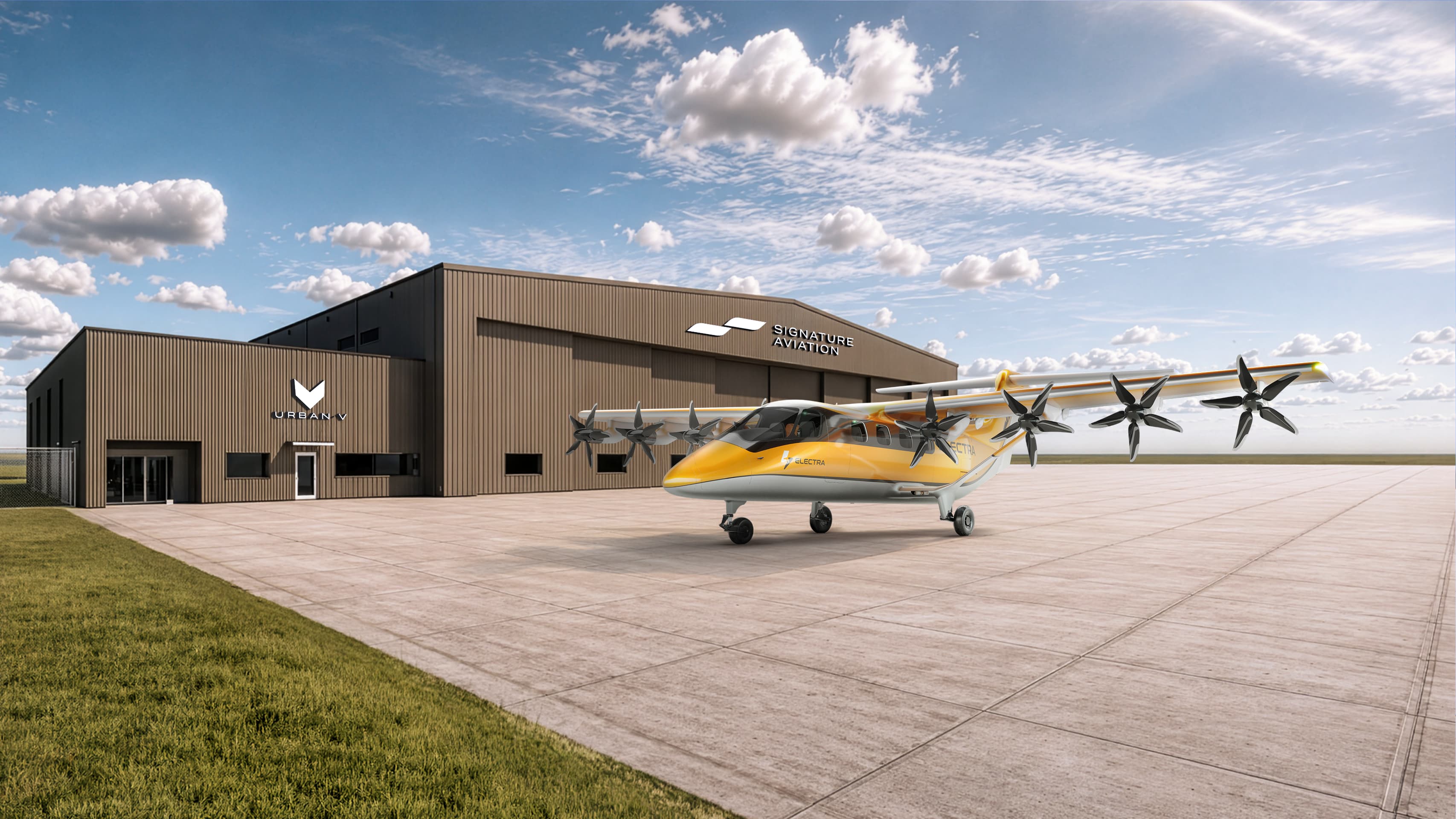
- The EL9 Ultra Short aircraft requires only 150 feet of runway using blown-lift technology, enabling deployment at rooftops, parking lots, barges, and other non-airport sites.
- The EL9 carries up to 9 passengers, cruises at approximately 175 knots, and has a maximum range of 330 nautical miles.
- Electra has accumulated approximately 2,200 pre-orders from over 60 operators, with commercial operations targeted for the end of this decade.
- Electra's market analysis projects that EL9 operations in the U.S. Northeast Corridor alone could generate approximately 27,000 daily flight demand opportunities.
Signature Aviation, the world's largest private aviation terminal network operator, may soon be among the first to adopt hybrid-electric aircraft capable of disrupting regional aviation — freeing flight operations from dependence on traditional airports.
Having previously established partnerships with electric air taxi manufacturers including Archer Aviation and Beta Technologies, Signature Aviation has now signed a memorandum of understanding (MOU) with Italian vertiport developer UrbanV and aircraft manufacturer Electra. The agreement centers on Electra's EL9 Ultra Short aircraft, which is designed to take off and land within a space roughly the size of a football field, in pursuit of what the company calls a "direct aviation" vision.
Three-Way Partnership Structure
Signature Aviation and UrbanV — which specializes in vertiport development — established a joint venture as early as 2025, with plans to build an electrified infrastructure network across the United States capable of serving next-generation propulsion aircraft. The new MOU marks the first formal collaboration between both companies and Electra.
Electra defines "direct aviation" as enabling passengers to fly directly from origin to destination, eliminating unnecessary connections and ground transfers — saving hours compared to driving. While the EL9 will initially operate from existing airports, the long-term goal is to establish ultra-short-takeoff-and-landing access points deployable on rooftops, parking lots, open lots, barges, shopping centers, casinos, and even ski resorts.
EL9 Technical Specifications
These access points require only 150 feet (approximately 46 meters) of space for takeoff and landing. This capability is made possible by the EL9's blown-lift propulsion technology, which redirects airflow over large flaps and ailerons and toward the ground at takeoff speeds as low as 35 knots — dramatically shortening the ground roll.
The EL9 has not yet completed its first flight, but Electra has already validated the 150-foot ground roll using its EL2 Goldfinch technology demonstrator.
Key EL9 specifications include:
- Propulsion: 8 Evolito electric motors mounted on the leading edge of the wings
- Cruise speed: Approximately 175 knots
- Maximum payload: 3,000 lbs (including pilot, 9 passengers, and 50 lbs of baggage per person)
- Maximum range: 330 nautical miles
- Noise level: 75 dBA during takeoff and landing, enabling deployment in noise-sensitive areas
Market Potential and Deployment Plans
According to Electra's latest Direct Aviation Market Outlook report, an estimated 12,000 to 16,000 EL9 aircraft will need to be produced during the first decade of commercial operations to meet projected demand. Commercial service is targeted to begin by the end of this decade. The company has already accumulated approximately 2,200 pre-orders from more than 60 operators.
The Signature Aviation–UrbanV joint venture is currently assessing vertiport networks in New York, California, Florida, and Texas — states where Signature Aviation operates dozens of facilities. The three parties will jointly develop EL9 access points at "core demand hubs" and begin establishing installation and operational standards for each site.
"The future of aviation will be defined by greater accessibility, connectivity, and seamless passenger experiences," said Derek DeCross, Chief Commercial Officer of Signature Aviation. "Combining Electra's breakthrough aircraft technology, UrbanV's next-generation vertiport vision, and Signature's global network, we have an opportunity to shape how regional air mobility is deployed and scaled."
The three parties also noted that the network will serve both passenger and cargo operations, and that the MOU is designed to be "replicable across a global network."
UrbanV's Role
UrbanV is responsible for vertiport planning, design, construction coordination, and network management, ensuring safe and efficient operations. Its infrastructure designs are compatible with any electric vertical takeoff and landing (eVTOL) aircraft and can be installed on the ground, on rooftops, or on floating water platforms.
In 2022, UrbanV activated its UV-0 test vertiport adjacent to Rome Fiumicino Airport (LIRF), under the supervision of Italy's civil aviation authority ENAC. Covering approximately 59,000 square feet, the facility supports both experimental flights and test demonstrations.
By 2030, UrbanV plans to establish up to 10 vertiports in the Rome region of Italy, while advancing network development in Venice, Bologna, and the French Riviera. The company has also signed network research agreements with partners in Japan, Brazil, and Kazakhstan.
Projected Market Impact
Based on an analysis of spring 2025 data spanning three months, Electra estimates that the EL9 could reduce travel time by more than one hour on over 2,600 daily routes — each currently served by at least 1,000 car-trip passengers traveling distances between 50 and 265 miles. The analysis accounts for EL9 flight time, average ground travel to and from access points, wait times, and embarkation/disembarkation time.
The analysis notes that currently only 1% of travelers choose to fly on such routes, primarily due to insufficient commercial airline service. However, with the introduction of the EL9 and its access point network, the U.S. Northeast Corridor alone is estimated to generate approximately 27,000 daily flight demand opportunities.
The realization of this vision will take time, but with Signature Aviation and UrbanV now formally on board, Electra has taken a significant step closer to its promise of shorter travel times and broader aviation accessibility.
原文來源: 查看原文
FAQ
Newsletter
Subscribe to our Low-Altitude Industry Newsletter
Daily curated news on low-altitude economy and drone industry, delivered to your inbox.
Reviewed and published by the LAETimes editorial desk ·