Hitachi Energy and Eve Air Mobility Sign MOU to Develop Electrification Infrastructure for Urban Air Mobility
Hitachi Energy and Eve Air Mobility have signed a Memorandum of Understanding to jointly develop electrification infrastructure for large-scale Urban Air Mobility (UAM) operations. The partnership covers grid integration, high-power charging systems, and vertiport power supply. Eve Air Mobility, backed by Embraer, is targeting eVTOL commercial certification and operations by 2028 and has approximately 2,700 letters of intent from customers worldwide.
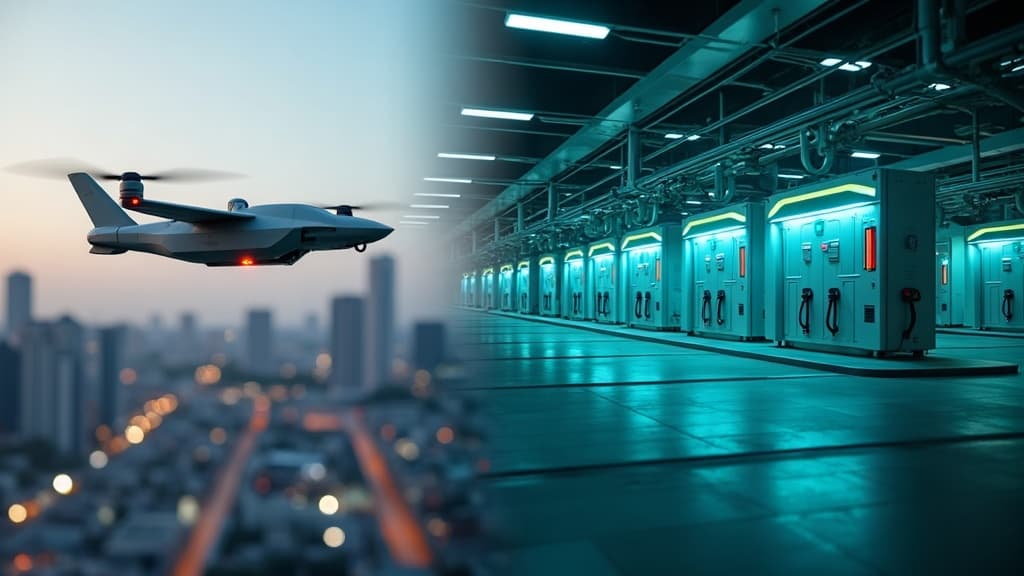
Highlights
- Hitachi Energy and Eve Air Mobility signed an MOU to jointly develop electrification infrastructure—including grid integration, high-power charging, and vertiport power supply—for large-scale UAM commercial operations.
- Eve Air Mobility, backed by Embraer, holds approximately 2,700 eVTOL letters of intent from global customers and targets commercial certification and operations in 2028.
- Hitachi Energy will adapt its Grid-eMotion charging platform for eVTOL-specific requirements and has invested over USD 9 billion in electrification and grid modernization.
- The partnership will explore second-life applications for retired eVTOL batteries, repurposing them as energy storage systems to improve sustainability and reduce operational costs.
- Infrastructure readiness—particularly power supply and rapid charging capability at vertiports—is identified as a decisive factor in the commercial viability of eVTOL services.
Hitachi Energy and Eve Air Mobility Partner on UAM Electrification Infrastructure
Hitachi Energy and Eve Air Mobility have formally signed a Memorandum of Understanding (MOU) to pursue deep collaboration on the electrification infrastructure required for large-scale commercial Urban Air Mobility (UAM) operations.
Focus Areas: Grid Integration, Charging Infrastructure, and Vertiport Power Supply
Under the agreement, the two companies will focus on grid integration, charging infrastructure deployment, and power supply integration for vertiports. Together, they will assess power availability, high-power charging requirements, and approaches to seamlessly connecting new energy demands to existing grid networks. Hitachi Energy plans to adapt its Grid-eMotion charging infrastructure platform to address the specific charging needs of eVTOL aircraft.
The partnership will also explore second-life applications for retired aircraft batteries, repurposing them as energy storage systems to extend battery lifecycle and improve overall sustainability. The MOU further encompasses joint business model planning and coordinated customer development to advance UAM infrastructure on a global scale.
Eve Air Mobility: Targeting Commercial Launch in 2028 with ~2,700 LOIs
Eve Air Mobility, backed by Brazilian aerospace major Embraer, is actively advancing eVTOL aircraft development and airworthiness certification, with a target to achieve certification and begin commercial operations in 2028. Eve has received letters of intent (LOIs) for approximately 2,700 eVTOL aircraft from customers around the world, reflecting strong market demand for urban air mobility services.
Hitachi Energy: Deep Expertise in Grid and Power Electronics
Hitachi Energy brings extensive experience in grid integration, power electronics, and charging systems to the partnership. The company has invested more than USD 9 billion in electrification and grid modernization initiatives, spanning research and development, manufacturing, and strategic partnerships.
Eve Air Mobility CEO Johann Bordais noted that the collaboration will help advance safe, efficient, and sustainable eVTOL operations. Marco Berardi, Head of Grid & Power Quality Solutions and Service at Hitachi Energy, emphasized that cross-industry collaboration is essential to driving the energy transition forward.
Electrification Infrastructure: A Critical Challenge for eVTOL Commercialization
As Advanced Air Mobility (AAM) moves closer to commercialization, the need for robust electrification infrastructure has become increasingly urgent. Vertiports require stable power connections and rapid charging capabilities to support high-frequency flight operations. Second-life battery applications not only address sustainability challenges but can also reduce overall operating costs.
The collaboration between Eve and Hitachi Energy combines aircraft development expertise with energy systems knowledge to directly tackle a key bottleneck in scaling UAM networks. Infrastructure readiness—particularly in terms of power supply and charging capacity—is widely recognized by the industry as a decisive factor in the commercial viability of eVTOL services.
The two companies plan to develop concrete implementation roadmaps for vertiport power supply, with an initial focus on technical requirements analysis and system integration strategy. The partnership is expected to further support the broader industry in building the ground infrastructure ecosystem necessary for urban air mobility.
原文來源: 查看原文
FAQ
Reviewed and published by the LAETimes editorial desk ·


