F-15E Pilot Reportedly Saw 'Jellyfish-Like' Drone Swarm Over Iran Before Ejecting — What Could It Be?
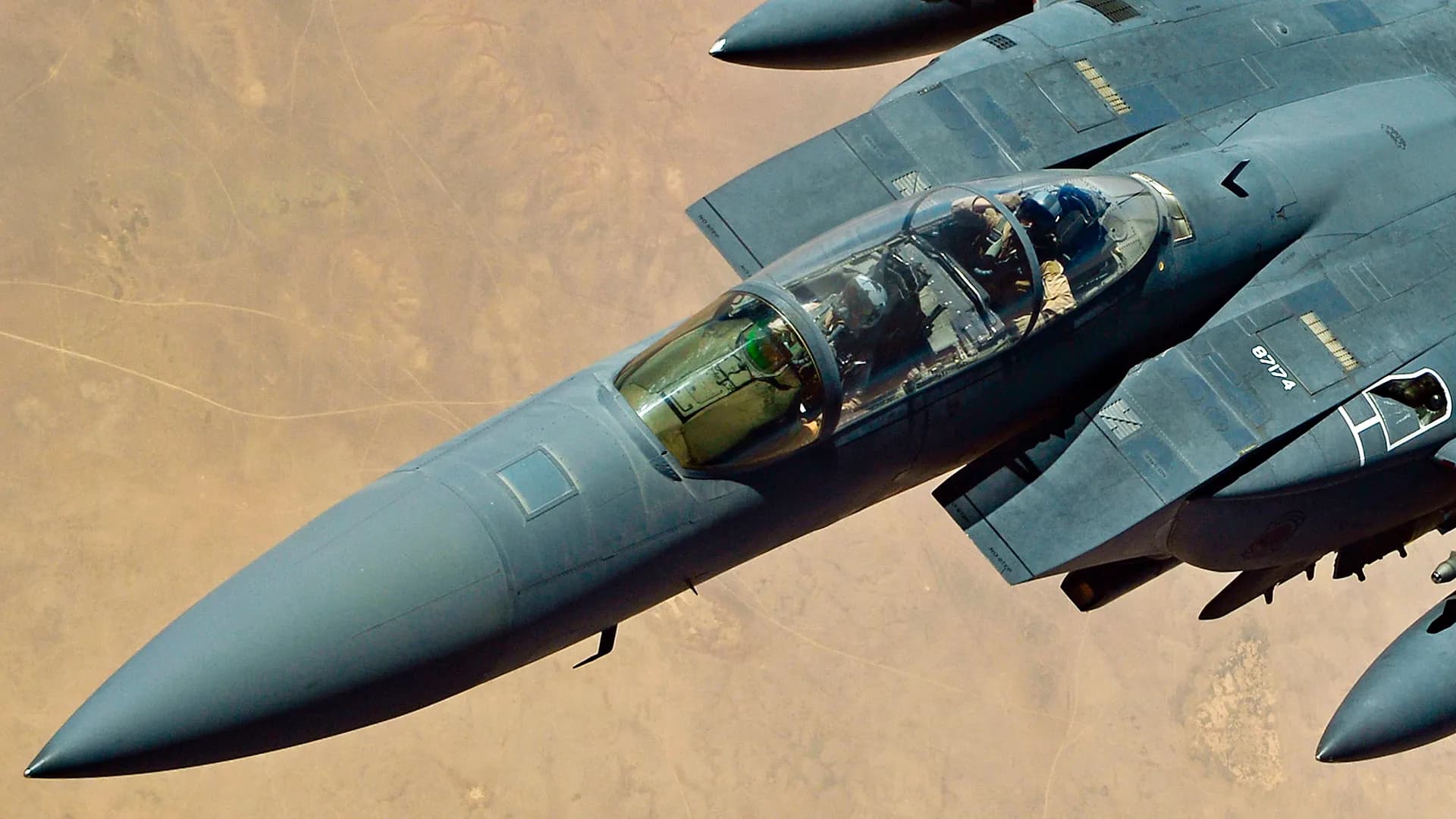
A U.S. Air Force F-15E Strike Eagle pilot who ejected over Iran in April reportedly told intelligence officials he witnessed multiple Iranian drones linked together, moving as one in a jellyfish-like formation. CNN cited four anonymous sources familiar with the account. Analysts and officials remain divided on the claim's credibility, noting the pilot suffered a concussion. Possible explanations range from an Iranian suicide drone swarm to friendly systems, balloons, or natural phenomena.
Highlights
- An F-15E Strike Eagle pilot debriefed after ejecting over Iran in April reportedly described a 'jellyfish-like' swarm of linked drones moving as a single unit, according to CNN citing four anonymous sources.
- The pilot was subsequently diagnosed with a concussion, and U.S. intelligence officials are divided on the reliability of his account, with disagreement over whether he could clearly recall the events.
- NBC News previously reported the F-15E was likely struck by a Chinese-made man-portable shoulder-fired missile, possibly assisted by a long-range early warning radar Iran acquired early in the conflict.
- DARPA is currently developing an autonomous drone constellation capable of supporting a networked swarm of up to 500 drones simultaneously, reflecting the growing strategic importance of swarm technology.
- The rescue of the WSO took approximately 50 hours after ejection and involved hundreds of troops, dozens of aircraft, and diversionary operations at more than six locations inside Iran; the U.S. lost one A-10, two MC-130Js, and several Little Bird helicopters in the effort.
Numerous questions remain unanswered about the complex rescue operation that followed the shoot-down of a U.S. Air Force F-15E Strike Eagle over Iran in April, as well as the cause of the aircraft's loss. Now, a reported pilot account has added a striking new detail: in the seconds before ejecting, the crew reportedly witnessed a swarm of drones in the sky that resembled a jellyfish.
According to CNN, the pilot stated he saw "multiple Iranian drones hovering in the air, moving as one, forming a jellyfish-like formation." The report cited four anonymous sources described as familiar with the matter.
It goes without saying that this account should be treated with caution, given the extreme stress and confusion of the moment. Nevertheless, CNN claims the statement was taken seriously enough to prompt discussion within the U.S. intelligence community. Notably, the testimony comes from the pilot alone and not from the Weapons System Officer (WSO).
What the Pilot Reportedly Said
In post-mission debriefs, the F-15E pilot reportedly told intelligence officers:
"Multiple drones linked together, moving as one, with smaller drones hanging below a larger one like tentacles. It was like something out of an alien movie."
This was not a direct quote from the pilot, but rather a characterization attributed to a source familiar with the witness's account. A separate source told CNN that the same pilot also described seeing a "drone minefield" in the air.
Even accepting these accounts at face value, it remains impossible to confirm whether what the pilot described accurately reflects what he actually saw. The incident unfolded under extreme duress, and the pilot was subsequently diagnosed with a concussion. Even U.S. intelligence officers present at the debriefs reportedly hold differing views on how to interpret the F-15 pilot's description and whether he could clearly recall the events in question.
The same CNN report also reiterated that this pilot had previously been shot down once already during the same conflict — in a friendly-fire incident in March that resulted in three Strike Eagles going down over Kuwait. The Substack publication The High Side first reported that detail, citing multiple current and former Air Force officials on condition of anonymity, and CBS News subsequently followed with its own anonymous-source reporting.
The Shoot-Down and the Rescue
The precise cause of the F-15E's loss over Iran has not been publicly confirmed. NBC News previously cited three unnamed officials who said the jet was "likely struck by a Chinese-made man-portable shoulder-fired missile," potentially assisted by "long-range early warning radar capable of detecting stealth aircraft" that Iran had acquired in the "early" stages of the conflict. President Donald Trump was also reported to have said Iran used a shoulder-fired missile, adding that "they just got lucky."
The pilot was recovered within hours of the shoot-down. The WSO, however, concealed himself in a rocky crevice as both rescue forces and Iranian troops conducted a frantic search. He was not recovered until approximately 50 hours after ejecting, in an operation that involved hundreds of troops, dozens of aircraft, and diversionary actions carried out across more than six separate locations inside Iran. The rescue also cost the U.S. one A-10 Thunderbolt II, two MC-130J Commando II special operations aircraft, and several AH/MH-6 Little Bird helicopters destroyed on the ground.
Could the Drone Swarm Have Been Involved in the Shoot-Down?
The most dramatic interpretation — that the drone swarm directly participated in, or incidentally contributed to, the Strike Eagle's loss — cannot be entirely ruled out, but no publicly available evidence currently supports it.
The "minefield" description is particularly intriguing, suggesting some kind of zone that the F-15 may have blundered into. This could be purely figurative, but there is tactical logic to deploying some form of drone barrier along a known flight path, especially one used for low-altitude ingress or near a high-value facility. An aircraft entering such a zone could be destroyed by a collision, by a drone detonating in proximity, or even by flying into a tether if the drones were physically linked. This loosely fits the reported description and would not require any genuine swarm coordination capability — it is, in some ways, a more flexible, on-demand version of a barrage balloon concept. China is already using balloons in a similar manner to protect critical infrastructure.
What Is a True Drone Swarm?
If the pilot did in fact observe a genuine coordinated swarm of "jellyfish-like" Iranian drones, it would point to a previously unknown Iranian capability — though one that falls within the realm of technical plausibility.
In this context, a swarm refers to a group of vehicles or guided munitions that are datalinked to one another and operate cooperatively to maximize collective effectiveness. The degree of computational autonomy, as well as the nature of the supporting communications architecture, are critical factors. Swarm capability can range from basic coordination to highly dynamic AI-driven systems. A swarm should not be confused with a group of drones simply assigned the same mission without genuine coordination — the latter is better understood as a pre-programmed drone "formation" or "pack" that relies on tactical planning and mass rather than real-time collective decision-making in response to external stimuli.
Regardless, CNN asserted — based on two of its sources — that "preliminary reports suggest the drone formation may have somehow helped Iran shoot down the American fighter jet."
Swarm Development by China and Russia, and U.S. Responses
China and Russia, the two primary suppliers of military assistance to Iran, have both made drone swarming a significant development priority. Swarms offer not only the ability to overwhelm adversaries through sheer numbers, but also the capacity to collectively sense large areas and deliver blended effects that exceed the sum of their parts.
China in particular has advanced its drone swarm capabilities at a rapid pace, as this publication has covered extensively over the years. Beijing has demonstrated loitering munition swarms launched from containerized systems mounted on light vehicles or helicopters on multiple occasions. China is also developing high-end swarming capability using larger drones and advanced unmanned combat air vehicles (UCAVs).
The potential of this form of warfare has not been lost on the U.S. military, which has invested in related research for decades. The public disclosure of the Perdix micro-drone program is now nearly a decade old, and coordinated swarm trials have since been conducted openly on multiple occasions. With the broader drone revolution sweeping the defense sector, these efforts have well and truly entered the mainstream.
Just last month, this publication reported that DARPA is developing highly autonomous drones and remote-controlled containerized systems for launching, recovering, and supporting them. The ultimate goal is a largely self-sustaining "autonomous constellation" capable of supporting a networked swarm of up to 500 drones simultaneously.
Other Possible Explanations
Of course, there remains the possibility that the pilot witnessed something else entirely — perhaps compounded by the effects of a concussion or some other factor. A flock of birds or a cluster of balloons (the latter of which can be used as decoys to confuse enemy radar and lure fighters and other air defense assets) could, under certain circumstances, be mistaken for a drone swarm. Iran has clear incentives to employ such low-cost but potentially effective tactics. While a seasoned combat pilot would typically be able to distinguish between drones and birds, the circumstances at the time were anything but typical.
This account could also fall into the category of Unidentified Aerial Phenomena (UAP), given the difficulty in identifying what was reportedly observed. It is not yet known whether the pilot provided a specific physical description of the aircraft, which could help narrow down the possibilities. Whether the jet's onboard sensors detected them is equally unknown.
For now, the reported drone sighting remains a compelling but unverified detail within a much larger story — one whose most significant facts have yet to be fully disclosed.
Contact the author: thomas@thewarzone.com
原文來源: 查看原文
FAQ
Reviewed and published by the LAETimes editorial desk ·


