F-15EX Eagle II and MQ-28 Ghost Bat Fly Together at Valiant Shield 26 Exercise in the Pacific
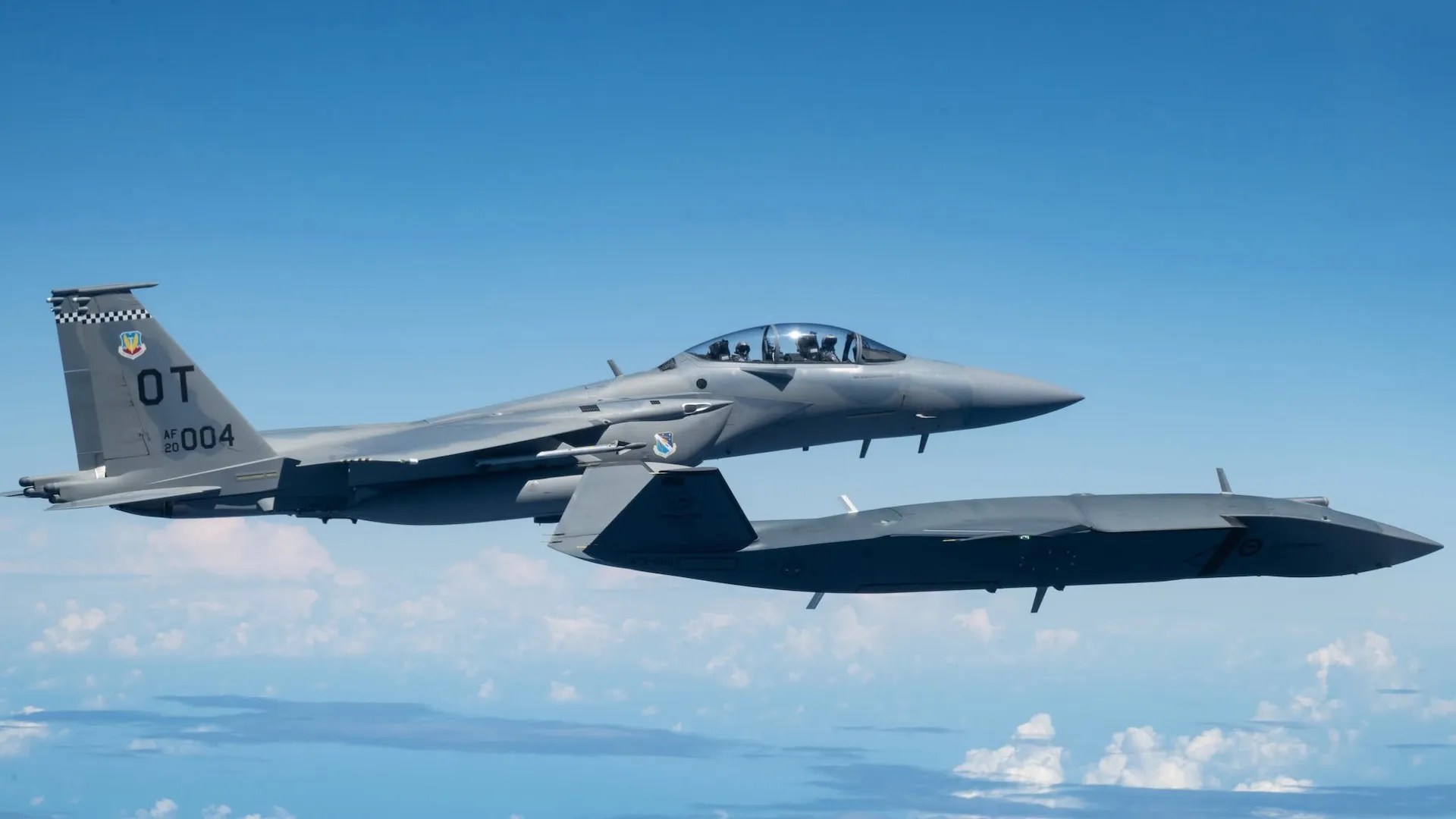
The U.S. Air Force's F-15EX Eagle II and Australia's Boeing-built MQ-28 Ghost Bat drone flew together for the first time at the multinational Valiant Shield 26 exercise over the Philippine Sea, offering the clearest demonstration yet of the F-15EX's potential as an airborne command node for Collaborative Combat Aircraft (CCA). The pairing underscores the Indo-Pacific command's urgency to field manned-unmanned teaming capabilities against a rapidly expanding PLAAF.
Highlights
- U.S. Air Force F-15EX Eagle II and Boeing MQ-28 Ghost Bat flew together for the first time during Valiant Shield 26 over the Philippine Sea, marking a milestone in manned-unmanned teaming.
- PACAF described the pairing as demonstrating 'the future of manned-unmanned teaming in the theater,' with unmanned systems acting as force multipliers for human pilots.
- MQ-28 successfully fired a live AIM-120 AMRAAM during Trial Kareela at RAAF Base Woomera in South Australia, validating its air-to-air weapons capability.
- The MQ-28 conducted a Forward Arming and Refueling Point (FARP) demonstration on Rota Island, Northern Mariana Islands, supporting Agile Combat Employment (ACE) concepts.
- The U.S. Air Force FY2027 budget significantly increases F-15EX investment, with total procurement reportedly set at 267 aircraft, while Boeing builds the first nine MQ-28 Block 2 aircraft for the RAAF.
For years, analysts and defense observers have discussed the potential of the U.S. Air Force's F-15EX Eagle II as a drone command-and-control platform to work alongside upcoming Collaborative Combat Aircraft (CCA). Now, that concept has been photographed in action for the first time: an F-15EX flying alongside an MQ-28 Ghost Bat drone during the U.S.-led Valiant Shield 26 exercise spanning the Indo-Pacific.
PACAF Releases First Joint-Flight Imagery
The photographs were first published on the official Facebook page of Pacific Air Forces (PACAF), with the jets pictured over the Philippine Sea. PACAF described the images as depicting "the future of manned-unmanned teaming in the theater," adding that "unmanned systems serve as force multipliers, extending the reach and effectiveness of human pilots."
Further details on the degree of integration between the two aircraft have not been released, but as this outlet has previously noted, the MQ-28's participation in its first large-scale multinational exercise presented an ideal opportunity to validate collaborative concepts in a high-end coalition environment.
A Natural Boeing Partnership
Both the F-15EX and the MQ-28 are Boeing products, and the pairing has featured prominently in the company's concept artwork for years — a clear indication that the Eagle II was always envisioned as a leading platform for CCA cooperation.
When the F-15EX program was first unveiled, this outlet noted the aircraft's suitability as a drone control platform, citing several key advantages:
- Two-seat cockpit design
- Spacious cockpit displays
- Powerful onboard computing capability
- Advanced network connectivity
- High adaptability and long range
Pilots and WSOs on the CCA Control Mission
In a 2024 interview, Maj. Aaron "Kamikaze" Eshkenazi, an F-15EX pilot with the 85th Test and Evaluation Squadron "Skulls" at Eglin Air Force Base, Florida, told this outlet:
"There is a lot of discussion about what the back seat role could look like. Whether it's the existing WSO role, a cyber warfare officer, or an Air Battle Manager — all options are on the table depending on the mission sets we continue to expand into."
In the same interview, Maj. Joshua "Viper" Judy, a WSO with the 40th Flight Test Squadron, elaborated: "We're evaluating the back-seat role in terms of owning the battlespace. Whether that involves command-and-control functions, battle management, or some combination depending on the mission — we're talking about the possibility of piloting unmanned combat aircraft. The overall goal of this jet is to optimize what the front and back seats do across every mission type."
Judy also highlighted the F-15EX's Large Area Display (LAD) and customizable screen layouts, which he said offer "dramatically improved data fusion and situational awareness across nearly every mission" compared to the F-15E's legacy configuration of "four 1980s-era monochrome screens."
Strategic Implications for the Indo-Pacific
The need for CCA capabilities is particularly acute in the Indo-Pacific, where the People's Liberation Army Air Force (PLAAF) is rapidly expanding in both scale and capability.
Gen. Kenneth Wilsbach, Commander of Air Combat Command and former PACAF commander, has stated explicitly that the Air Force is "absolutely" evaluating the deployment of CCA drones to Kadena Air Base in Japan alongside the F-15EX fleet already based there. He also noted that distributing CCAs across multiple bases in the region while keeping them under remote F-15EX command would "complicate the battlespace and create dilemmas for adversaries."
The U.S. Air Force's decision to establish a permanent F-15EX presence in Japan likewise reflects the aircraft's unique strategic value in any potential conflict with China.
Forward Arming and Refueling Point Validation
During Valiant Shield 26, the MQ-28 also participated in a Forward Arming and Refueling Point (FARP) concept demonstration for CCA on Rota Island in the Northern Mariana Islands. Air Force imagery showed the Ghost Bat alongside an HC-130J Combat King II, HH-60W Jolly Green II rescue aircraft, Royal Australian Air Force (RAAF) personnel, and the Nellis-based Experimental Operations Unit.
This aligns with the foundational design philosophy of the Air Force's CCA program, which centers on distributed, decentralized operations — and with Agile Combat Employment (ACE), regarded as essential to survivability in a future conflict.
YFQ-44 Fury Advances in Parallel
The Air Force has established test units to explore CCA employment concepts, including ACE operations. The first Increment 1 CCA, the YFQ-44 Fury prototype, has completed testing at Edwards Air Force Base in California, validating CCA deployment and sustainment in a contested environment, and has undergone captive-carry testing with the AIM-120 AMRAAM missile.
Weapons Test Milestone
Notably, the MQ-28 has already conducted at least one live weapon firing: during Trial Kareela held late last year at RAAF Base Woomera in South Australia, the aircraft successfully launched an AIM-120 Advanced Medium-Range Air-to-Air Missile (AMRAAM).
Program Status and Outlook
The F-15EX program is currently at a high point — the U.S. Air Force's FY2027 budget significantly increases investment in the program, with the total procurement quantity reportedly set at 267 aircraft. The F-15EX has also performed strongly in Developmental and Operational Test and Evaluation (DOT&E).
For the MQ-28, CCA-type systems are precisely the kind of capability that can extend the F-15EX's sensor reach, weapons payload, and tactical options — including the infrared search and track (IRST) sensor observed on the Ghost Bat during Valiant Shield 26. The aircraft has been flying in Australia since 2021, and the RAAF has taken delivery of eight pre-production Block 1 aircraft.
Boeing is currently building the first nine Block 2 aircraft for the RAAF as a stepping stone to the fully operational Block 3 variant. Block 3 will feature an enlarged wingspan, increased payload capacity, and an internal weapons bay capable of carrying one AMRAAM, two GBU-39/B Small Diameter Bombs (SDB), or equivalent munitions.
On the U.S. testing side, the MQ-28 has conducted test flights off the Southern California coast at Naval Air Weapons Station Point Mugu. Boeing is also actively pursuing export opportunities, with the Indo-Pacific region identified as a priority market.
If testing continues on its current trajectory, the F-15EX is on course to become an airborne command node capable of directing multiple autonomous CCAs simultaneously — significantly multiplying the combat effectiveness of every crewed fighter, and of the broader Air Force as a whole.
原文來源: 查看原文
FAQ
Newsletter
Subscribe to our Low-Altitude Industry Newsletter
Daily curated news on low-altitude economy and drone industry, delivered to your inbox.
Reviewed and published by the LAETimes editorial desk ·


