F-15EX Eagle II and CCA Drone Complete Historic First Cooperative Flight Over the Pacific
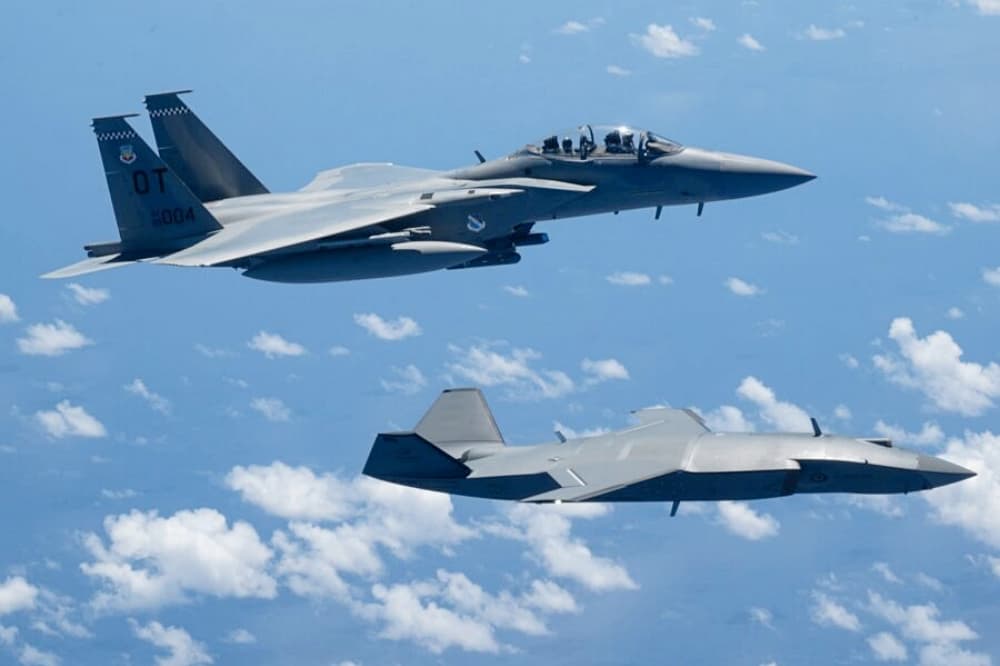
The U.S. Air Force has completed a landmark manned-unmanned teaming flight during Exercise Valiant Shield 26, with an F-15EX Eagle II fighter jet flying alongside a Collaborative Combat Aircraft (CCA) drone over the Philippine Sea. Pacific Air Forces officially announced the milestone on July 1, 2025, marking a significant step toward integrating autonomous wingmen into frontline operations.
Highlights
- Pacific Air Forces officially announced on July 1, 2025, that an F-15EX Eagle II flew alongside a CCA drone over the Philippine Sea — the first such cooperative flight in the Pacific.
- The manned-unmanned teaming mission was conducted during Exercise Valiant Shield 26, a large-scale U.S. joint military exercise in the Indo-Pacific.
- The CCA drone serves as an autonomous wingman, designed to extend combat effectiveness and reduce pilot risk in high-threat environments.
- The F-15EX Eagle II, one of the U.S. Air Force's most advanced fourth-generation fighters, was selected as the platform for this landmark MUM-T demonstration.
- The flight marks a pivotal shift for the CCA program, moving from testing and development toward frontline operational integration.
F-15EX Eagle II and CCA Drone Achieve Historic Cooperative Flight Over the Pacific
The U.S. Air Force reached a significant milestone this week in the Pacific, completing the first-ever coordinated flight between an F-15EX Eagle II fighter jet and a Collaborative Combat Aircraft (CCA) drone — a development that signals a new era in manned-unmanned teaming (MUM-T) for frontline combat operations.
Pacific Air Forces Makes It Official
Pacific Air Forces (PACAF) announced the historic flight via social media on July 1, 2025. The mission was conducted over the Philippine Sea as part of Exercise Valiant Shield 26, a large-scale joint military exercise regularly held by the United States in the Indo-Pacific region.
Demonstrating the Future of Air Combat
The flight showcased the U.S. Air Force's manned-unmanned teaming concept, in which CCA drones serve as autonomous wingmen alongside piloted aircraft. Operating in high-risk mission environments, CCA drones are designed to extend the combat effectiveness of crewed fighters while reducing the risk to human pilots.
The F-15EX Eagle II — one of the most advanced fourth-generation fighters in the U.S. Air Force inventory, equipped with cutting-edge avionics and increased weapons payload capacity — is considered an ideal platform for demonstrating MUM-T concepts ahead of future fifth- and sixth-generation integration.
Strategic Implications for the Indo-Pacific
Exercise Valiant Shield 26 is one of the U.S. military's premier large-scale, multi-service joint exercises in the Indo-Pacific, designed to strengthen combat readiness and alliance interoperability in the region. The CCA drone's first real-world cooperative flight with a crewed fighter during a live exercise environment is widely regarded as a pivotal step in transitioning the Collaborative Combat Aircraft program from testing and development into operational integration.
As nations around the world accelerate investment in unmanned combat systems, this demonstration underscores that the U.S. Air Force's CCA program is moving decisively from the laboratory to the flight line. The routine deployment of autonomous drone wingmen alongside manned fighters is now within tangible reach — and its implications for regional security across the Indo-Pacific are substantial.
原文來源: 查看原文
FAQ
Newsletter
Subscribe to our Low-Altitude Industry Newsletter
Daily curated news on low-altitude economy and drone industry, delivered to your inbox.
Reviewed and published by the LAETimes editorial desk ·