U.S. F-15EX and Australian MQ-28 Ghost Bat Complete First Formation Flight in the Philippine Sea, Marking Historic Manned-Unmanned Teaming Milestone
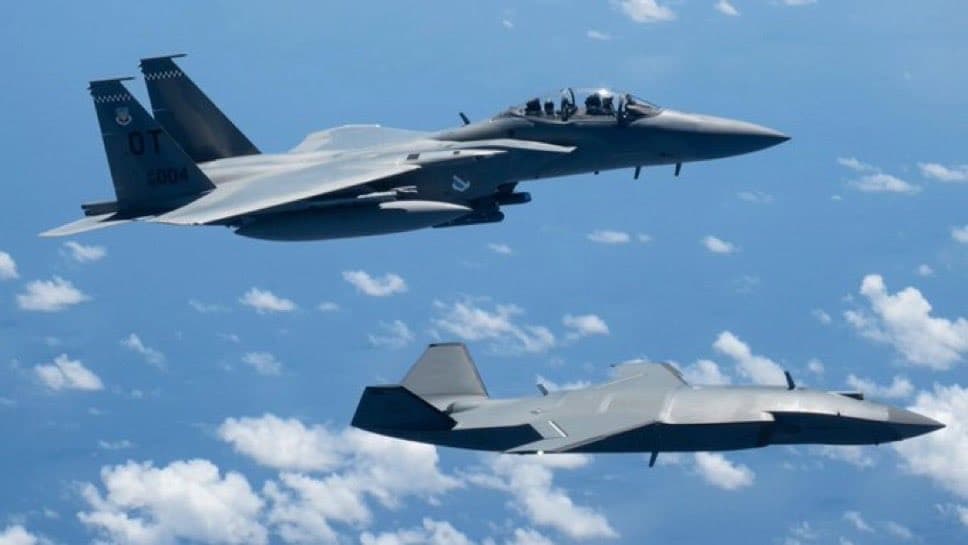
During Exercise Valiant Shield 2026, Boeing Defence Australia's MQ-28 Ghost Bat flew in formation with a U.S. Air Force F-15EX Eagle II over the Philippine Sea — a landmark achievement for Manned-Unmanned Teaming (MUMT). The 10-day multinational exercise included anti-submarine warfare, maritime strike, and advanced drone testing, validating the MQ-28's role as a force multiplier in contested environments.
Highlights
- MQ-28 Ghost Bat於2026年勇盾演習期間在菲律賓海與美軍F-15EX Eagle II完成首次有人機與無人機編隊飛行。
- MQ-28航程約3,700公里、續航超10小時,Block 1與Block 2型已在澳洲及美國累計完成超過150次測試飛行。
- 2025年12月,MQ-28在澳洲Woomera靶場成功試射AIM-120 AMRAAM,與RAAF E-7A及F/A-18F協同擊毀靶機。
- 升級版Block 3機翼面積增大約25%,可多攜帶約907公斤酬載,並新增內部武器艙以提升匿蹤能力。
- 波音與萊茵金屬正聯合向德國推銷MQ-28,波音亦曾向波蘭提供F-15EX與MQ-28套裝方案,顯示其全球出口潛力。
Boeing Defence Australia's MQ-28 Ghost Bat has flown in formation with a U.S. Air Force F-15EX Eagle II during Exercise Valiant Shield 2026 over the Philippine Sea, marking a significant milestone for Manned-Unmanned Teaming (MUMT).
Exercise Background and Mission Objectives
A production-representative MQ-28 test aircraft was reportedly integrated with U.S. and allied forces for the 10-day multinational exercise. Mission sets included anti-submarine warfare, maritime strike, and cutting-edge drone testing, with the exercise also evaluating human-machine teaming in realistic scenarios — including both defensive and offensive counter-air missions.
Prior to the MQ-28's deployment, Pacific Air Forces (PACAF) stated that a primary objective was to assess the aircraft's role as a "force multiplier" capable of extending the reach, situational awareness, and survivability of crewed aircraft in contested environments.
According to open-source reporting, the MQ-28 flew alongside an F-15EX Eagle II assigned to the 85th Test and Evaluation Squadron over the Philippine Sea. PACAF also released photographs of the two aircraft flying in formation, though no information has confirmed whether the fighter pilot directly commanded the Collaborative Combat Aircraft (CCA).
The MQ-28 and F-15EX: A Potent Partnership
CCAs — also known as loyal wingman drones — can execute high-risk missions, extend sensor coverage, carry additional payloads, provide electronic warfare or jamming support, and conduct strikes against ground targets.
U.S. Air Force Major Daniel Pesich, commander of the Experimental Combat Force CCA detachment, stated: "The future of airpower lies in the partnership between our most capable assets — battle-tested warriors and the technology that empowers them. By advancing manned-unmanned teaming, we are strengthening power projection while building a more resilient, capable, and lethal joint force."
The MQ-28 is a stealthy, AI-driven drone designed for Intelligence, Surveillance, and Reconnaissance (ISR), electronic warfare (EW), and strike missions. The F-15EX, meanwhile, is a modernized two-seat, high-payload, non-stealthy 4.5-generation fighter equipped with advanced radar, long-range combat capability, and a large weapons loadout — widely regarded as an ideal command node for loyal wingman drones.
Aviation tracking account AirPower wrote on X: "Batman and Robin? Actually, this is the F-15EX Eagle II and MQ-28 Ghost Bat loyal wingman photographed together during Valiant Shield '26. This Pacific debut is a major milestone for Manned-Unmanned Teaming (MUM-T). With a 3,700 km range, the Ghost Bat serves as an AI-driven, off-board low-observable sensor and weapons platform — a perfect partner for the F-15EX."
MQ-28 Ghost Bat Technical Specifications
Derived from Australia's Loyal Wingman Advanced Development Program, the MQ-28 has a range of approximately 3,700 km, an endurance of over 10 hours, and a low radar cross-section designed to evade detection. Its open, modular architecture supports data integration and cooperative engagement with the F-15EX's advanced systems.
The MQ-28 can conduct ISR missions, collecting real-time data and disrupting adversary communications, radar, and defense systems. It is also capable of delivering precision strikes against enemy targets or acting as a decoy to draw fire and protect crewed aircraft. Unlike conventional drones requiring continuous remote control, the MQ-28 integrates onboard AI and autonomous capabilities, enabling it to operate independently and adapt to rapidly evolving combat situations.
Block 3 Upgrade and Recent Milestones
In December 2025, the MQ-28 Ghost Bat successfully fired an AIM-120 Advanced Medium-Range Air-to-Air Missile (AMRAAM) at the Woomera Range Complex (WRC) in South Australia, engaging and destroying an Australian-built Phoenix jet target drone in coordination with a Royal Australian Air Force (RAAF) E-7A Wedgetail airborne early warning aircraft and an F/A-18F Super Hornet.
Last month, the upgraded MQ-28 Block 3 made its public debut. Boeing stated that the Block 3 Ghost Bat features a wing area approximately 25% larger than previous variants, enabling it to carry around 907 kg (2,000 lb) more in fuel, stores, and mission payloads. Critically, the Block 3 introduces an internal weapons bay capable of housing four Small Diameter Bombs (SDBs) or two AIM-120 AMRAAM missiles, further enhancing its stealth performance.
Block 1 and Block 2 aircraft have completed more than 150 test flights across Australia and the United States, making the Ghost Bat one of the most mature CCA technologies in the world. Its recent integration with crewed aircraft in a multinational exercise adds to a string of milestones — including its first international flight, conducted at Naval Air Weapons Station Point Mugu in Ventura County, California.
Indo-Pacific Strategic Implications
The integration of the MQ-28 Ghost Bat with crewed aircraft in the Indo-Pacific theater carries significant strategic weight. The United States and its allies are continuously developing capabilities to counter China's increasingly assertive military posture, particularly in the South China Sea and East China Sea. A two-seat F-15EX carrying both a pilot and a Weapons Systems Officer (WSO) could command multiple MQ-28s simultaneously, substantially increasing sortie rates, sensor coverage, and weapons delivery capacity without requiring additional crewed platforms.
Notably, Boeing and Rheinmetall are jointly marketing the MQ-28 concept to Germany, and Boeing has previously offered Poland a combined F-15EX and MQ-28 package.
原文來源: 查看原文
FAQ
Reviewed and published by the LAETimes editorial desk ·


