Rafale's Stealth Gap vs. F-35: Why France Is Betting on Speed, Numbers, and Networked Warfare
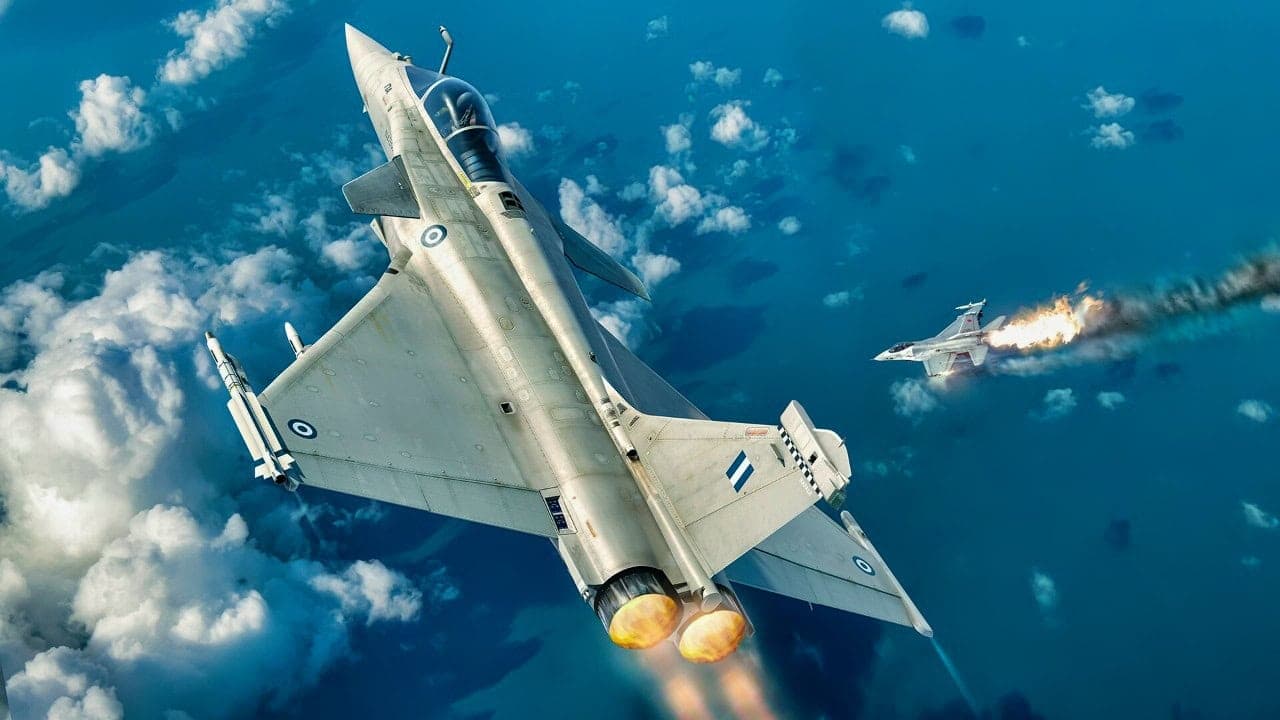
With the Franco-German FCAS next-generation fighter programme effectively collapsed over leadership and IP disputes, France is redirecting billions into the Dassault Rafale F5 upgrade. Industry insiders describe the F5 as transforming a 1990s airframe into a near-sixth-generation combat node — integrating loyal-wingman drones, advanced data fusion, and nuclear-strike connectivity. France acknowledges the Rafale cannot match the F-35's low-observable profile, but argues that speed, mass, and network-centric warfare may better suit modern battlefields.
Highlights
- The Franco-German FCAS next-generation fighter programme has effectively collapsed after years of disputes between Dassault Aviation and Airbus over leadership, IP rights, and design authority.
- France is redirecting billions of euros originally committed to FCAS into a national Rafale F5 upgrade programme extending to 2040.
- The Rafale F5 integrates loyal-wingman drone teaming, next-generation radar, advanced data fusion, and deeper nuclear strike connectivity — capabilities industry insiders compare to a light sixth-generation fighter.
- India is reportedly considering an additional 114 Rafale aircraft, which would significantly expand the production line and sustain the programme financially.
- The Rafale F5's primary limitation is its lack of stealth performance comparable to the F-35 or F-22, though France argues that speed, mass, and networked warfare may outweigh low-observability on the modern battlefield.
Dassault Rafale Prepares for a Major Upgrade
Europe is eager to demonstrate — particularly to an increasingly skeptical United States — that it can shoulder its fair share of military responsibility within NATO.
To prove this, European nations have been working together to develop advanced, independently designed military platforms.
The most prominent example was the Future Combat Air System (FCAS), a joint programme involving France, Germany, and Spain.
However, after years of bitter disputes between Dassault Aviation and Airbus over programme leadership, intellectual property rights, and design authority, FCAS has effectively collapsed.
France and Germany never reached agreement on who should lead the effort. France wanted the legendary Dassault brand to take the helm; Germany insisted on a more equal partnership arrangement.
FCAS had originally aimed to replace the Dassault Rafale and the Eurofighter Typhoon around 2040. France has now announced it will continue its own national fighter development path independently.
Paris has made clear that the billions of euros originally committed to FCAS will be redirected into a national fighter development programme extending to 2040.
The Rafale Is Not Going Anywhere
This means the iconic Rafale will not be disappearing any time soon. The aircraft continues to attract export orders, and the F5 upgrade package is designed to keep it competitive on the battlefield well into the 2040s.
Potential orders from India and other Asian nations could significantly expand the Rafale production line.
France's strategy is essentially identical to what the United States has done with the F-15EX — continuously upgrading a proven, combat-tested airframe with new sensors, networked capabilities, and drone teaming functions.
These measures delay the need for a costly clean-sheet replacement design — one that has already run into severe difficulties.
The Rafale's export success gives France an advantage most European nations lack: a fighter programme that can largely sustain itself through overseas sales.
India alone is reportedly considering the purchase of an additional 114 Rafales.
Why the Rafale F5 Matters
France's F5 standard is far more than a software patch for an aging platform.
Multiple industry insiders indicate the aircraft is undergoing a fundamental transformation — bringing its capabilities closer to a light sixth-generation fighter than a conventional fourth-generation combat aircraft.
If true, American taxpayers might reasonably ask: if France can elevate a fourth-generation fighter to near-sixth-generation baseline capability, why does the US Air Force need to spend enormous sums developing an entirely new sixth-generation aircraft from scratch?
Advocates for next-generation programmes would counter that France is overstating its upgrade results.
The F5 upgrade includes several critical improvements:
- Next-generation radar technology: enhanced detection of low-observable targets
- Advanced data fusion: repositioning the Rafale as an airborne "quarterback" rather than a standalone fighter
- Nuclear deterrence integration: deeper incorporation into France's future nuclear strike capability
- Loyal-wingman drone teaming: integration of unmanned collaborative combat aircraft
- Expanded stand-off strike options: incorporating lessons learned from the conflicts in Ukraine and Iran
The F5 upgrade cannot therefore be viewed as a modest incremental step in the Rafale's development history. The F5 represents a shift toward a system-of-systems operational philosophy — the fighter becomes the central node commanding drones, missiles, sensors, and networked weapons.
This is exactly the direction the US Air Force is pursuing with the F-47, and the path China has taken with its sixth-generation fighter concepts.
The Rafale Is Evolving from Fighter to Combat Network Node
The message embedded in the F5 is clear: the traditional paradigm of platform-centric air combat is coming to an end.
The Rafale F5 is designed on the premise that future combat will be dominated by network-centric warfare, not platform-centric warfare. Dassault's core argument is that the network is what matters — and the Rafale simply needs to be the most survivable and flexible node within that network.
All of this is being achieved on an airframe evolved from a fourth-generation design.
The Fatal Flaw: Stealth Performance
The upgraded Rafale F5's most significant limitation remains its lack of stealth capability.
French officials themselves acknowledge that the Rafale cannot match the low-observable performance of the Lockheed Martin F-35 Lightning II, the F-22 Raptor, or Chinese stealth fighters.
But is stealth still the absolute decisive factor in modern air combat? Recent trends suggest that speed and mass are once again being reassessed.
Suppressing enemy air defenses through lower cost, higher speed, and greater firepower — rather than relying on stealth alone — appears to be France's calculated choice.
Nevertheless, the stealth deficit remains one of the primary reasons France continues to seek a long-term Rafale successor. It was also the original motivation that drew France into the FCAS programme, and why Paris is still seeking a next-generation replacement following FCAS's collapse.
If the F5 delivers on its promises, however, Paris will face no immediate pressure to accelerate sixth-generation development — the Rafale F5 buys France valuable strategic breathing room.
Strategic Implications: The Fragmentation of European Defense
Amid all the discussion about European rearmament, a deeper phenomenon is often overlooked: Europe is fragmenting at the fastest pace seen in 30 years.
Even in the domain of common defense, Europe has fractured into three distinct camps:
-
France: operating the Rafale F5, independently developing a sixth-generation fighter, seeking potential partnerships with India or the UAE, maintaining its own nuclear arsenal, and prioritizing French sovereignty — even at the expense of regional solidarity.
-
The UK–Italy camp: partnering with Japan on the Global Combat Air Programme (GCAP).
-
The US camp: maintaining a complete fifth- and sixth-generation fighter ecosystem.
Rather than converging into a unified European fighter industry, the continent is fragmenting into competing aerospace blocs. The collapse of FCAS may represent the most significant failure of European defense industrial cooperation since the end of the Cold War.
Conclusion: France's Strategic Vision
France's Rafale F5 programme is not about Paris clinging to an old platform out of inertia. It is a strategic choice to transform a fourth-generation airframe into a genuine network-centric combat platform — one that will remain in service until a more advanced next-generation successor is ready.
This is not strategic nostalgia, nor short-sightedness.
This is France preparing for a more divided, less unified new Europe — and it represents genuine strategic foresight from Paris.
Author: Brandon J. Weichert, Senior National Security Editor, 19FortyFive.com. Author of A Disaster of Our Own Making: How the West Lost Ukraine.
原文來源: 查看原文
FAQ
Reviewed and published by the LAETimes editorial desk ·