F1 Austrian Grand Prix Spotlights FPV Drone Footage as a Lead Broadcast Feature — Fans Want to Know Who's Flying
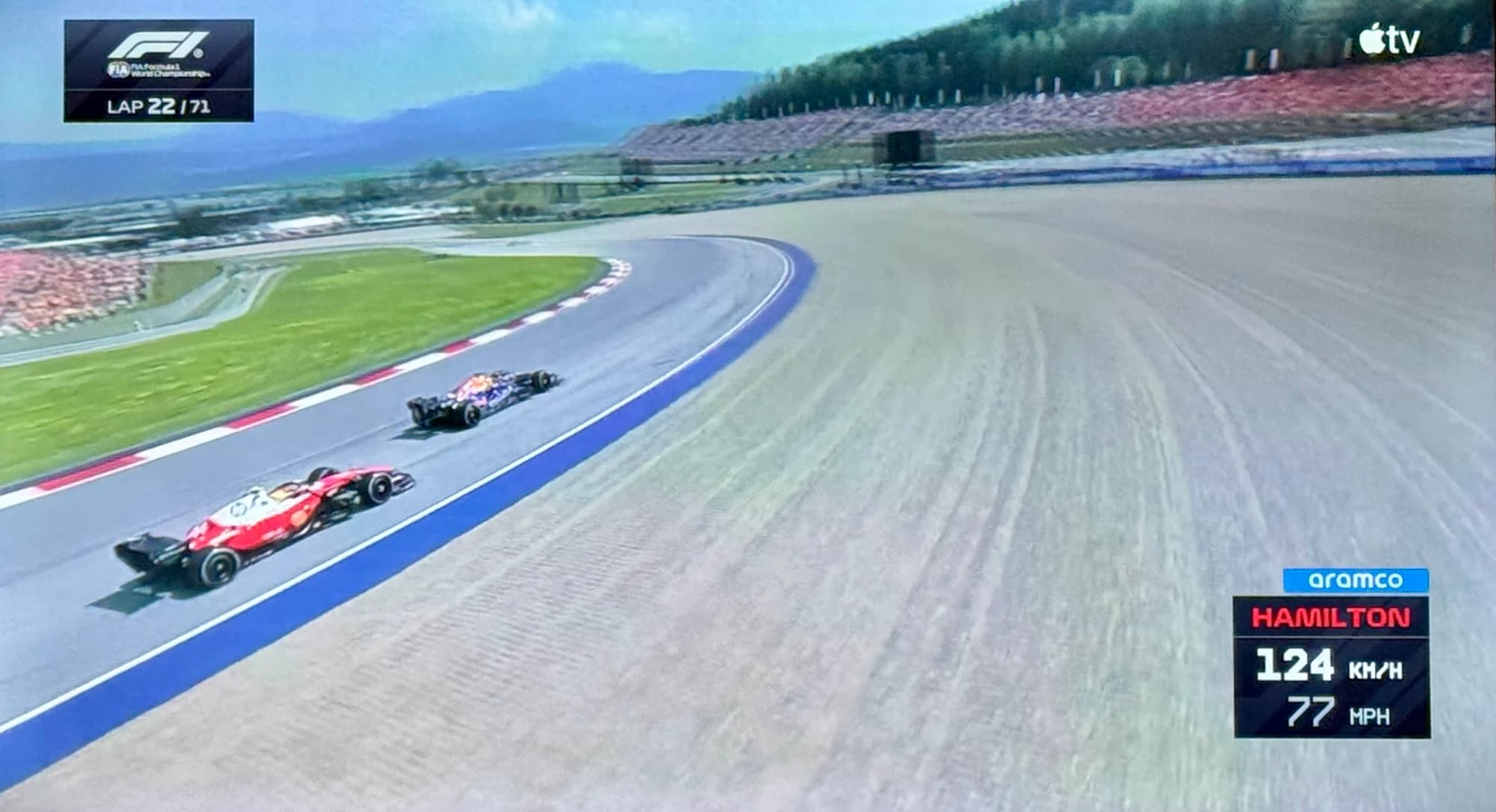
At the 2026 F1 Austrian Grand Prix on June 28, FPV drone footage took center stage during the live broadcast, capturing Lewis Hamilton (Ferrari) and Max Verstappen (Red Bull) battling through the Red Bull Ring's Spielberg hills. The stunning aerial sequences ignited social media debate, with fans demanding to know the identity of the pilot behind the controls — marking a milestone for FPV technology in top-tier motorsport broadcasting.
Highlights
- At the June 28, 2026 F1 Austrian Grand Prix, FPV drone footage was used as a primary broadcast camera position — not a novelty insert — capturing Lewis Hamilton and Max Verstappen battling at the Red Bull Ring.
- F1 first incorporated FPV drone footage in a live broadcast at the 2022 Spanish Grand Prix, using a basic GoPro that fell short of the production's overall image quality standard.
- Dutch Drone Gods, collaborating with Red Bull Advanced Technologies, achieved a straight-line chase speed of 310 km/h (193 mph) tracking Verstappen's RB20 at Silverstone — flown fully manual without GPS assistance.
- F1 deploys its own drone systems at approximately ten race weekends per season, using pre-certified hardware to meet the different licensing and safety regulations in each host country.
- Social media responses to the Austrian footage were immediate and widespread, with fans and official team accounts alike sharing the footage and demanding the pilot's name be publicly credited.
On Sunday, June 28, 2026, the F1 Austrian Grand Prix made FPV drone footage a headline broadcast feature. The most compelling sequences gave viewers a low-flying, chase perspective of Lewis Hamilton in the Ferrari and Max Verstappen in the Red Bull car weaving through the Spielberg hills at the Red Bull Ring. The footage aired multiple times during the live race and replays, with the camera skimming over undulating terrain at blistering speed.
For those watching on Apple TV — the exclusive U.S. broadcaster for F1 in 2026 — the switch to the drone perspective at Lap 11 transformed the entire atmosphere of the race.
This is the angle Formula 1 has been searching for over many years. This time, the sport finally stopped treating drones as a novelty insert and elevated them to a primary broadcast camera position. Within minutes of the footage airing, discussion exploded online, with fans asking one question: who was flying that drone?
F1 Positions Drone Footage as the Star, Not a Gimmick
The official Formula 1 channel threw its full promotional weight behind the footage. The F1 account posted a clip of the low-altitude pass over the circuit with the caption: "Drone cam view, flying over the Red Bull Ring." Oracle Red Bull Racing followed with the Hamilton–Verstappen battle clip, headlined: "Come for the battle, stay for the drone footage." When the team being chased is actively promoting the chase cam, it signals that the broadcast team has full confidence the angle is worth marketing.
Fan accounts shared it throughout the afternoon. One widely circulated post read: "F1, hats off to you. This drone footage — can anyone tell me the pilot's name?" Another, translated from Turkish, joked: "At this rate, no one will want to attend races in person anymore." The on-screen timing data visible in the footage confirmed Lap 11 of 71, with Hamilton and Verstappen running second and third — matching the actual race situation precisely.
FPV in F1: A History That Traces Back to the 2022 Spanish Grand Prix
F1's first use of FPV drone footage in a live broadcast was the 2022 Spanish Grand Prix, capturing Verstappen's race victory. The debut, however, was rough around the edges: the drone was equipped with a basic GoPro, and the image quality was noticeably inferior to F1's other cameras. DroneXL noted at the time that the footage had not yet reached the broadcast standard of the wider production.
The technology evolved steadily from there. In 2023, Johnny FPV chased a Red Bull car through the Nevada desert and onto the famous Las Vegas Strip in a cinematic sequence. A landmark moment followed when Dutch Drone Gods, in collaboration with Red Bull Advanced Technologies, built a purpose-built chase drone that tracked Verstappen's RB20 around Silverstone at a top straight-line speed of 310 km/h (193 mph).
By the 2024 Hungarian Grand Prix, FPV drone footage had been formally integrated into the live broadcast across multiple laps. From the GoPro insert at the 2022 Spanish Grand Prix to the headline camera position at the 2026 Austrian Grand Prix, the progression is a story of a technology earning its place through demonstrated capability.
Flying FPV at an F1 Circuit Is Far Harder Than It Looks
Operating an FPV drone at a Grand Prix is a fundamentally different challenge from flying at a rally stage. F1 cars' cornering and braking performance is not easily matched by a drone, and the circuit perimeter is packed with spectators. Safety regulations prohibit drones from flying over spectator areas or crossing the racing surface, which severely constrains the available operating envelope — pilots can capture lateral or overhead angles but cannot chase every apex.
Formula 1 has taken a measured approach to integrating the technology over several seasons. The series now deploys its own drone systems at approximately ten rounds per season — including Bahrain, Miami, and Budapest — using pre-certified proprietary hardware to ease the licensing, insurance, and safety approvals that vary from country to country. F1 Head of Television Production Dean Locke told SVG Europe that the Red Bull chase drone remains a private project that F1 is still in discussions about, as it cannot fly over spectators or cross the track. The most likely answer for what flew at the Red Bull Ring on Sunday is F1's own drone operation unit — and the footage was no less spectacular for it.
Those constraints are precisely why elite pilots matter. Dutch Drone Gods' Silverstone run was flown fully manual, without GPS or automated tracking, reading the car's behavior and circuit characteristics in real time. That gap between a trained FPV pilot holding a steady frame through an F1 car's high-speed blind-apex exit and a consumer drone's auto-follow mode is not a small one. The Austrian footage was not flawless, but it achieved what mattered most: it communicated speed.
DroneXL's Take
No camera format transmits the immediacy of a race to television viewers like FPV drone footage. Trackside cameras capture a car flashing past; helicopters survey the circuit from a distance; onboard cameras lock you to a single car. An FPV drone places you inside the circuit, moving with the cars, cresting the same hills, feeling the same velocity that the drivers feel.
The same effect has been demonstrated in other sports. FPV drones at the 2026 Winter Olympics tracked athletes through their courses rather than observing from a distance below, with the same fundamental impact — when the camera moves in a way that matches the sport itself, the sensation it delivers to viewers is something a static camera position can never replicate.
Formula 1 pushing this footage into prime time and watching its own teams scramble to share it confirms a trajectory that was already visible: every major motorsport series will have a dedicated FPV drone broadcast presence. What F1 now owes its fans is one thing: tell us who that pilot is. The person who captured Hamilton and Verstappen at the Red Bull Ring deserves a credit. F1 used their work to market its broadcast; their name should be on the screen. This article will be updated once the identity is confirmed.
Sources: Formula 1 and Oracle Red Bull Racing (X/Twitter). Images: Formula 1, Apple TV. Original reporting by Haye Kesteloo.
原文來源: 查看原文
FAQ
Reviewed and published by the LAETimes editorial desk ·