GARMI: The Assistive Robot Platform Designed for an Aging Society
The Munich Institute of Robotics and Machine Intelligence (MIRMI) at TU Munich has developed GARMI, a mobile manipulation platform built on the Clearpath Ridgeback, designed for elderly care and telehealth applications. Standing approximately 165 cm tall and weighing around 105 kg, GARMI integrates mobility, dual-arm manipulation, telepresence, and human-centered design. The platform is currently undergoing real-world validation in a test apartment in partnership with care provider Caritas.
Highlights
- TU Munich's MIRMI developed GARMI, a mobile manipulation robot standing 165 cm tall and weighing 105 kg, built on the Clearpath Ridgeback omnidirectional platform.
- GARMI is designed for elderly care applications including daily living assistance, telehealth, remote rehabilitation, and immersive telepresence.
- The team chose a wheeled mobile base over a legged humanoid design for greater safety, payload capacity, and reliability in flat indoor care environments.
- GARMI runs on a ROS 2 software stack integrating MoveIt 2, libfranka, RTAB-Map navigation, and Nav2 path planning for field-deployable research.
- Real-world field trials with older adults are planned through a partnership with care provider Caritas, pending ethics committee approval.
GARMI: The Assistive Robot Platform Designed for an Aging Society
As the global population continues to age, demand for care resources is rising sharply, prompting researchers to explore how robotics can help older adults maintain independence while easing the burden on healthcare systems. The Munich Institute of Robotics and Machine Intelligence (MIRMI) at the Technical University of Munich (TUM), through its geriatric robotics research group based in Garmisch-Partenkirchen, is tackling this challenge head-on with GARMI — a mobile manipulation platform purpose-built for real-world elderly care scenarios.
Since 2026, GARMI has integrated mobility, manipulation, telepresence, and human-centered design into a single research platform built on the omnidirectional Clearpath Ridgeback, helping researchers bridge the gap between laboratory robotics and everyday life.
Designing a Robot Around Real Human Needs
The team's work stems from a straightforward observation: people are living longer, but the number of care workers is not keeping pace. Most older adults want to remain in their own homes for as long as possible, yet many everyday tasks become increasingly difficult with age.
Rather than developing technology for its own sake, the team works closely with older adults, clinicians, and care providers to identify where robotics can genuinely make a difference.
GARMI sits at the heart of this effort. The humanoid service robot is designed to support activities of daily living, telehealth and remote rehabilitation applications, and immersive telepresence experiences that allow family members or healthcare professionals to interact remotely through the robot. The platform operates within a fully equipped test apartment developed in partnership with care organization Caritas, enabling researchers to evaluate new robotic capabilities in a near-realistic home environment.
"We develop and test assistive, telepresence, and safety skills in real everyday environments. GARMI is our central experimental platform for exploring how robots can support an aging society."
Why a Mobile Manipulation Platform Rather Than a Legged Humanoid?
While public attention often gravitates toward walking humanoid robots, the team took a different approach. For home, clinic, and care facility environments, they determined that a wheeled mobile manipulator offered greater practical utility than a bipedal walking robot.
"These spaces are mostly flat, structured indoor environments — exactly where an omnidirectional wheeled base performs best."
This decision reflects a careful balance of safety, reliability, and practicality. A wheeled mobile manipulator provides a stable platform for physical interaction, carries the payload required for a full upper-body system, conserves energy by eliminating continuous balance control, and offers the reliability needed for long-term field research. The team also wanted a platform that could realistically scale toward widespread deployment in the future — an objective that legged systems would make considerably harder to achieve.
Because GARMI operates around many physically vulnerable older adults, safety is a core design consideration. The robot's whole-body compliant control enables safe responses to unexpected contact, while the stable mobile base projects a predictable and reassuring presence during interactions.
Why the Ridgeback?
Earlier versions of GARMI used a custom-built differential-drive mobile base. While serviceable during initial development, this base became a limiting factor as the platform moved into increasingly realistic care environments.
"The nonholonomic constraints of the old base had become a genuine bottleneck for precise positioning and agile maneuvering."
For the latest generation platform, the team selected the Clearpath Ridgeback for its omnidirectional mobility, payload capacity, and mature ROS ecosystem. Omnidirectional movement allows GARMI to position itself precisely in confined home and clinical environments, making manipulation and assistance tasks considerably easier to execute.
The platform also comfortably carries the robot's telescoping torso, dual Franka robot arms, perception hardware, and communication systems while maintaining a stable, low center of gravity. For a research team focused on complex assistive robotics challenges, the Ridgeback's well-supported ROS software stack allowed rapid platform integration, freeing the team to concentrate on higher-level research questions rather than maintaining custom mobile base infrastructure.
Bringing GARMI to Life
One of GARMI's most distinctive features is its physical appearance. The team deliberately moved away from the intimidating humanoid aesthetic common in popular culture, instead drawing on feedback from older adults and healthcare professionals to create a smaller, approachable design.
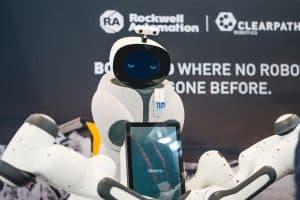
The result is a robot standing approximately 165 cm tall and weighing around 105 kg. Rounded contours, a compact upper body, forward-reaching arms, and a large interactive head-mounted display all convey a deliberately friendly impression. The team describes this design philosophy as "under-promise and over-deliver" — an approach that received consistently positive responses in user testing throughout the development process.
Bringing the full system together, however, was far from straightforward. The latest version required the team to integrate the Ridgeback base, telescoping torso, dual-arm manipulation system, perception sensors, head mechanism, and an entirely new ROS 2 software stack into a single field-deployable platform. According to the team, the integration of hardware and software components proved to be one of the most demanding phases of development, requiring considerably more debugging effort than originally anticipated.
As with all research platforms, GARMI reflects a series of engineering trade-offs. The team deliberately prioritized a compact, non-intimidating form factor over a larger, more imposing design. During navigation, the robot's arms must currently be folded within the footprint of the base — a limitation that will be addressed once full 3D whole-body perception and navigation capabilities are completed.
Building a Platform That Can Actually Be Tested
GARMI currently runs on a ROS 2-based software stack combining Clearpath's mobile platform software, MoveIt 2, libfranka, and the team's own autonomy framework. The researchers have established a reproducible environment that integrates the mobile base, robot arms, perception systems, and autonomy software into a single platform that can be deployed consistently across experiments.
For navigation, the robot uses an RTAB-Map-based pipeline that fuses data from an onboard 3D camera and 2D LiDAR sensor to map and localize within the test apartment. Nav2 handles collision-free path planning and guides the platform to target positions. This software stack serves not only as GARMI's current navigation solution, but also as a benchmark for evaluating future autonomy approaches — giving the team a reliable foundation for developing more advanced capabilities.
Looking Ahead
With platform development largely complete, the team's focus is shifting toward real-world validation. Upcoming work includes field trials with older adults and care workers in genuine care environments through the Caritas partnership, pending ethics approval, to evaluate GARMI's assistive capabilities.
In parallel, the team continues to expand the platform's technical capabilities. Current research efforts include developing navigation systems that account for GARMI's full three-dimensional geometry, integrating semantic mapping and navigation-based manipulation, and exploring large language model-driven human-robot interaction via robotic communication interfaces. Researchers are also developing immersive telepresence experiences and remote care applications enabled by next-generation wireless networks, as well as digital twins to support safety validation and future certification work. Novel healthcare applications — including robotic frailty assessment and cognitive screening — are also under investigation.
For the TUM research team, however, the long-term goal remains unchanged: translating robotics research into tools that can genuinely support an aging society. As assistive robotics technology continues to evolve, GARMI demonstrates what becomes possible when researchers design around real users, real environments, and real challenges.
Interested in building your own mobile manipulation platform? Learn more about the Ridgeback omnidirectional mobile robot and explore why research teams around the world rely on it as a development foundation for applications ranging from autonomous navigation to advanced human-robot interaction.
原文來源: 查看原文
FAQ
Reviewed and published by the LAETimes editorial desk ·