Operation Firecrest: HMS Prince of Wales Demonstrates Royal Navy's 'Hybrid Fleet' Transformation
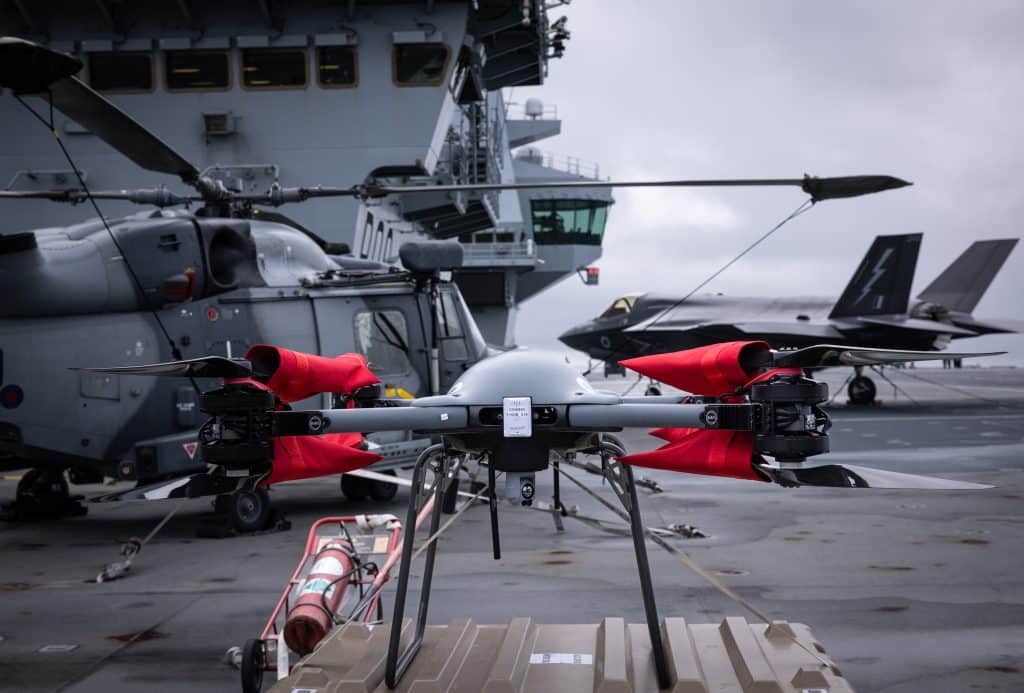
The HMS Prince of Wales Carrier Strike Group is executing Operation Firecrest across the North Atlantic into the High North, simultaneously validating a manned/unmanned teaming architecture. The carrier's flight deck now operates F-35Bs, helicopters, and Malloy T150B drones concurrently, marking a significant milestone in the Royal Navy's 'Hybrid Naval Service' strategy moving into live deployment.
Highlights
- HMS Prince of Wales Carrier Strike Group is executing Operation Firecrest in the High North, leading NATO's Operation Arctic Sentry launched in January 2026 to defend the GIUK Gap.
- The carrier's current air wing includes 8 F-35Bs, 3 Merlin Mk2s, 2 Wildcat HMA Mk2s, and 2 Malloy T150B drones, with 2 additional Malloy drones aboard escort destroyer HMS Duncan.
- The UK's June 2025 Strategic Defence Review and June 2026 Defence Investment Plan formally committed to developing carrier-launched jet-powered UAVs to operate alongside F-35Bs under the 'Hybrid Naval Service' initiative.
- Commodore Richard Hewitt stated the Navy will pursue the Hybrid Naval Service 'at pace,' with autonomous platform capability expected to grow significantly in capability, endurance, and complexity.
- Commander Air Group Captain Ed Philips anticipates a significant shift in the manned-to-unmanned ratio within the carrier air wing over the next 10 to 20 years, while affirming the F-35B remains its core for the foreseeable future.
The Royal Navy's (RN) HMS Prince of Wales Carrier Strike Group (CSG) is currently transiting the North Atlantic into the High North, on a deployment designed not only to reinforce deterrence against regional threats but also to demonstrate the Navy's accelerating push toward a 'hybrid' manned/unmanned force architecture.
Operation Firecrest and NATO Cooperation
Operation Firecrest encompasses large-scale joint exercises with NATO allies, with the core objective of supporting the generation, development, and sustainment of UK and allied operational capability in the region. For the Royal Navy, the deployment carries significance on two fronts: NATO cooperation and the development of the 'Hybrid Naval Service.'
The UK's Strategic Defence Review (SDR), published in June 2025, reaffirmed a 'NATO first' posture, centred on leading the strengthening of North Atlantic security and enhancing Euro-Atlantic deterrence and defence. The SDR also announced the Hybrid Naval Service initiative, which seeks to grow the fleet by integrating manned and unmanned platforms across the Royal Navy's force structure and operational output — including the development of 'hybrid' carrier air wings.
The Defence Investment Plan (DIP), published in June 2026, further cemented the Hybrid Naval Service commitment, detailing plans to develop carrier-launched 'jet-powered' unmanned aerial vehicles (UAVs) to operate alongside embarked F-35B Lightning II Joint Strike Fighters, while escort platforms are also set to progressively field highly autonomous rotary-wing assets.
Current Deployment: A Hybrid Carrier Air Wing in Action
The carrier air wing currently embarked aboard HMS Prince of Wales comprises:
- 8 F-35B fighter jets
- 3 Merlin Mk2 anti-submarine warfare helicopters
- 2 Wildcat HMA Mk2 multi-role helicopters
- 2 Malloy T150B remotely piloted drones
A further two Malloy drones are embarked aboard HMS Duncan, the Type 45 destroyer assigned to the strike group.
The broad, open flight deck of the Queen Elizabeth-class carriers offers considerable flexibility for implementing the Hybrid Naval Service concept. During Operation Firecrest, one side of Prince of Wales's flight deck can simultaneously conduct F-35B or helicopter flight operations while the other side operates Malloy drones — practically validating multi-platform concurrent operations.
Commanders: Autonomous Platform Capability Will Continue to Grow
"The Navy will pursue the Hybrid Naval Service concept at pace," said Commodore Richard Hewitt, Commander UK Carrier Strike Group (COMUKCSG), in an interview with Naval News aboard HMS Prince of Wales while operating off the coast of Norway during Operation Firecrest.
Commodore Hewitt noted that F-35Bs, helicopters, and drones can operate simultaneously and continuously on the deck, adding: "We are at the very beginning of this journey. Autonomous platforms will only get better in terms of capability, endurance, complexity, and performance — the possibilities are limitless."
Captain Ben Power, Commanding Officer of HMS Prince of Wales, noted that the size and configuration of the flight deck means the Navy is "extremely well-placed to respond to this technological revolution that is accelerating."
Captain Ed Philips, the strike group's Commander Air Group (CAG), underscored that the current focus on drones and hybrid operations during Operation Firecrest resonates with capability and operational developments in other contexts, such as the conflict in Ukraine.
"The Malloy drone is the first step in that direction, allowing us to start building the concepts, procedures, thinking, culture, and mindset," Captain Philips said. He also emphasised that the F-35B will remain the core of the hybrid carrier air wing for the foreseeable future, but anticipates a significant shift in the ratio of manned to unmanned platforms over the next 10 to 20 years.
Scalability: A Strategic Advantage of the Hybrid Architecture
Commodore Hewitt highlighted another major benefit of the hybrid approach: "Depending on the threat faced, the composition and scale of the strike group can be flexibly adjusted."
Both HMS Queen Elizabeth and HMS Prince of Wales were originally designed to embark and operate up to 36 F-35s. Captain Philips noted: "We have that capacity — and these ships will continue to offer scale and versatility as the air wing evolves over the coming decades."
Analysis: Manned Platforms Remain the Strategic Cornerstone
Operation Firecrest also underscores the enduring strategic importance of manned platforms, particularly those designed to conduct high-end warfighting missions.
At the NATO level, the strike group deployment demonstrates the UK's ability to project power within the Alliance framework and integrate seamlessly into Allied command structures. During this deployment, the CSG is leading NATO's newly established Operation Arctic Sentry — launched in January 2026 — which aims to strengthen deterrence and defence across the Greenland-Iceland-United Kingdom (GIUK) Gap and the High North Arctic.
At the national level, the Royal Navy's possession of two carriers provides the conditions to sustain a continuous carrier capability, an output whose strategic significance for conventional deterrence mirrors the role played by the four Vanguard-class ballistic missile submarines in nuclear deterrence.
Image note: A Malloy drone (foreground), Wildcat helicopter, and F-35B are pictured simultaneously on the flight deck of HMS Prince of Wales during Operation Firecrest. (Image credit: UK Crown Copyright / Ministry of Defence, 2026)
原文來源: 查看原文
FAQ
Reviewed and published by the LAETimes editorial desk ·


