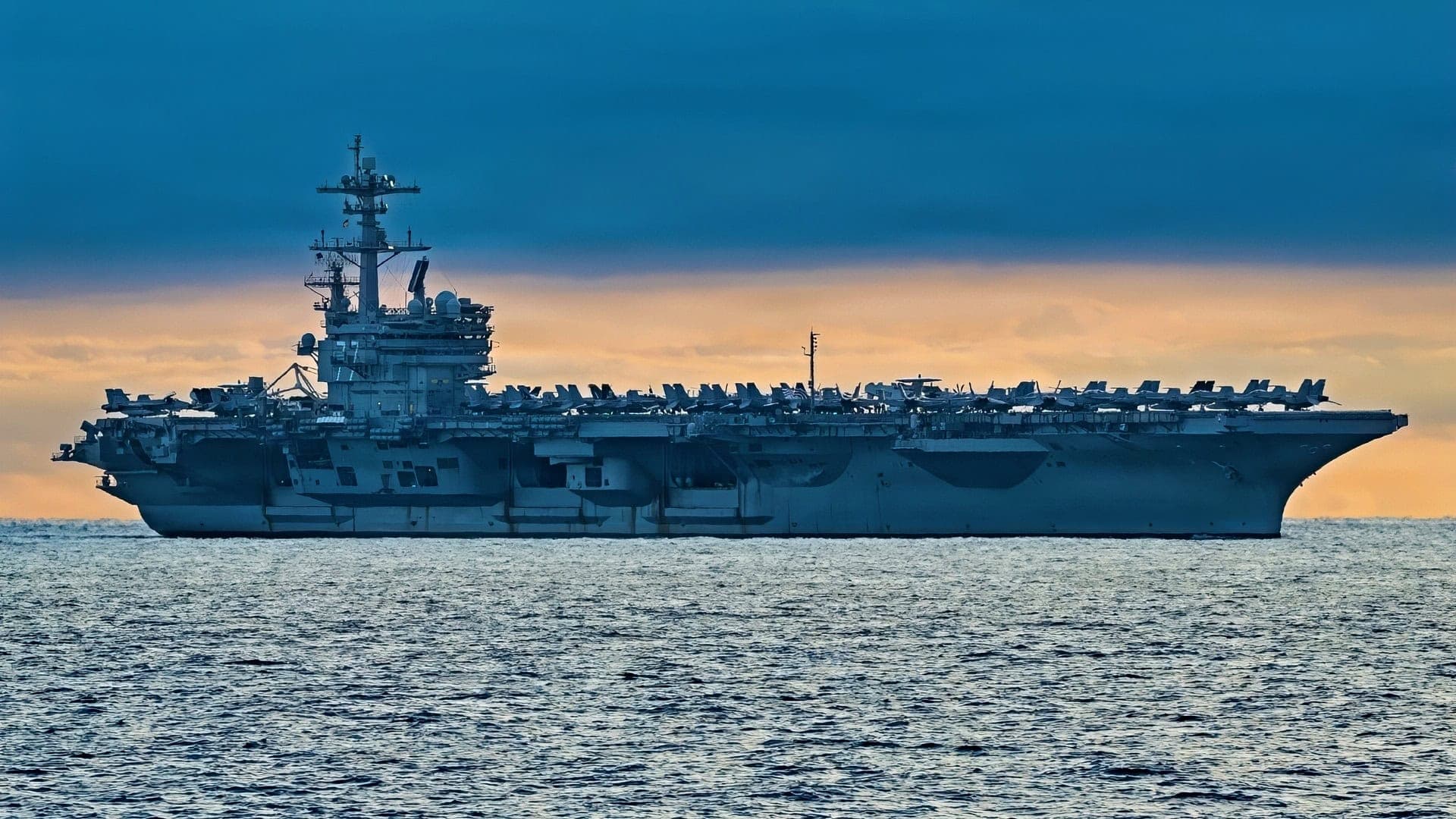
USS George H.W. Bush (CVN-77): The Bridge Between Nimitz and Ford — and a 2025 Laser Anti-Drone Testbed
USS George H.W. Bush (CVN-77), the U.S. Navy's final Nimitz-class carrier commissioned in 2009, incorporates design improvements that bridged the gap to the Ford class. In 2025, the ship served as a testbed for the Locust Laser Weapon System (LWS), successfully detecting, tracking, and shooting down multiple drones during live-fire exercises, underscoring the carrier's role at the forefront of counter-UAS development.
Highlights
- USS George H.W. Bush (CVN-77), commissioned in 2009, is the last Nimitz-class carrier and displaces over 100,000 tonnes at full load.
- In 2025, CVN-77 served as the testbed for the Locust Laser Weapon System (LWS), which successfully shot down multiple drones in live-fire exercises.
- Bush's island superstructure was repositioned further aft compared to earlier Nimitz-class ships, improving flight deck efficiency and reducing sensor interference.
- Two Westinghouse A4W nuclear reactors power CVN-77, delivering approximately 260,000 shaft horsepower and a top speed exceeding 30 knots with virtually unlimited range.
- Bush's 2025 Middle East deployment marked the first simultaneous three-carrier U.S. presence in the region since the 2003 invasion of Iraq.
USS George H.W. Bush (CVN-77) is the U.S. Navy's last commissioned Nimitz-class aircraft carrier.
Entering service in 2009, she remains one of the most modern carriers in the U.S. fleet and is expected to serve for many decades to come.
While she shares the core design of her sister ships, Bush underwent a series of design changes and improvements during construction that set her apart from earlier Nimitz-class vessels — and positioned her as a transitional platform bridging the Nimitz class and the next-generation Gerald R. Ford class of supercarriers.
What Sets Bush Apart from Her Sister Ships?
Although technically still a Nimitz-class carrier, CVN-77 incorporates a number of design refinements that distinguish her from the rest of the class.
Designers drew on lessons learned from previous ships in the class and integrated those improvements into CVN-77. Many of those refinements went on to influence the design of the Ford class, making Bush a genuine cross-generational platform.
One notable change was the repositioning of the island superstructure further aft, which improved flight deck operational efficiency and reduced interference with the ship's sensors.
Additional improvements include a composite mast, an optimized hull form, more efficient and quieter propellers, and a modernized fuel-handling system.
The hull is built from high-strength low-alloy steel, reducing weight while maintaining durability and improving overall performance and survivability.
In terms of scale, Bush is among the largest warships in the world, measuring approximately 333 metres (around 1,092 feet) in length, with a full-load displacement exceeding 100,000 tonnes.
Her expansive flight deck covers roughly 4.5 acres (approximately 1.8 hectares), supporting large-scale aviation operations.
The ship is powered by two Westinghouse A4W nuclear reactors driving a four-shaft propulsion system, delivering approximately 260,000 shaft horsepower and a top speed exceeding 30 knots.
Nuclear propulsion gives her virtually unlimited range, with the reactors requiring no refueling for decades — endurance is limited primarily by crew stamina and logistics resupply requirements.
World-Class Combat Capability
Like her sister ships, Bush can operate an air wing of approximately 89 to 90 aircraft.
A typical air wing includes F/A-18 Super Hornets for strike and air superiority missions, EA-18G Growlers for electronic warfare, E-2 Hawkeyes for airborne early warning, and MH-60 helicopters for search-and-rescue and anti-submarine operations.
The carrier employs a conventional steam-powered Catapult Assisted Take-Off But Arrested Recovery (CATOBAR) system for aircraft launch and recovery.
The angled flight deck layout allows simultaneous launch and recovery operations during high-tempo combat scenarios.
At peak operational tempo, a Nimitz-class carrier can generate up to approximately 250 combat sorties per day.
While carriers rely heavily on escort vessels for air defense, Nimitz-class ships also carry their own defensive armament, including RIM-162 Evolved Sea Sparrow Missiles (ESSM), Rolling Airframe Missiles (RAM), and Phalanx Close-In Weapon Systems (CIWS) for engaging incoming aircraft and anti-ship missiles.
Electronic warfare systems and decoy countermeasures provide additional layers of protection against modern threats.
2025: Testing the Locust Laser Weapon System Against Drones
In recent years, Bush has become an important platform for trialing cutting-edge emerging technologies.
In 2025, she was used to test the Locust Laser Weapon System (LWS), a directed-energy system currently under development as a potential counter-UAS solution.
Details of the live-fire exercises were not publicly disclosed, but the U.S. Navy confirmed that the system successfully detected, tracked, and shot down multiple unmanned aerial systems (UAS), demonstrating its practical potential for shipboard counter-drone operations.
Service History
Having commissioned in 2009, Bush has a relatively shorter operational history compared to some of her predecessors and has not yet accumulated as rich a combat record.
Nevertheless, she has completed multiple deployments since entering service. After completing initial sea trials and training, she undertook her first major deployment in 2011, operating in the Mediterranean and Middle East in support of U.S. Operation Enduring Freedom and Operation New Dawn.
Subsequent deployments have taken her to the Persian Gulf, the North Sea, and the Mediterranean, encompassing combat missions, maritime security operations, and multinational exercises with allied navies.
Earlier this year, Bush was initially expected to reinforce a U.S. naval buildup near Iran (dubbed "Operation Epic Fury"), but USS Abraham Lincoln and USS Gerald R. Ford were dispatched instead. However, on March 31, the decision was made to deploy Bush to the Middle East as well — reportedly following certain mechanical issues aboard Ford.
This deployment marked the first time three U.S. carriers have operated simultaneously in the Middle East since the 2003 invasion of Iraq. At the time of writing, the ship was last spotted in waters off southeastern Africa, participating in the U.S. effort to enforce a blockade of the Strait of Hormuz.
She is likely to remain on station until a formal peace agreement is reached — which may still be some time away.
原文來源: 查看原文
FAQ
Reviewed and published by the LAETimes editorial desk ·