War of the Shadow Fleet: IISS Report Exposes Russia's Drone Reconnaissance Campaign Over Europe
The International Institute for Strategic Studies (IISS) released a report on July 2 revealing that Russia used shadow fleet vessels as drone launch and recovery platforms to conduct deniable reconnaissance operations over Europe between August 2024 and February 2026. The report documents 144 incidents and highlights critical gaps in European air defenses, calling for the integration of maritime surveillance and airspace defense.
Highlights
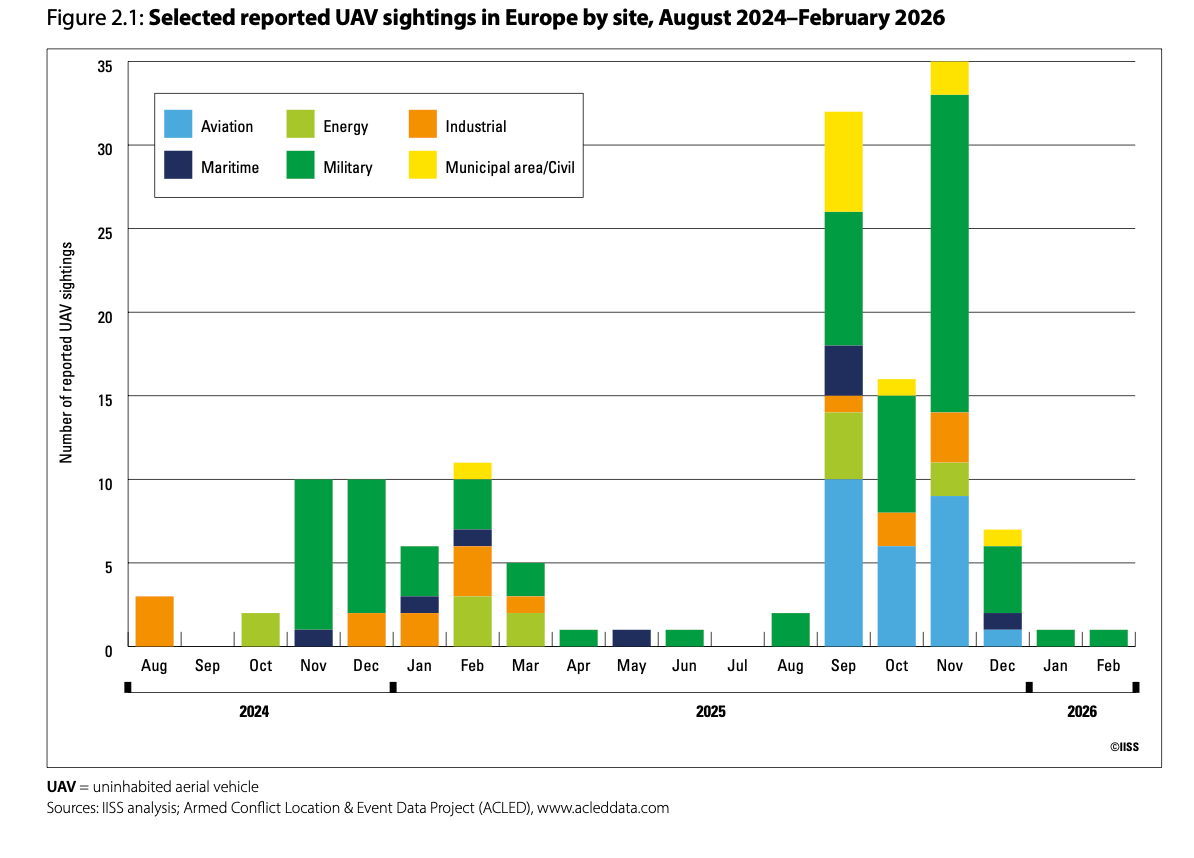
- The IISS and Hanns Seidel Foundation published 'Russia's UAV Campaign Over Europe' on July 2, documenting 144 Russian drone incidents over Europe between August 2024 and February 2026.
- Russia used shadow fleet vessels loitering in international waters and EEZs as covert drone launch and recovery platforms, exploiting AIS signal gaps and GNSS spoofing to obscure attribution.
- No European government has formally attributed any of the 144 incidents to Russia, a state of attribution paralysis the report identifies as a deliberate and successful Russian operational outcome.
- Intra-NATO legal disparities — such as Germany restricting shoot-down authority to police while Poland and Romania allow broader military action — have been exploited by Russian information operations.
- The European Drone Defense Initiative (EDDI) is not expected to close Europe's counter-drone capability gap before 2027, leaving a prolonged window of vulnerability.
War of the Shadow Fleet: IISS Report Exposes Russia's Drone Reconnaissance Campaign Over Europe
On July 2, the International Institute for Strategic Studies (IISS), in partnership with the Hanns Seidel Foundation, published a report titled Russia's UAV Campaign Over Europe. Authors Charlie Edwards, Rex Fox O'Loughlin, and Louis Bearn document how Russia, between August 2024 and February 2026, used shadow fleet vessels as launch and recovery platforms to conduct a deniable drone reconnaissance campaign across Europe.
To support their findings, the research team built a dataset of 144 incidents using the Armed Conflict Location and Event Data Project (ACLED), supplemented by open-source intelligence, AIS/SAR maritime tracking, and interviews with European defense officials. All 144 drone incidents were found to have links to Russian shadow fleet vessels.
The report's conclusions are alarming: Europe's existing air defense architecture is fundamentally ill-equipped to stop such operations. Below are the report's core findings and their implications.
Key Takeaways
The Maritime-Aerial Seam Is the Defensive Vulnerability
Conventional land-border air defense systems are designed to detect threats crossing territorial boundaries. In this campaign, however, drones were launched from vessels loitering in international waters or exclusive economic zones (EEZs), exploiting gaps in AIS signals, GNSS spoofing, and the cover of flags of convenience to maintain persistent ambiguity over attribution. Across the entire dataset, only the Zhigulevsk–Charles de Gaulle incident — in which a Russian drone launched from the former was intercepted en route to the latter — provided relatively clear attribution. The ambiguity in every other case was by design.
Aerial Incursions Are Fundamentally a 'Reconnaissance by Action' Tactic
Every European intercept, scrambled fighter jet, or activated jammer feeds Moscow with intelligence on response times and rules of engagement. For Russia, even when an operation falls short of its immediate objective, the intelligence gathered constitutes a success in its own right.
Attribution Paralysis Is an Operational Outcome
No European government has formally attributed any incident to Russia. That hesitation, repeated across more than a dozen uncoordinated nations, is precisely the defensive gap this campaign was designed to expose.
Legal Authorities Are Outpaced by Operational Realities
Germany authorizes only law enforcement — not the military — to shoot down drones, while Poland and Romania operate under more permissive frameworks. This conspicuous intra-alliance divergence has been amplified and exploited by Russian information operations.
Cost Asymmetry Favors the Attacker
Using low-cost drones to exhaust expensive interceptor resources is a lesson validated on the Ukrainian battlefield — and it is now playing out on NATO's home territory. The European Drone Defense Initiative (EDDI) is unlikely to close this gap before 2027.
Conclusion
The report's central recommendation is clear: maritime domain awareness and airspace defense must be treated as a single, unified problem. As long as shadow fleet vessels can loiter and launch drones with near impunity, any investment in land-based counter-drone weaponry will address only half of the threat.
This is a complex, cross-domain, cross-border challenge. As the report notes, the capability to attribute incursion operations does exist, and there are documented cases of success. For Europe, the real question is whether governments are prepared to act — to cross regulatory and political barriers and forge a genuine collective response.
原文來源: 查看原文
FAQ
Reviewed and published by the LAETimes editorial desk ·