FAA Drone Waiver for Washington IndyCar Race Sparks Security Concerns Near Capitol and FBI Headquarters
The FAA plans to grant drone flight waivers for the Freedom 250 IndyCar race on the National Mall on August 22–23, with the circuit passing just 1,400 feet from the U.S. Capitol and past FBI headquarters. Homeland security experts warn that the FAA currently lacks adequate real-time airspace monitoring capability, raising serious safety concerns amid recent drone threat incidents.
Highlights
- The FAA will issue drone flight waivers for the Freedom 250 IndyCar Grand Prix on the National Mall on August 22–23, 2025, authorized by a Trump executive order signed in January.
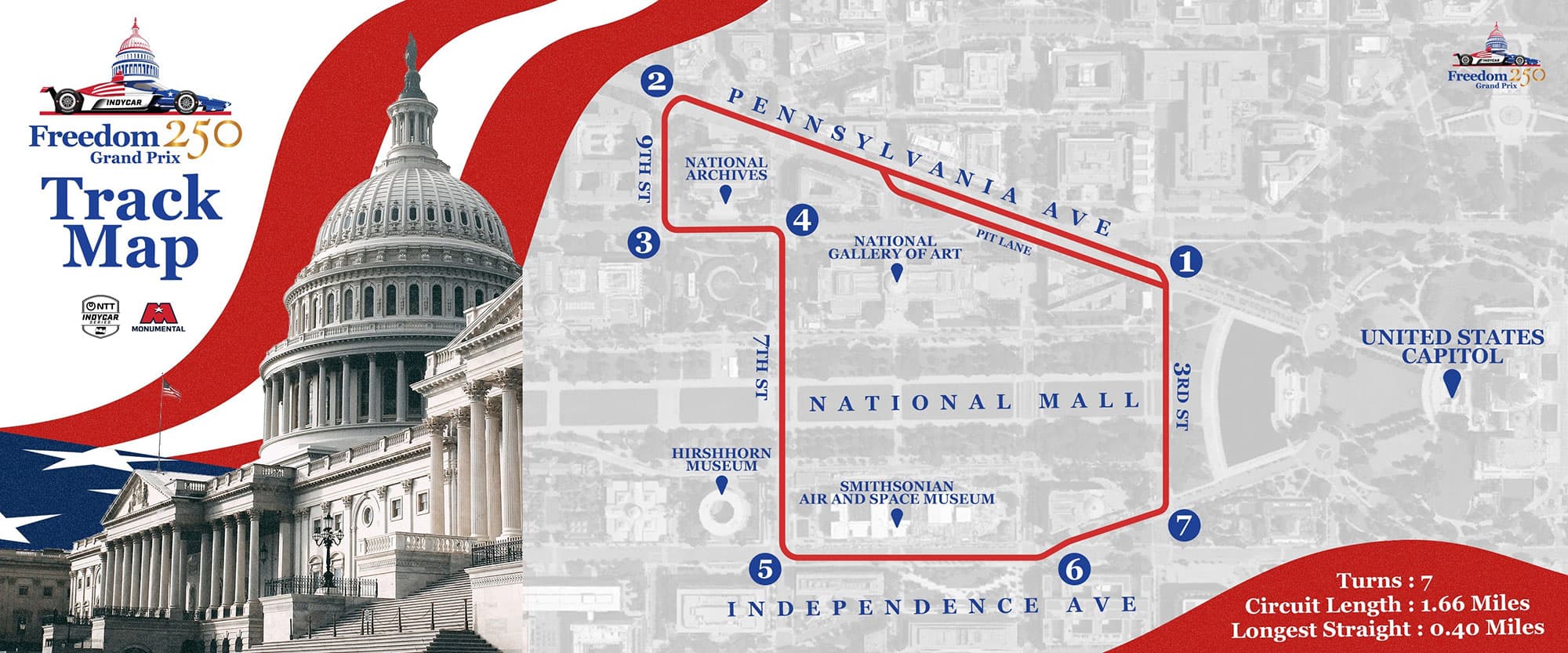
- The 1.7-mile race circuit passes 1,400 feet from the U.S. Capitol, directly past FBI headquarters on Pennsylvania Avenue, and within 3,400 feet of the White House.
- Retired Coast Guard Vice Admiral Peter Gautier warned that U.S. national-level counter-drone preparedness is 'far below where it needs to be,' citing gaps in real-time airspace awareness.
- More than 600 drones were seized for entering restricted airspace over FIFA World Cup host cities by July 4, 2025, and seven suspects were arrested in June for an alleged explosive-drone plot at a White House event.
- The FAA has not disclosed the number of approved drones, protective measures, or enforcement procedures, with official guidelines expected only days before the event.
WASHINGTON — When IndyCar racing takes over the National Mall in August — penetrating the heart of the most tightly controlled restricted airspace in the United States — the Federal Aviation Administration (FAA) will authorize drone flights to capture the spectacle on camera. Homeland security experts, however, remain deeply skeptical about whether that can be done safely.
Race Overview
The Freedom 250 Grand Prix is scheduled for August 22–23, with a 1.7-mile circuit that will send cars screaming past the U.S. Capitol at just 1,400 feet, around a tight corner in front of the FBI's headquarters on Pennsylvania Avenue, and down a long straight alongside the Department of Justice building.
"If drones fall into the wrong hands, they pose a significant threat — whether to critical infrastructure or to personal safety — purely because of the capability they provide in the air. Without regulation, without tracking, the consequences could be severe." — Retired U.S. Coast Guard Vice Admiral Peter Gautier, former disaster response director at the National Security Council and current Senior Fellow at the Atlantic Council
Presidential Executive Order Authorizes the Flights
President Donald Trump signed an executive order in January authorizing the drone operations as part of the nation's 250th anniversary celebrations.
"These beautiful race cars will let the roar of freedom echo across the skies," Trump said at a White House ceremony showcasing the event on Monday, estimating that cars could reach speeds of 190 mph on the Pennsylvania Avenue straightaway.
FAA Has Yet to Disclose Regulatory Details
The FAA has not yet specified how many drones it will authorize, what restrictions will be imposed, or how real-time enforcement will be conducted. Despite a series of recent security incidents, the agency has not indicated it will withdraw approval for the event.
Those incidents include an alleged plot to deploy an explosive-laden drone at a White House UFC event on June 14 — the FBI arrested seven co-conspirators whom authorities say planned to create a disturbance, force an evacuation, and allow a sniper to assassinate senior government officials.
In addition, according to FBI data, more than 600 drones had been seized as of July 4 for entering restricted airspace over U.S. FIFA World Cup host cities.
Airspace Control: Historical Context
Following the September 11, 2001 terrorist attacks, the FAA established a 17-mile no-fly zone around Reagan Washington National Airport, banning all recreational flights and imposing lengthy review processes even for government aircraft.
Restrictions over the National Mall are even more stringent. Under a 1938 presidential directive, a prohibited flight zone extends from the Lincoln Memorial to the U.S. Capitol — encompassing the White House and much of downtown Washington — to an altitude of 18,000 feet; the Naval Observatory, the Vice President's residence, was added to the zone in 1950.
Only aircraft supporting the Secret Service, the Executive Office of the President, and specific government agencies are permitted to fly within this area. Under normal circumstances, the only aircraft near the White House are Marine One and its escort and scout helicopters.
In 2015, a two-foot quadcopter crashed into a tree on the White House South Lawn, heightening awareness of small threats that are difficult to detect by radar, let alone intercept. This past March, unidentified drones were spotted over Fort McNair, an Army installation close to Washington, D.C., where Defense Secretary Pete Hegseth and Secretary of State Marco Rubio both reside.
Expert Opinions Divided
FAA spokesperson Rick Breitenfeldt confirmed the agency will issue drone waivers for the IndyCar race, but declined to disclose the number of approvals, the protective measures to be implemented, or how authorities will ensure only authorized drones are airborne and prevent equipment from being used in an attack or straying outside permitted areas. He said official guidance would be published before the event. According to the National Business Aviation Association, regulations for similar events are typically announced no earlier than two weeks in advance.
Gautier noted that the wars in Ukraine and in the Israel-Iran conflict have made clear that drones can be potent weapons. While the U.S. military and federal agencies such as the FAA and the Department of Homeland Security have made progress on counter-drone defenses, they still do not possess sufficient situational awareness and have not yet deployed adequate countermeasures.
"Our level of preparedness at the national level is far below where it needs to be," he said.
Greg James, Vice President of Business Development at airspace management software company DroneUp, agreed that the FAA has made progress on airspace safety but stressed that significant gaps remain in real-time aerial awareness. He noted that airspace managers are not yet able to fully identify drones, rapidly determine who is controlling them and from where, or confirm compliance with pre-approved flight plans — creating major challenges for airspace monitoring during the event.
"Putting a large number of hobbyist pilots in sensitive airspace is exactly where you need a significant step up in coordination, awareness, and trust," James said.
Supporters: FAA Can Ensure Safety
Katie Inman, a former FAA drone regulations official and former chief counsel at the National Transportation Safety Board (NTSB), expressed confidence in the existing safeguards. She said authorities have the capability to jam signals or use other technologies to disable non-compliant drones, and that some form of interception is also being considered.
"They will not allow any unsafe operations and will rapidly mitigate, deter, and address any safety concerns," she said.
Inman described the Grand Prix waiver as a positive signal that the FAA is open to innovation. "If your application is credible, proposes adequate risk mitigation or strict operational limitations, and undergoes proper review, they won't throw up unnecessary obstacles," she said.
It is worth noting that in February of this year, the U.S. military accidentally shot down a U.S. Customs and Border Protection drone near El Paso, Texas, using an unmanned anti-drone laser system. The Department of Defense, Customs and Border Protection, and the FAA subsequently issued a joint statement describing the incident as involving "an unmanned aerial system flying in military airspace that appeared visually to be a threat."
Beyond passing the FBI and the Department of Justice, the Freedom 250 circuit will also run past the Canadian Embassy, the Smithsonian National Air and Space Museum, the National Gallery of Art, and the National Archives — with cars coming within 3,400 feet of the White House at their closest point.
原文來源: 查看原文
FAQ
Reviewed and published by the LAETimes editorial desk ·