Insta360 Luna Ultra vs. DJI Pocket 4: Full Real-World Image Quality Comparison
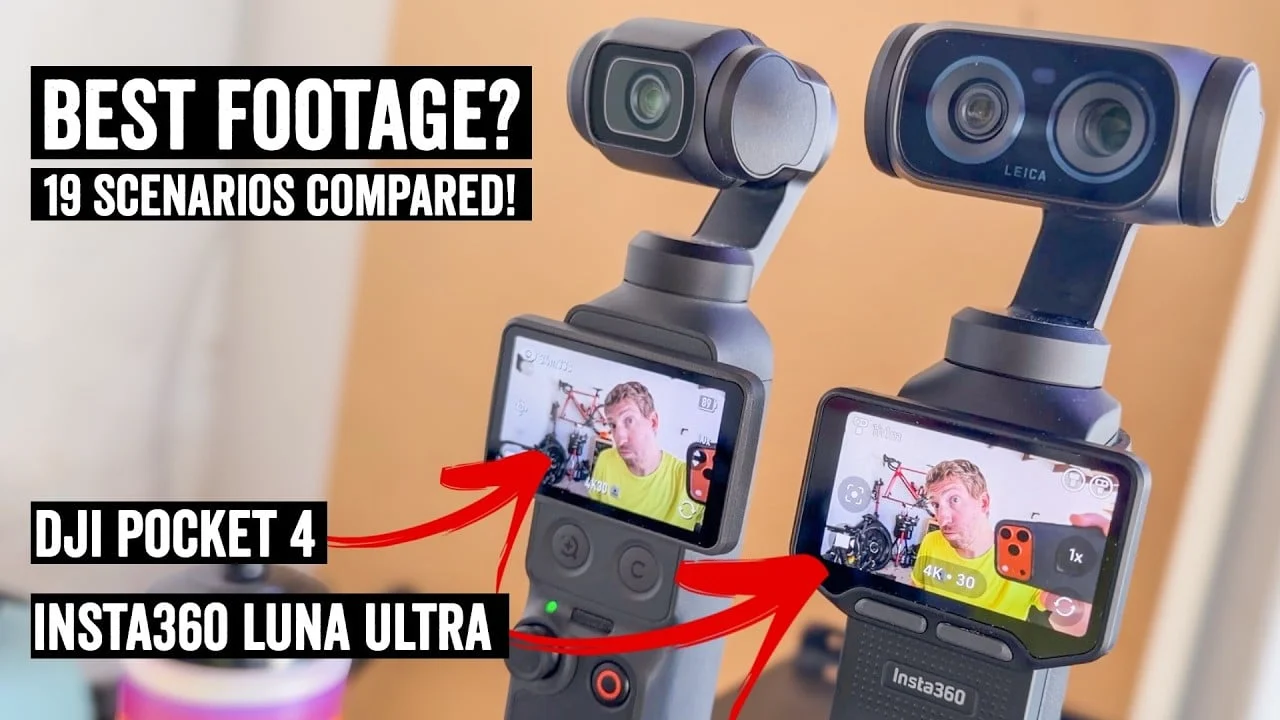
A YouTuber tested the Insta360 Luna Ultra and DJI Pocket 4 using default settings, comparing exposure, color, 3x optical zoom, 12x max zoom, autofocus tracking, and low-light performance. The Luna Ultra's dual-lens design and 12x zoom offer a clear telephoto advantage, while the Pocket 4 delivers more reliable autofocus lock and truer color reproduction. Both cameras perform similarly in low light.
Highlights
- The Insta360 Luna Ultra features a 3x optical telephoto lens and 12x maximum zoom, compared to the DJI Pocket 4's 4x digital-only zoom.
- At default settings, the DJI Pocket 4 produced overexposed footage, while the Insta360 Luna Ultra delivered more accurate exposure but with a warmer, higher-contrast color profile.
- The DJI Pocket 4 demonstrated superior autofocus lock, maintaining focus on non-face subjects even when faces appeared at the frame edge; the Luna Ultra automatically switched to face-priority AF without any tracking mode enabled.
- Both cameras performed similarly in near-total darkness low-light mode, each tending toward overexposure and producing images brighter than the actual scene.
- The Luna Ultra's 8K sensor output allows high-quality post-capture cropping, retaining more detail than the Pocket 4's lower-resolution digital zoom.
Introduction
This is a full real-world image quality comparison between the DJI Pocket 4 and the Insta360 Luna Ultra. At first glance, the two products sit at different price and specification tiers — one features a dual-lens setup, the other a single lens — but the current competitive landscape in the compact camera market makes this head-to-head particularly relevant. With the DJI Pocket 4 Pro not expected to launch for at least another month, this comparison offers a useful benchmark before that next major contender arrives.
It is worth noting that this review was not sponsored by either manufacturer. Insta360 provided a loan unit, while the reviewer purchased the DJI Pocket 4 independently. The reviewer also disclosed that DJI had invited him to a Pocket 4 Pro event, but on the condition that he refrain from publishing comparative reviews of this kind.
Exposure Performance at Default Settings
With all default settings applied — high bitrate enabled, 4K 30fps, 1x lens — the DJI Pocket 4 produced noticeably overexposed footage, while the Insta360 Luna Ultra delivered more accurate exposure. In terms of color rendering, however, the Insta360 leaned toward a fluorescent, orange-tinted look with higher contrast, whereas the DJI appeared paler but applied a degree of skin smoothing on faces — even with beauty filters turned off.
On color accuracy, the Insta360 made red objects appear more vivid and saturated, though this does not necessarily equate to realism. As the reviewer noted, most social media audiences tend to favor highly saturated footage, but this often diverges from true-to-life color.
In-Car and Out-of-Window Shooting
In handheld gimbal shooting inside a vehicle, both cameras performed comparably. When held outside the car window at approximately 60 km/h, neither gimbal showed stabilization issues, though both exhibited minor focus hunting between a nearby antenna and background subjects.
The 3x Optical Zoom Gap
This is one of the Insta360 Luna Ultra's most significant advantages. Compared to the DJI Pocket 4 (non-Pro), which relies entirely on digital crop zoom, the Luna Ultra's 3x optical telephoto lens delivers a clear image quality benefit — sharper detail and better clarity. The Pocket 4, by contrast, showed noticeable overexposure when zoomed in.
These Are Not Action Cameras
The reviewer emphasized that pocket gimbal cameras of this type are not waterproof and can only withstand light rain. A simple rule of thumb: if dropping the camera would likely destroy it, it is not an action camera. Gimbal stabilization during jogging was acceptable, but heavy impacts could cause issues.
Autofocus Lock: DJI Takes the Lead
In autofocus testing, the DJI Pocket 4 locked onto subjects immediately when placed in front of the lens and maintained focus even when a face appeared at the edge of the frame. The Insta360 Luna Ultra also focused quickly, but it would automatically revert to face-priority autofocus whenever a face entered the frame — even without any face-tracking mode enabled. This behavior proved to be a clear drawback when shooting product footage.
12x vs. 4x: Maximum Zoom Shootout
The gap at maximum zoom is striking. The Insta360 Luna Ultra reaches 12x zoom, while the DJI Pocket 4 tops out at 4x. At a distance of approximately 300 meters, the Luna Ultra still produced a sharp, usable image; the Pocket 4 beyond 4x relied on post-capture cropping, resulting in a significant drop in quality.
Additionally, the Luna Ultra's ability to shoot in 8K and then crop in post still retains considerably higher resolution — a tangible advantage of its higher sensor output.
That said, in certain scenes the DJI Pocket 4 actually rendered more accurate colors, while the Luna Ultra occasionally exhibited a subtle haze.
Sunset and Low-Light Mode
Neither camera excelled in sunset conditions. The Pocket 4 reproduced sky colors more faithfully, though both struggled with fine details such as foliage.
In dedicated night/low-light mode, the two cameras performed very similarly. The Insta360 occasionally overexposed sandy beach areas, while the Pocket 4 produced a slightly warmer tone. Gimbal stabilization while cycling was solid, with no issues during left-right panning.
Capturing Light in Near-Total Darkness
The most impressive test took place on a nearly pitch-black pier. Both cameras were able to "conjure" light invisible to the naked eye in low-light mode, producing images far brighter than the actual scene. While this makes for a more watchable result, it also means the footage does not reflect reality. Both cameras tended toward overexposure in these extreme conditions.
Night Street Shooting and Close-Up Conversations
In night street footage, both cameras performed well, with minimal differences. In a close-up talking-to-camera scenario, the DJI's tilt response was slightly slower, but overall performance was comparable. Regarding white balance, with warm ambient lighting the Pocket 4 leaned slightly yellow while the Insta360 skewed cooler and bluer — the actual scene fell somewhere in between.
Conclusion
Overall, the Insta360 Luna Ultra pulls ahead significantly in telephoto zoom thanks to its dual-lens design, with 12x zoom capability and 8K resolution being its headline strengths. The DJI Pocket 4 offers more consistent autofocus lock and more accurate color reproduction in general shooting. In low-light conditions, the two cameras are closely matched, each with minor trade-offs. Buyers should choose based on their primary needs — particularly whether telephoto reach is a priority. The upcoming release of the DJI Pocket 4 Pro is expected to make this rivalry even more compelling.
原文來源: 查看原文
FAQ
Reviewed and published by the LAETimes editorial desk ·


