Armed Police Drones, JFK Near-Miss Reports, and Surge in World Cup TFR Violations: This Week in Drone News
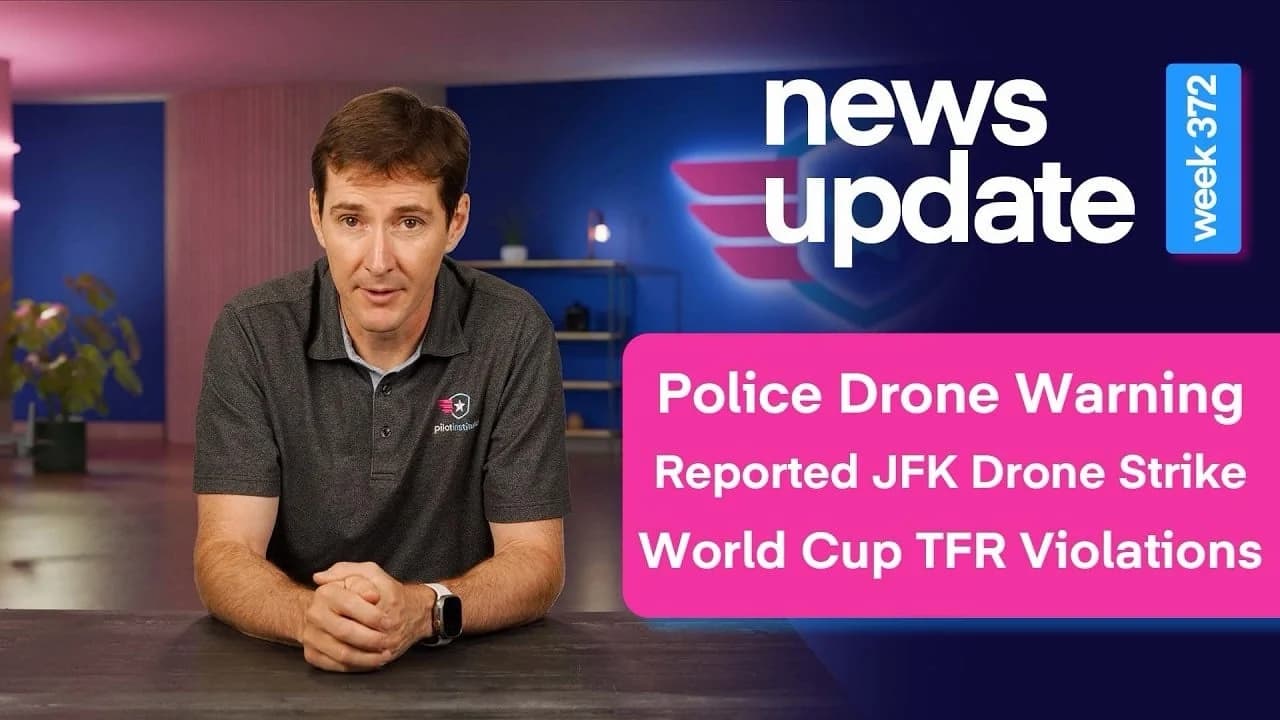
This week's top drone stories: the EFF warns legislators are running out of time to stop the arming of police drones; a JetBlue A321 pilot reported a suspected drone strike at 3,000 ft over JFK — but the aircraft was undamaged; a second JFK 'drone sighting' turned out to be a legally operating RC plane; and World Cup TFR violations continue to climb, with FAA Part 107 certificate holders among those responsible.
Highlights
- The EFF warned that no U.S. federal law currently governs when police or security drones may use force, as Skydio's CEO reversed the company's prior pledge to never weaponize its drones.
- JetBlue Flight 968, an Airbus A321, landed safely at JFK after the pilot reported a suspected drone strike at 3,000 feet; post-landing inspection found zero airframe damage.
- A widely reported JFK 'near-miss drone sighting' was confirmed to involve a legal RC fixed-wing aircraft operating over a National Park Service-recognized model aircraft field.
- World Cup TFR drone incursion reports exceeded 300 in a single week, with early data indicating a significant portion were committed by FAA Part 107 certificate holders.
- Campus Guardian Angel plans to deploy 'suppression drones' equipped with pepper spray and kinetic-strike capability at Georgia and Florida high schools as early as autumn 2025.
Armed Police Drones, JFK Near-Miss Reports, and World Cup TFR Violations — Four Drone Stories You Need to Know
This week brought four significant stories from across the drone industry: an urgent warning from the Electronic Frontier Foundation about armed police drones; a JetBlue pilot's report of a suspected mid-air drone strike near JFK; a second JFK 'drone sighting' that turned out to be a perfectly legal RC aircraft; and an alarming rise in Temporary Flight Restriction (TFR) violations during the FIFA World Cup.
EFF Warns: Window to Stop Armed Police Drones Is Closing Fast
The Electronic Frontier Foundation (EFF) has issued an urgent warning that legislators are rapidly running out of time to prevent the weaponization of law enforcement drones. The alert follows Skydio's CEO publicly walking back the company's previous commitment to never weaponize its drones. Adding to concerns, a company called Campus Guardian Angel has announced plans to deploy so-called "suppression drones" at high schools in Georgia and Florida as early as this autumn.
These drones are designed to deploy pepper spray, strobe lights, and deliver kinetic strikes against armed assailants. While the concept of using technology to neutralize threats may sound appealing, the EFF has identified a critical gap: there is currently no federal law in the United States governing when police or security drones may use force.
The EFF stated plainly: "We cannot continue to rely on the goodwill of companies that profit from selling technology to law enforcement to protect us from dangerous police tech." This is a story that warrants close attention as it develops.
JetBlue Pilot Reports Suspected Drone Strike at 3,000 Feet Over JFK
A JetBlue pilot reported that Flight 968 — operated by an Airbus A321 — may have been struck by a drone at approximately 3,000 feet while on approach to New York's John F. Kennedy International Airport (JFK). The aircraft landed safely, and a subsequent inspection revealed no damage to the airframe. The Federal Aviation Administration (FAA) has opened an investigation.
The drone industry is no stranger to incidents of this kind. Pilots on final approach sometimes report an object flashing past the windscreen and call it in as a possible drone, only for investigators to determine it was a bird, a balloon, or some other object. A similar report was filed by a United Airlines crew roughly one month ago.
It is certainly not impossible for a drone to appear at 3,000 feet, and anyone operating illegally in controlled airspace should be held accountable. However, restraint is warranted until the facts are established — sensationalist headlines about suspected drone strikes can cause lasting damage to the entire industry, often far greater than initially appreciated.
Second JFK 'Drone Sighting' Was Actually a Legal RC Aircraft on an Authorized Field
A second incident near JFK that drew national media coverage this week was ultimately confirmed to involve a remote-controlled (RC) fixed-wing aircraft operating legally within permitted airspace. The report came from a Bell helicopter crew who described a near-miss at roughly 500 feet with a large red-and-white RC plane.
The situation becomes clearer in context: the helicopter was flying approximately 300 feet above an established RC flying field — a site recognized by the National Park Service and used by model aircraft clubs for decades. The helicopter pilot even reported to air traffic control that additional RC aircraft were visible on the ground preparing to take off, which was entirely unremarkable given the location.
The FAA reportedly did not open a formal investigation, as the circumstances were self-explanatory. Nevertheless, this case serves as a reminder to all UAS operators: proximity to a known RC flying field does not grant drones any right-of-way over manned aircraft, and altitude limits still apply within approved operating areas.
World Cup TFR Violations Keep Rising — and Part 107 Pilots Are Part of the Problem
The most troubling story of the week involves the continued spike in TFR violations during FIFA World Cup matches. More than 300 drone incursion incidents were reported last week alone, and that number climbed further this week — with several rounds of the tournament still to come.
What makes the situation especially concerning is early feedback indicating that a significant share of these violations are being committed by operators who hold FAA Part 107 Remote Pilot Certificates. As an industry, we must do better.
Part 107 certificate holders receive training on how to check for active TFRs — so why are licensed pilots showing up in restricted airspace? History has shown repeatedly that public and regulatory overreaction to drone incidents, whether the threat is real or merely perceived, never produces good outcomes for the industry. We cannot allow a minority of reckless operators to impose consequences on the majority who follow the rules.
This article is adapted from content produced by YouTube channel partner Greg Reverdiau. Full weekly UAS news updates are available on the Pilot Institute YouTube channel; more of Greg's articles can be found on his DroneXL author page.
原文來源: 查看原文
FAQ
Newsletter
Subscribe to our Low-Altitude Industry Newsletter
Daily curated news on low-altitude economy and drone industry, delivered to your inbox.
Reviewed and published by the LAETimes editorial desk ·