Single-Crystal Turbine Blade Technology Detected in Russian Kh-101 Missile Wreckage, Suggesting GE-Class Engine Capability
Analysis of recovered Russian Kh-101 cruise missile wreckage suggests the missile may now feature an engine employing single-crystal turbine blade technology — previously associated almost exclusively with Western aerospace firms such as GE and Rolls-Royce. If confirmed, the upgrade could extend the missile's range to approximately 5,500 km and enable it to carry heavier warheads, raising significant concerns for U.S. and NATO defense planners.
Highlights
- Analysis of a Kh-101 missile engine believed manufactured in late 2025 indicates possible use of single-crystal turbine blades — technology previously associated only with Western firms such as GE and Rolls-Royce.
- If confirmed, the upgraded engine could extend the Kh-101's operational range to approximately 5,500 km (3,418 miles) and support heavier warhead payloads.
- Since 2024, Russia has reportedly introduced a dual-warhead Kh-101 variant, raising maximum payload from roughly 450 kg to approximately 800 kg by reducing fuel capacity.
- State-owned NPO Salyut and the All-Russian Institute of Aviation Materials have been identified as key institutions behind Russia's advanced turbine manufacturing programs.
- The findings suggest Russia is continuing to modernize strategic cruise missile technology despite years of Western export controls and sanctions.
Russian Kh-101 Wreckage Analysis Points to Advanced Single-Crystal Engine Technology
The latest analysis of wreckage from Russia's primary long-range cruise missile, the Kh-101, suggests Moscow may have introduced a more advanced engine design — a development that could meaningfully enhance the weapon's performance and has drawn close attention from U.S. defense planners.
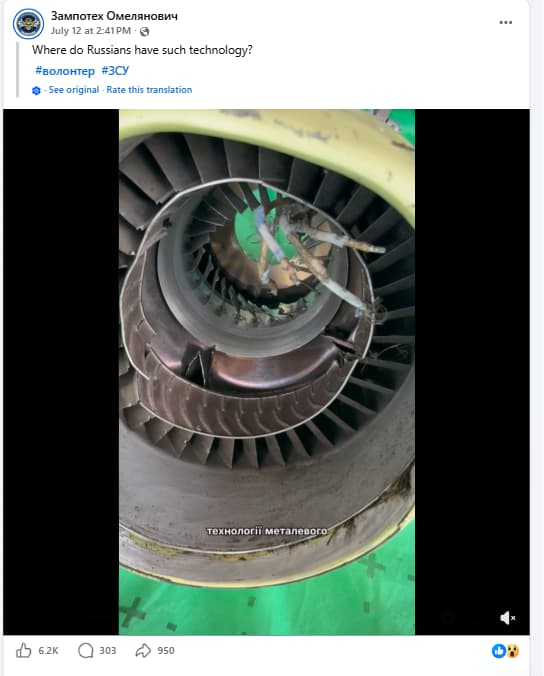
Investigators examining the engine of a Kh-101 missile believed to have been manufactured in late 2025 reported that it appears to incorporate single-crystal turbine blades — a critical technology closely associated with high-performance jet engines. If confirmed, the upgrade would allow the missile to withstand higher operating temperatures, improve combustion efficiency, and partially offset performance losses when carrying a heavier warhead.
The findings emerged from a video shared by Facebook user "Zampotekh Omelyanovich," which showed a recovered missile engine. Specialists are now conducting detailed examination of the turbine blades to determine their manufacturing process and whether Russia has mastered single-crystal casting technology for cruise missile propulsion systems.
Advanced Engine Technology Explained
Single-crystal turbine blades represent a significant engineering breakthrough. By eliminating the grain boundaries present in conventional metal components — structures that tend to weaken under extreme heat and stress — single-crystal blades allow engines to operate at higher temperatures while delivering substantially improved durability and corrosion resistance.
Historically, only a handful of Western aerospace companies have possessed comparable manufacturing capabilities, most notably General Electric (GE) of the United States and Rolls-Royce of the United Kingdom. Should Russia have successfully integrated similar technology into the Kh-101's engine, it would represent a notable leap in Russian cruise missile production capability — all the more remarkable given years of sustained Western sanctions.
The discovery has sparked debate on social media over how Russia may have acquired the relevant manufacturing know-how. Some Facebook commenters suggested that Chinese suppliers can now provide advanced equipment once available only from a small number of Western vendors, though this claim has not been independently verified. Others argued that Russia may have built upon Soviet-era single-crystal production techniques rather than relying entirely on foreign technology.
Why It Matters
The Kh-101 is one of Russia's primary air-launched cruise missiles and has been extensively used in long-range strike missions. As a core component of Russia's strategic conventional strike arsenal, any improvement to its propulsion system is of significant interest to the Pentagon and NATO.
Those conducting the analysis assessed that an upgraded engine could extend the missile's range to approximately 5,500 km (roughly 3,418 miles) while enabling it to carry heavier warheads. This assessment has not been independently verified, but investigators expect to conduct more detailed examination of the recovered hardware.
Russia has pursued advances in turbine manufacturing technology for years. Reports as far back as 2017 linked relevant developments to the TRDD-50 series of small turbofan engines, which power several cruise missiles including the Kh-55, Kh-555, and Kh-101. State-owned engine manufacturer NPO Salyut and the All-Russian Institute of Aviation Materials (VIAM) have previously been identified as key institutions supporting these efforts.
An Evolving Kh-101 Design
Since 2024, Russia has reportedly equipped some Kh-101 missiles with a dual-warhead configuration, increasing payload from approximately 450 kg (992 lbs) to around 800 kg (1,764 lbs). Engineers reportedly achieved this by reducing fuel capacity to create space for additional explosives — making a more efficient propulsion system essential for maintaining range and flight performance.
Evidence of design evolution has been present in recovered missiles for some time. In 2024, analysts noted that some Kh-101 airframes were fitted with the Soviet-era R-95-300 engine rather than the standard Russian TRDD-50A engine.
For U.S. defense analysts, the suspected upgrade is significant: it indicates that Russia continues to modernize its strategic missile technology even under sustained export controls and sanctions pressure.
原文來源: 查看原文
FAQ
Newsletter
Subscribe to our Low-Altitude Industry Newsletter
Daily curated news on low-altitude economy and drone industry, delivered to your inbox.
Reviewed and published by the LAETimes editorial desk ·